
The Jazz Blueprint: Decoding the Scales and Mindsets of the Greats

PAGE
By PAGE Editor
Every aspiring jazz player reaches a moment of complete frustration. You know your major scales, you can read standard notation, and you understand basic music theory. Yet, the moment the sheet music is taken away, and it’s time to solo over a standard, your mind goes blank. Your fingers default to the same rigid, uninspired patterns.
The truth is, playing authentic jazz isn't about memorizing endless streams of random notes—it's about learning a highly structured, conversational language. If you want to stop guessing what to play next, you need to understand the underlying framework that the masters use to build their legendary solos.
At tenacitymusic.com, we cut through the academic fluff to give you practical, actionable pathways. Whether you are looking for foundational jazz lessons online or ready to plunge into an intensive jazz masterclass, mastering the genre requires a calculated blend of harmonic theory and raw expression.
The Core Vocabulary: Essential Scales for Jazz Improvisation
To communicate effectively in jazz, you need to be familiar with the distinct scales that give the genre its signature, sophisticated color palette. While classical music relies heavily on major and natural minor scales, jazz improvisation lessons focus on modes and altered scales that create beautiful harmonic tension.
1. The Dorian Mode
The absolute baseline for minor chord soloing. Derived from the second degree of the major scale, the Dorian mode features a natural 6th, which provides a brighter, cooler minor sound than the standard natural minor scale. It is the defining sound behind modal jazz classics like Miles Davis's "So What."
2. The Mixolydian Scale
This scale is built for dominant 7th chords—the ultimate driver of tension and resolution in jazz. By flattening the 7th degree of a standard major scale, you create a bluesy, forward-moving sound that perfectly navigates the dominant chords found in standard ii-V-I progressions.
3. The Altered Scale
When you want your playing to sound truly modern and advanced, the altered scale is your secret weapon. Played over an altered dominant chord (like a $G7(\sharp9)$ or $G7(\flat13)$), this scale includes a flat 9, sharp 9, sharp 11, and flat 13. It creates intense, chromatic friction that sounds incredibly satisfying when resolved cleanly to a stable tonic chord.
[Scale Selection] ➔ [Tension Generation (Altered Notes)] ➔ [Clean Resolution (Tonic Chord)]
Breaking the Mold: Why You Need a Jazz Masterclass
You can practice scales in isolation for hours, but music doesn't happen in a vacuum. The intermediate player's greatest hurdle is learning how to apply these abstract theoretical concepts to an actual tune. This is exactly where a structured jazz masterclass comes into play.
A masterclass shifts the focus from simple mechanics to real-world artistic application. Instead of learning what note to play, elite masterclasses teach you the philosophy of performance:
Pacing and Tension: Learning how to start a solo with simple, sparse ideas, building up the complexity and speed dynamically over multiple choruses to tell a compelling story.
Ensemble Interaction: Jazz is a team sport. A masterclass breaks down how to actively listen and respond to the drummer’s rhythmic accents and the bassist’s note choices while improvising.
Reharmonization: Discovering how to mentally rewrite a song's chord structure on the fly, substituting standard chords for complex variations to surprise both the audience and your bandmates.
Choosing the Right Path on Tenacity Music
At tenacitymusic.com, we firmly believe that abstract theory is useless without real musical context. That’s why our digital platform is specifically organized to match your exact evolutionary stage as an artist:
Step 1: Foundational Jazz Lessons Online
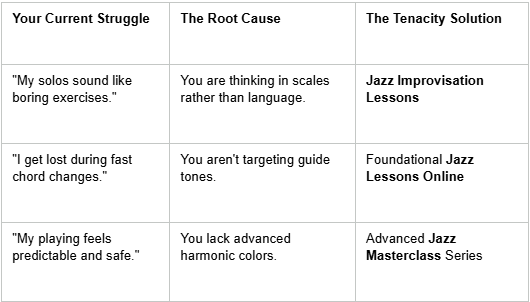
Perfect for classical or pop musicians crossing over into the genre. We focus heavily on rhythm, ear training, basic 7th-chord voicings, and interpreting a jazz lead sheet correctly.
Step 2: Advanced Jazz Improvisation Lessons
Here, we dive deep into chord-scale theory, target tones, and phrasing. We show you how to connect your chords seamlessly so your solos sound like fluid melodies rather than disconnected scale exercises.
Step 3: The Elite Masterclass Series
Designed for advanced students and working professionals looking for that competitive edge. These courses explore cutting-edge harmony, odd-meter time signatures, and advanced artistic philosophy, taught by touring virtuosos.
Actionable Tips to Transform Your Next Practice Session
To turn your online coursework into actual muscle memory, apply these strategic rules to your daily routine:
Practice in All 12 Keys: Don't let yourself get comfortable playing a lick or progression in only one or two easy keys. Force your brain to translate the musical intervals across the entire instrument.
Sing Your Solos: Before you try to play a phrase, try to sing it out loud over a backing track. If you can't sing it, you aren't truly hearing it in your head—you're just guessing with your fingers.
Focus on the 3rds and 7ths: When the chords change quickly, prioritize landing on the 3rd or 7th degree of the new chord. These are the guide tones that define the harmony, and targeting them ensures your lines sound smooth and logical.
Take the Stage
The journey to becoming a confident jazz player doesn't have to be a guessing game. By breaking down the music into clear, digestible concepts, you can skip the years of frustration and start speaking the language of jazz naturally.
Ready to unlock your creative potential? Visit tenacitymusic.com to browse our interactive jazz lessons online, refine your technique with targeted jazz improvisation lessons, and take your playing to the next level.
For a visual breakdown of real-time solo construction, you can watch this helpful Jazz Improvisation Masterclass, which walks through practical steps to build melodic lines over complex changes.
HOW DO YOU FEEL ABOUT FASHION?
COMMENT OR TAKE OUR PAGE READER SURVEY
Featured





Deep clean, seal, and protect your tile & grout in Oceanside, CA. Bring the original shine back to your floors. Request a quote today!