
Top 5 Prototyping Mistakes Animation Studios Make and How 5-Axis CNC Machining Saves 25% Cost
PAGE
By PAGE Editor
Introduction
In the competitive field of animation creation, the demand for visually impressive and structurally correct character designs, objects, and hardware has never been more significant. Unfortunately, studios often find themselves at an important crossroads where the traditional means of crafting these components through the use of 3-axis CNC machining or manual craftsmanship prove inadequate in addressing their needs. This is due to the complexity of the geometry and precision necessary for modern asset creation, resulting in expensive revisions and delays.
This article attemptsto address this problem by providing a unique perspective on how 5-axis CNC machining can serve as a competitive edge. Through the application of a single setup machining process along with quality standards such as ASME Y14.5 and ISO 9001, this technique promises savings of up to 25 percent alongside flawless prototypes.
What are some of the Main Prototyping Issues in Animation Studios?
The nature of animation studio work meansthat prototype fidelity plays an essential role in determining the outcome of their productions. Some issues that may arise include geometrical intricacies in organically shaped objects, incorrect choices of materials, and inconsistent suppliers who all serve to make production costly and prolonged.
The Problem of Geometrical Intricacy and Multi-Setups: In order to accurately model characters' physical featureswith 3D CNC machines, artists have to create very detailed and complex shapes. In order to access certain areas during the manufacturing process, the object needsto be positioned in several ways, creating positioning errors. Such positioning errors will cause problems during assembly, making aesthetics suffer greatly.
Discrepancies in Materials and Timeframes: For prototypes of hardware used in gaming applications or heavy duty props, the right material, such as aluminum or engineering plastics such as PEEK, ABS, must be chosen. Since many suppliers may find it challengingto work with these materials, issues like delamination or heat distortion are encountered and may take too much time. This discrepancy compelsthe studio to employ substitute materials that cannot match the final design.
The Overlooked Expenses of Multiple Suppliers: The use of multiple suppliers for various components of an asset – CNC supplier for one part, the other supplier for finishing – leads to complicated tracking of the project. Without a single point accountability system, it becomes impossibleto ensure consistency throughout the entire process.
How does 5-axis CNC machining solve complex geometry problems in character models?
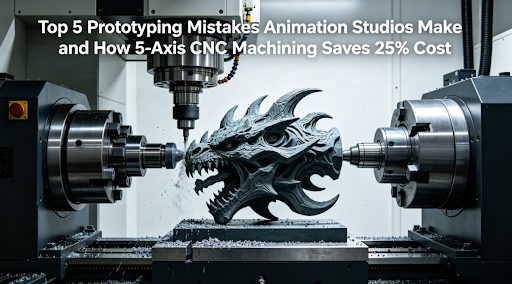
Dynamic nature of the 5-axis CNC machining technology makes its use in creation of complex geometries possible. The fact is that by being able to access a part with the cutting tool from any angle one can get rid of all the shortcomings characteristic of the old technologies and make them suitable for prototype production in animation studios.
1. Single setup machining: Elimination of cumulative error
The first thing that needsto be mentioned about the technology is the opportunity to machine a complicated character model at once. Using the datum reference point throughout the entire machining process helps to avoid the positioning errors of the 3-axis technology. In particular, the 5-axis machining helps to fulfill all the GD&T criteria (in accordancewith ASME Y14.5) concerning true position and pr ofile.
2. Achieving Genuine Geometric Freedom through Tool Orientation
In contrast to conventional 3-axis machines, which make use of the cutting point, 5-axis technology makes use of tool axis control in order to achieve the best possible lead angle relative to the surface being machined. Thus, it is possibleto apply short and stiff tools when machining deep cavities and undercuts without any collisions. This leads to obtaining the best quality surface finish (Ra < 0.8 µm), requiring little to no polishing.
3. The Efficiency Breakthrough in Prototyping Process
In the context of a studio making an order of custom props, the move to 5-axis technology may prove to be revolutionary. What used to require three different 3-axis operations can now be accomplished with just one single cycle of 5-axis CNC machining, eliminating the need for multiple setups and saving on fixtures. In the case of complicated shapes, using a dedicated 5-axis CNC machining service is the most efficient way to go.
What Are the Advantages of Using 5-Axis CNC for Gaming Devices and Entertainment Equipment?
Apart from model characters, other areas of application for the entertainment industry include creating prototypes of VR equipment, motion platforms, or even special gaming devices. In all these cases, 5-axis CNC technology will help achieve the necessary strength and accuracy.
1. Machining of High-Strength Materials for Durability
In order to ensure durability and sufficient strength, gaming devices' parts, such as load bearing brackets or casings, are made of 6061 aluminum or stainless steel. Using 5-axis machines for processing them, one will be able to remove substantial material volumes at a decent rate of speed without losing accuracy. Flank milling is possible due to the high level of flexibility.
2. Micron-Level Precision for Perfect Integration
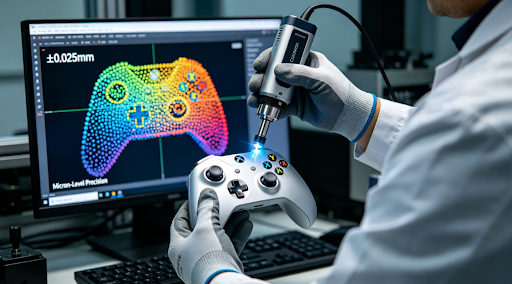
Accuracy with 5-axis machine technology is very important in creating components that require tight tolerancesto be maintained. When tolerances of ±0.025 mm are maintained, all the assemblies are ensured to fit in perfectly with PCB mounts, bearing seat, and aesthetic seam. Thus, it makes sure that there is no “play” in the controller’s construction which can affect the feel of a luxury gaming controller.
3. High Surface Integrity for Functional and Aesthetic Finishing
Entertainment products usually go through post-process finishing like anodizing or paint. With a good quality finish without any steps that can be seen in a product machined using 5-axis technology, it gives the best results possible in terms of aesthetic appearance. This meansthat you do not have to worry about applying filler to cover up steps.
How Are Prototypes Protected Against Low Quality with Such International Certifications as ISO 9001 and AS9100D?
When one prop can ruin a whole movie shoot because it turned out to be of low quality, the importance of quality assurance can hardly be underestimated. Certifications are much more than decorative items on walls. They prove that the company uses a systematic approach toward reducing risks.
1. ISO 9001: The Guarantee of Consistent Quality
Being a customer of a custom CNC parts manufacturer certified by ISO 9001 means you deal with a business using a Quality Management System (QMS). This meansthat any prototype is manufactured according to a certain procedure starting from material approval and machine calibration to finishing processes. As a result, the manufacturer guaranteesthat you receive identically sized props in a series.
2. AS9100D and IATF 16949: High-Reliability Standards
Whereas the former is an aerospace standard and the latter is an automotive standard, their key principles are immensely useful when dealing with high-value entertainment productions. Such certifications impose strict requirements of traceability and risk management. A company that works according to such frameworks ensures full material certification as well as first article inspection reports (FAIR) for all safety-critical parts of motion bases and interactive displays.
3. The Audit Trail for Accountability
A certificate requires a clear audit trail, which meansthat if there is an out- of-specification measurement in terms of dimensions, one can trace the cause behind that problem down to the individual machine path, the employee working on it, or the batch of the material used. Such transparency can never be achieved with other companies.
What Measures Are There for the Animation Studio to Maximize Efficiency in Prototype Development from Cost and Timing Perspectives?
In addition to purchasing a more efficient machine to help with prototype development, it would be necessary to partner with an appropriate manufacturer for Precision Manufacturing Solutions. In fact, it is smart design for manufacturability and process optimization that will allow the studio to achieve the maximum benefit.
1. Early Stage DFM: Design for the Machine: Early stage DFM can result in cost reduction before any chips are even cut. An experienced 5-axis CNC supplier in the animation industry can advise on some changes such as making small draft angles for tool access, consolidating various parts into one unit to minimize assembly costs, and finding better materials with good machining properties.
2. Batch Optimization and Fixture Techniques: If you have a project involving several variants of props, the best strategy to employ is batch optimization. This allows various pieces to be machined from the same block of material by utilizing the five-axis CNC milling process, ensuring maximum use of materials while minimizing downtime. In addition, the employment of fixture plates enables fast changeover times.
3. The Total Cost of Ownership (TCO) Mindset: Studios should base their judgment on suppliers’ TCOs, rather than merely comparing prices per unit. Although the quotation is a little higher in comparison to other vendors, including one who may be a certified supplier offering full inspections, certificates of material, and engineering assistance, can lead to significant savings in terms of avoiding re-work, delivery problems, and malfunction on set. 5-axis CNC machining services suppliers need to have a clear breakdown of their quality process.
How Should You Evaluate and Choose a Reliable Manufacturing Partner with a 5 Axis CNC Machine for Your Creativity?
Choosing the appropriate manufacturing partner is a critical business decision that can affect either the success or failure of your project. In addition to assessing the machine, you should consider process capability and industry experience.
1. Assessing Technical Capability
When you approach a potential manufacturer, be curious to know what kind of machine they have and its capabilities, including how it performs thermal growth compensation, on-machine probe techniques, and how their tool library works. A good manufacturer will be willing to show their statistical process control data of past projects done with a tight tolerance level.
2. Quality Management System Assessment
Ask your potential manufacturing partner to show you their ISO 9001 certification. In addition, get an insight into how they inspect their parts and whether they can provide CMM results. The manufacturing partner you choose should have an established FAI process that adheresto AS9102 standards.
3. Collaboration and Communication Fit
Your ideal partner will integrate seamlessly into your studio's internal processes and should provide a specialist in engineering who will know what you are trying to achieve in terms of aesthetics and who will be able to explain any technical limitations using understandable language. Being responsive in your quoting phase and willing to perform a thorough DFM analysis is a good sign of collaboration.
Conclusion
If there are animation studios looking for a way to improve their prototyping processes, then 5-axis CNC machining offers a solution worth exploring. It directly impacts the three key issues that make prototyping difficult for animators – complex geometry, accuracy and time constraints. Working with an experienced manufacturer that adopts international manufacturing standards will allow studios to significantly reduce costs and ensure that high-quality prototypes do not jeopardize their investment.
FAQs
Q: How long is the turnaround time for 5-axis CNC machined prototyping for animation?
A: Standard turnaround can take around 5-10 working days. Single-set up machining prevents additional fixture adjustments, thus speeding up delivery. Consult with suppliers early for DFM analysis.
Q: How does 5-axis CNC machining produce a higher quality surface finish for animated characters compared to 3-axis?
A: The constant direction of tooling prevents any steps and allows creating smoother forms that can have a surface finish as fine as Ra 0.8 µm.
Q: Can 5-axis CNC machining perform on varied materials of entertainment equipment, such as aluminum alloys and engineering plastics?
A: Yes. State- of-the-art 5-axis machines will be able to work efficiently with over 50 materials like aluminum 6061, stainless steel, and polyether ether ketone (PEEK).
Q: In what formats must the design be submitted to be ready for prototype machining by 5-axis CNC?
A: The design should be submitted as STEP or IGES for 3D model, and in PDF/DWG format with drawings that define key dimensions. Most vendors will offer free DFM checkup within 24 hours.
Q: Do any certifications, such as ISO 9001 and AS9100D, affect the reliability of CNC machined prototypes?
A: These certifications ensure that there is a documentation process to support traceability and inspection. This results in higher consistency and accuracy and fewer iterations.
Author Bio
This expert guide highlights valuable insights from the experienced team of LS Manufacturing. Certified manufacturing partner, focused on assisting inventors in solving the most challenging design and manufacturing problems, their customized CNC milling services range from machining prototypes of high-end sporting equipment to large scale mass manufacturing processes. We encourage you to connect with their engineering team now to get your complimentary DFM analysis.
HOW DO YOU FEEL ABOUT FASHION?
COMMENT OR TAKE OUR PAGE READER SURVEY
Featured





Wale joins CapSole as Chief Creative Officer and equity partner, bringing his influence in sneaker culture to a business focused on preservation, sustainability, and extending the life of collectible footwear.