
Why Kids Prefer Certain Foods Over Others
PAGE
By PAGE Editor
Every parent knows the frustration of preparing a nutritious, balanced meal only to watch their child pick at a single piece of plain bread while refusing green vegetables. To exhausted caregivers, picky eating can feel like a willful battle of temperaments. However, a child’s strong preference for certain foods—and intense rejection of others—is rarely about stubbornness.
Children view, smell, and taste food through an entirely different biological lens than adults. From evolutionary survival instincts to sensory processing, several distinct children's food preference factors shape what kids choose to eat. Understanding these underlying mechanisms helps parents navigate mealtime challenges with patience and practical strategy.
1. The Evolutionary Engine: Sweetness as a Survival Instinct
Quick Answer: Children are biologically hardwired to prefer sweet and salty flavors because they signify calorie-dense energy required for rapid growth, while bitter tastes historically signaled poisonous plants.
From an evolutionary standpoint, a child’s preference for sweet foods like fruit, milk, and carbohydrates is a protective adaptation. In ancestral environments, sweet flavors signaled safe, energy-rich calories necessary to support growth spurts and brain development.
Conversely, plant toxins in nature almost always taste bitter. Because young children are particularly vulnerable to poisoning, human evolution instilled an innate aversion to bitter compounds. When a toddler rejects broccoli, kale, or Brussels sprouts, their brain is responding to ancient survival programming that equates bitterness with danger.
2. Higher Taste Bud Density: Why Kids Are "Supertasters"
Quick Answer: Children have a higher density of taste buds per square millimeter on their tongues than adults, making flavors taste far more intense and overwhelming.
A child’s tongue is not simply a smaller version of an adult’s tongue. Children possess a significantly higher density of taste receptors, making them heightened "supertasters." Flavors that adults perceive as pleasantly complex or mildly tangy can taste overwhelmingly sharp, sour, or bitter to a young child.
As people age, taste buds naturally diminish in number and sensitivity, which explains why adults grow to enjoy coffee, dark leafy greens, and aged cheeses. For a child, however, the chemical compounds called glucosinolates found in cruciferous vegetables trigger intense bitter signals that adult palates simply do not register with the same severity.
3. Texture, Chewing Mechanics, and Oral Comfort
Quick Answer: Unpredictable or complex textures can trigger sensory overload, while physical mouth discomfort from loose teeth or cavities makes firm, fibrous foods difficult to chew.
Texture plays a massive role in childhood food selection. Many children experience challenges with sensory processing food textures, finding slimy, lumpy, or stringy foods off-putting. Foods like mushrooms, cooked tomatoes, or stringy meats present unpredictable mouthfeel, triggering a child's gag reflex as a protective measure.
Beyond sensory preferences, physical discomfort can quietly dictate what a child will eat. Loose primary teeth, tender gums from emerging molars, or undetected tooth decay make chewing tough meats, raw carrots, and firm fruits painful. Scheduling routine wellness visits with a trusted family dentist in Layton helps rule out underlying oral health issues, ensuring that physical discomfort is not secretly driving a child’s preference for soft, highly processed foods.
4. Food Neophobia: The Toddler Defense Mechanism
Quick Answer: Food neophobia—the fear of new foods—peaks between ages 2 and 6 as a natural developmental stage designed to prevent mobile toddlers from eating harmful objects.
Around the age of two, many children who previously ate a wide variety of purees suddenly become extremely restrictive about what they will swallow. This shift is known as food neophobia, or the behavioral fear of novel foods.
Examining the evolutionary biology of picky eating explains this sudden transition. Around age two, young children historically began walking and exploring their environment independently of their mothers. A healthy skepticism toward new, unfamiliar foods prevented them from picking up and consuming toxic berries, wild mushrooms, or spoiled meat while wandering.
5. The Comfort of Predictability: Why "Beige Foods" Win
Quick Answer: Processed carbohydrates like crackers, bread, and chicken nuggets offer complete sensory consistency, ensuring every single bite tastes identical.
Notice how most picky eaters gravitate toward a similar color palette: beige, tan, and yellow. Foods like pasta, white bread, potato chips, and chicken nuggets provide psychological comfort through complete visual and flavor uniformity.
An industrial cracker tastes identical every single time a child eats it. By contrast, natural whole foods are inherently variable. A blueberry might be sweet and firm one day, but tart and mushy the next. For a child navigating a world full of big changes and unpredictable sensory inputs, the reliable consistency of simple carbohydrates feels safe.
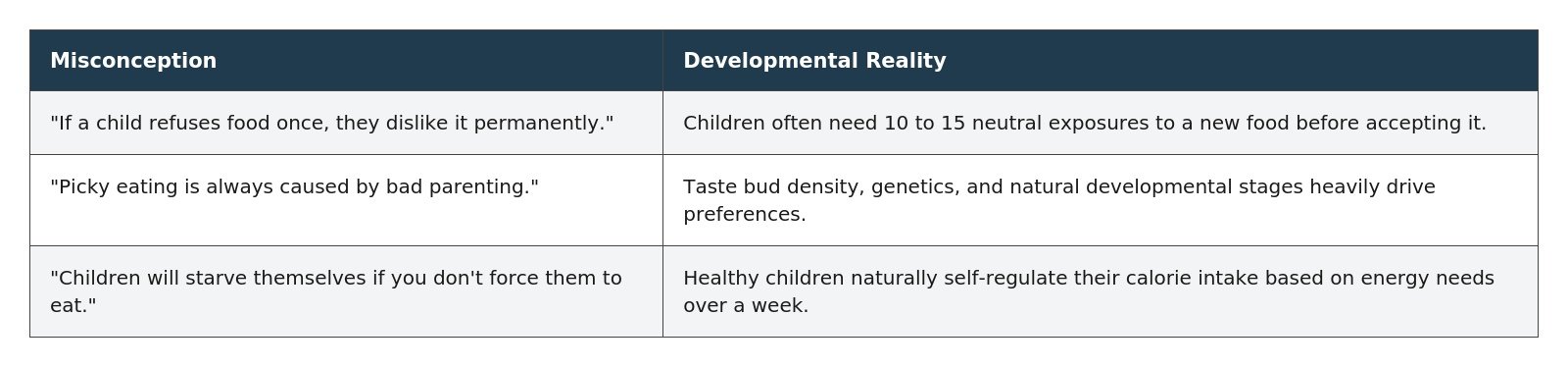
6. Myth vs. Fact: Unpacking Childhood Eating Habits
Clearing up common misconceptions helps parents approach mealtimes with realistic expectations:
7. Parent's Action Guide: Safely Expanding Your Child's Palette
Use these evidence-based strategies to gently encourage a broader diet without power struggles:
[ ] Serve Micro-Portions: Offer a single piece of a new vegetable (like one pea or a tiny broccoli floret) alongside familiar favorite foods to prevent intimidation.
[ ] Deconstruct Mixed Meals: Keep ingredients separate on the plate rather than serving complex casseroles or mixed salads.
[ ] Pair Foods Strategically: Serve a preferred dip (like hummus, ranch, or peanut butter) alongside a less preferred vegetable to mask bitter tones.
[ ] Maintain Neutral Exposures: Place new foods on the table without forcing the child to eat them; touching, smelling, or simply tolerating the food on their plate is progress.
[ ] Involve Kids in Meal Prep: Allow children to wash, chop, or arrange vegetables; hands-on familiarity lowers food neophobia.
A child’s preference for certain foods is a complex mixture of evolutionary biology, heightened taste sensitivity, developmental stage, and sensory processing. Recognizing that food refusal is a normal biological reaction rather than intentional misbehavior removes stress from the dinner table. By maintaining consistent exposure, serving manageable textures, ruling out oral discomfort, and offering low-pressure environments, parents can help their children gradually build a lifelong, healthy relationship with a diverse array of foods.
HOW DO YOU FEEL ABOUT FASHION?
COMMENT OR TAKE OUR PAGE READER SURVEY
Featured





Video is no longer optional for marketing teams, e-commerce brands, and solo creators.