
Why Network Security Measures Are Essential for Enterprise IT Environments

PAGE
By PAGE Editor
The IT infrastructure of the business plays a crucial part in performing various activities within the organization like communication, storage, cloud computing, and collaboration. With the growth in technology, which has made businesses more digitally connected, various threats have emerged that can jeopardize the business environment.
In order to minimize the risk, it is necessary for organizations to adopt network security measures. It is important for network security to be adopted properly to protect the business from any sort of interruption.
Understanding Network Security Measures for Enterprises
Network security refers to the measures put in place to secure the infrastructure, machines, applications, and data in an enterprise’s network.
Some of the Network Security Measures for Enterprises include firewalls, access control, encryption, network segregation, and threat detection. This guarantees that the enterprise will be able to detect any vulnerabilities, access control, and any activity that is suspicious. There is no way an enterprise can rely on just one security measure.
Importance of Network Security in Corporate IT Environment
A corporate network environment may integrate several departments, applications, people, and external entities within the system. This means that any weakness in the environment can give way for an attacker to attack other systems.
1. Safeguards Business Information
Firms keep their business information very secret, which includes customers’ information, financial information, employees’ information, intellectual property, and other internal communications. Leaks of such information may cost the firm money, legal action being taken against it, and its reputation being spoiled.
Encryption, access control, and data protection would help prevent leaks of business information. It is advisable that firms check their access rights of confidential information and revoke those which are unnecessary.
2. Minimizes the Risk of Cyber Attacks
Some of the techniques used by the attackers for penetrating into the network of the organization include phishing, malware, ransomware, credential theft, and exploiting system vulnerabilities.
Some of the ways through which such risks can be minimized are firewalls, intrusion prevention, endpoint security, and security patches. Although a certain level of protection may not prevent all the cyber-attacks, multiple levels of protection make the task of the hacker more difficult.
3. Facilitates Business Continuity and Resiliency
In case there are problems with the network, the services provided to customers will suffer; communication within the business will be disrupted; production will be halted; and access to critical applications will not be possible.The cost will be extremely high if such systems are out of use for a long time.
A well-crafted security policy will help companies recognize risks on time and take action against them.
4. Supports Safe Remote Work and Cloud Connection
Many organizations have become dependent on remote workers, cloud computing, third-party software, and geographic dispersion of physical locations. It means that additional vulnerabilities are created, through which the threats can penetrate into the network and must be addressed.
VPN, MFA, access controls, and device compliance are just some of the ways of ensuring the security of the remote connection. Security must be ensured both in the cloud and local environment.
5. Improves Visibility in Enterprise Networks
In the absence of adequate visibility, it will be hard for security teams to detect any anomalies within the network traffic, unknown devices, and any attempted malicious logins.
Logging systems, network traffic monitoring, and security information and event management systems help security teams understand what is happening in their networks.
6. Helps in Compliance with Regulatory Standards
For instance, there is a need for an organization in a regulated environment to conform to the set standards with regards to the protection of data, access, documentation, and incident reporting.
The policy with respect to security and documentation, audit trail, access control, and vulnerability scanning can go a long way in helping an organization establish that adequate controls were put in place. The controls put in place should be benchmarked against the set regulatory standards.
7. Prevents the Propagation and Impact of Security Incidents
The likelihood of attacks being carried out against another system will be higher in case an attacker is able to penetrate a single system or user account, especially if there is insufficient network segmentation in place.
This might result in a bigger security incident. Network segmentation, implementation of least privilege, and monitoring of internal traffic may help in reducing unnecessary system communication.
Common Network Security Measures Used in Enterprise Environments
The network security techniques adopted by an enterprise must be appropriate to the needs of different parts of its system. This depends on the size of the enterprise and other factors.
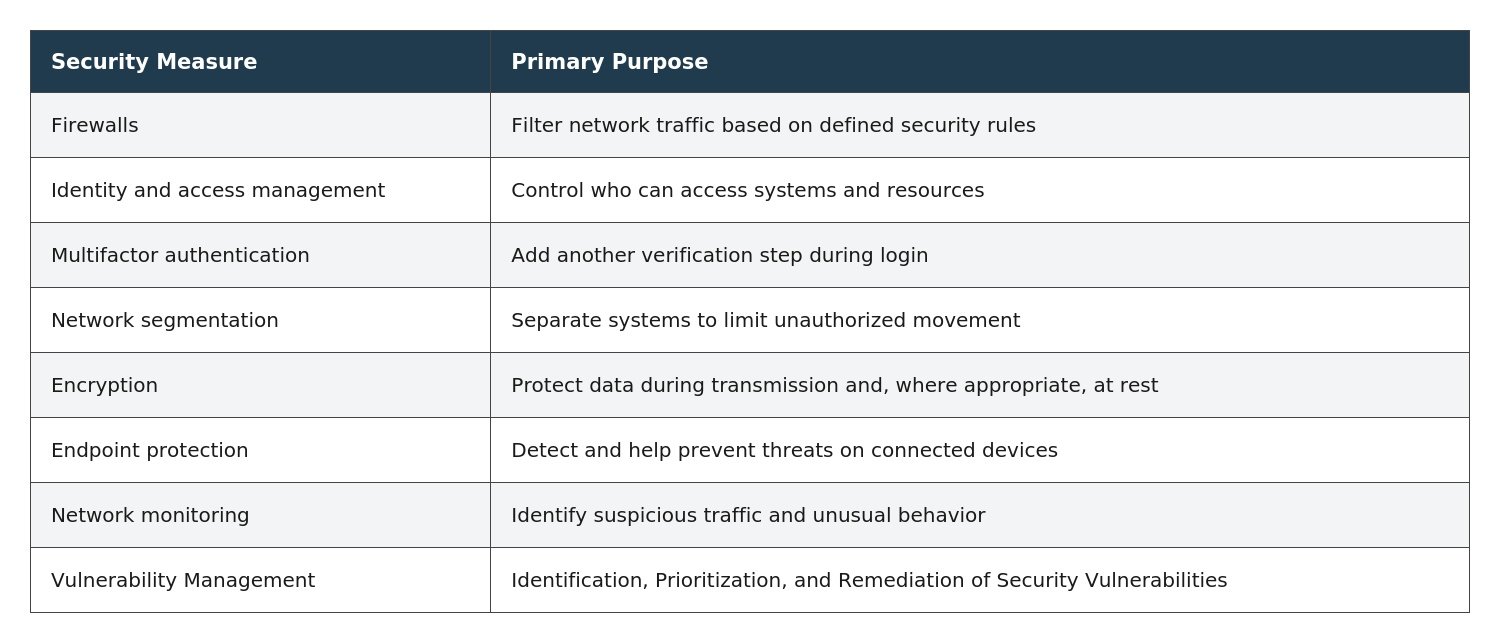
Methods by Which Companies can Enhance their Network Security Strategy
Safety is about much more than simply acquiring cutting-edge technology. There should be a company which uses a process that will enable it to evaluate its risks and apply control.
Evaluation of Risks and Identification of Critical Assets
It all starts with the identification of critical systems, sensitive data, external links, and third party contacts. Identify the critical assets which will cause the biggest harm if there is a security breach in them.
The company could examine the appropriate network security concepts to gain insight into the various security controls, network security measures, and methods for detecting any malicious behavior.
Use of Least Privilege Access
Every person, application, and system shall be granted minimum privileges only. An audit of the privilege access shall help to strip off any unnecessary privilege, thereby reducing the vulnerability faced by the attacker who has already gained the privilege credential. For critical systems, multi-factor authentication must be adopted.
Systems Should Be Kept Up-to-Date and Securely Configured
Inherent vulnerabilities exist due to not being updated properly and not configuring securely. A patch management system must be implemented that will cover the discovery of updates, the priority of installation, testing when required, and timely installation of those updates.
Besides, the system should be set up by disabling unnecessary services, using new passwords and configuring the firewall.
Employee Training and Assessment of Network Security Policy
It is necessary for the employees to be trained on network security issues. The training will also be helpful to them in identifying phishing attacks and dealing with secure data.
The importance of network security makes it easy for one to know the importance of the protective measure. The network security policy should be evaluated as the company embraces technology.
Final Thoughts
Network security plays an extremely important role for companies using systems and services, as these require connectivity and contain sensitive information. By having a proper security policy in place, a company will be protected, its data and information secured from any cyber attacks and have proper visibility in complex IT environments.
Through the use of techniques such as access control, firewall, encryption, network segmentation and monitoring, the company is protected against emerging threats. It is not enough to use numerous security technologies, but also to develop a proper strategy.
Frequently Asked Questions
1. Why are network security measures important for enterprises?
They help protect sensitive information, prevent unauthorized access, reduce cyber risks, maintain service availability, and support compliance with relevant security requirements.
2. What are the main network security measures used by enterprises?
Common measures include firewalls, multifactor authentication, identity and access management, encryption, network segmentation, endpoint protection, traffic monitoring, and vulnerability management.
3. How does network security support business continuity?
It helps detect threats, restrict unauthorized activity, and reduce the impact of security incidents. Combined with backups, incident response plans, and recovery procedures, these controls help organizations restore operations more effectively.
4. How often should enterprises review their network security?
Enterprises should continuously monitor network activity and review security controls periodically. Access permissions, vulnerabilities, configurations, and incident response plans should also be reassessed whenever significant infrastructure or business changes occur.
HOW DO YOU FEEL ABOUT FASHION?
COMMENT OR TAKE OUR PAGE READER SURVEY
Featured





The IT infrastructure of the business plays a crucial part in performing various activities within the organization like communication, storage, cloud computing, and collaboration.