
Why Pacific Northwest Homes Are Finally Adding Air Conditioning
PAGE
By PAGE Editor
For most of the 20th century, skipping AC in western Washington was not a gamble. It was just common sense. Summers near Puget Sound stayed cool enough that a box fan felt sufficient, and builders left cooling systems out of nearly every floor plan as a result. That logic has been quietly dismantled over the past decade, and the 2021 heat dome finished the argument entirely.
If you own a home in the Pacific Northwest and still don't have a cooling system, you're in large company. But that company is shrinking fast, and for good reason. Here's what's actually driving the shift, what your options look like, and how to think through the decision before another summer catches you off guard.
Washington Is One of the Least Air-Conditioned States in America
The numbers are stark. According to 2023 Local Air Conditioning Estimates released by the U.S. Census Bureau, only 65.8% of Washington State households have any form of air conditioning, placing the state third from the bottom nationally, ahead of only Alaska and Hawaii. Compare that to virtually any Southern or Midwestern state, where AC adoption sits at 95% or higher, and you get a sense of just how far behind the region sits on this one home feature.
The reasons are historical. Builders in Pierce County, King County, and surrounding areas designed homes for mild maritime summers. Insulation was built for retaining heat in winter, not repelling it in August. Those same homes now bake during heat events that the original blueprints never accounted for.
The U.S. Census Bureau's 2023 American Housing Survey found that 13.2 million households nationwide reported being uncomfortably hot for 24 hours or more that year, and a disproportionate share of those reports came from regions like the Pacific Northwest, where homes lack both central air and the thermal mass to stay cool on their own.
The Mild Climate Math No Longer Works
Here's a framework worth applying before you decide to wait another year. Ask yourself three questions:
How many days last summer did your indoor temperature exceed 80°F?
Did you sleep well during those stretches, or did you end up buying a window unit anyway?
Are you planning to stay in this home for five or more years?
If the answer to any of those is yes or more than two, the math on delaying AC has already turned against you. Window units run between $200 and $700 each, don't cool an entire home, and get dragged out and stored every fall. A properly installed central system or heat pump costs more upfront, but it works across every room and adds measurable resale value.
The trend underneath this isn't subtle. According to NOAA's Climate at a Glance tool, summer temperatures across the Pacific Northwest have risen at a pace of 0.2°F per decade since 1895, a rate that sounds small in isolation but compounds into a meaningful shift across a century. The NOAA Climate.gov heat event analysis makes clear this is a structural change, not a run of bad luck. Your home will face more of these summers, not fewer.
"While temperatures in the low 100s may seem commonplace for somewhere like Arizona, the Pacific Northwest isn't prepared for the heat. It is not uncommon to find residences without air conditioners." — NOAA Climate.gov, heat wave event analysis
Central AC vs. Heat Pump: Which One Makes Sense Here?
This is the real decision most Pacific Northwest homeowners face, and the answer depends on your existing heating setup more than anything else.
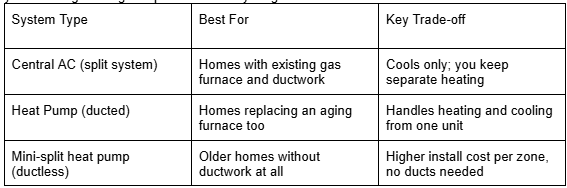
For most Puyallup and Pierce County homes that were built without ductwork, a ductless mini-split or a ducted heat pump installation makes the most structural sense. You're not just adding cooling; you're giving your home a whole new way to manage temperature year-round. Heat pumps also tend to qualify for utility rebates in Washington, which softens the upfront cost.
If your home does have existing ductwork from an old oil or gas furnace, a traditional split-system central AC is usually the fastest path to a cool house. A technician measures square footage, window exposure, insulation quality, and sun load to calculate the right tonnage. Getting that sizing wrong is where homeowners run into trouble: an undersized unit struggles on hot afternoons while an oversized one short-cycles and wears out early.
What a Good Installation Actually Involves
The physical process of adding AC to a home that's never had it takes one to three days for a standard installation, longer if new ductwork is involved. Here's the sequence a reputable contractor follows:
Manual J load calculation to size the system correctly
Selection of indoor air handler and outdoor condenser unit
Electrical panel check to confirm capacity for the new load
Ductwork assessment or installation if starting from scratch
Refrigerant line set and drainage routing
System commissioning and airflow testing
Skipping the load calculation is the single most common mistake in DIY-adjacent installs. A contractor who quotes you a price without measuring your home first is guessing, and you'll pay for that guess in comfort and utility bills for years.
If you're in Pierce County and working through this decision right now, AC Installation Puyallup WA covers the process in detail specific to the local climate, including heat pump options and what a proper load calculation looks like for Pacific Northwest homes. That regional specificity matters: a contractor calibrated to Puget Sound summers will size and configure your system differently than one working from national averages.
Resale Value and the Practical Case for Acting Now
Beyond personal comfort, there's a practical financial argument. Buyers shopping for homes in western Washington have started treating air conditioning the way they treated garages twenty years ago: not technically required, but very much expected. A home without cooling sells at a discount compared to a comparable property that has it, particularly after a high-profile summer heat event refreshes buyers' memories.
The U.S. Census Bureau's 2023 housing data confirmed that 6.9% of all occupied housing units across the country, roughly 9.2 million homes, still had no air conditioning whatsoever, and in Washington that share is substantially higher. That gap represents both a persistent vulnerability and, from a seller's perspective, an opportunity to differentiate your home at listing time.
The practical window to schedule an installation is fall or early spring, before the crush of summer demand books out HVAC contractors for weeks. If you're reading this in late summer after another brutal July, make the call now while the urgency is fresh and your calendar isn't competing with everyone else in your zip code who made the same mental note and forgot about it by October.
The Pacific Northwest's identity as a place that didn't need AC was always partly a story about a climate that no longer exists. The U.S. Census Bureau's 2026 Local Air Conditioning Estimates report captures just how visible this gap has become at the national level, with Washington flagged as one of the states most exposed to heat risk relative to its current cooling infrastructure. The gap between the homes that have cooling and those that don't is closing, and the ones closing it earliest tend to be the ones with the most comfortable summers and the strongest resale position.
What's your home's plan for the next heat dome?
HOW DO YOU FEEL ABOUT FASHION?
COMMENT OR TAKE OUR PAGE READER SURVEY
Featured




A decade ago, “rest day” was a line in a training plan.