
5 Drain Warning Signs Homeowners Should Never Ignore
PAGE
By PAGE Editor
Most water damage doesn't start with a burst pipe. It starts with a drain you kept meaning to look at.
Your plumbing system gives you plenty of warning before things get serious. The problem is that the signals are easy to rationalize: the shower drains a little slow, there's a faint smell near the sink, the toilet gurgles once. Each one feels minor on its own. Together, they're your home sending out a distress call you really don't want to miss.
Here are five signs your drains are in trouble, what each one actually means, and when to stop guessing and call a pro.
That Slow Drain Isn't Being Patient With You
You fill the sink, you walk away, and when you come back there's still an inch of standing water swirling toward the drain. It's easy to chalk this up to a little soap scum or a clump of hair. Sometimes that's exactly what it is. But a drain that drains slowly is a partial clog building toward a full one, and partial clogs don't resolve themselves.
Hair, grease, toothpaste residue, and soap buildup accumulate in layers on pipe walls. The drain doesn't go from working to blocked overnight. It slows over weeks, then months, until one Tuesday morning you have standing water in your shower and a ruined morning.
The smarter move is to treat slowness as a data point, not an annoyance. A single slow drain in a bathroom usually points to a local clog within a few feet of the fixture. That's the best-case scenario because it's the easiest fix. Catch it here and you're dealing with a simple job. Ignore it and keep reading.
Why Water Damage Gets Expensive Fast
Here's a number that changes how you think about procrastinating on drain problems. According to data collected by the Insurance Information Institute covering 2019 through 2023, one in every 67 insured homeowners filed a claim due to water damage or freezing each year, with an average claim amount of $15,400. That's not flood damage from a hurricane. That's everyday water damage inside homes, from the kinds of plumbing failures that often trace back to neglected drainage problems.
The reason costs compound so quickly is that water is patient. A slow drain that backs up repeatedly keeps moisture behind your walls and under your floors. Mold gets a foothold. Subflooring softens. Drywall stains and eventually buckles. The original plumbing issue might be a $150 fix. The water damage that follows it can be a $10,000 renovation.
"Water can damage drywall, warp floors, ruin electronics, and promote mold growth," noted Michael Loik, Ph.D., professor of environmental studies at UC Santa Cruz, in comments cited by This Old House regarding FEMA's water damage cost estimates.
None of that is inevitable. But catching the drain problem before the moisture problem is the only way to stay in the cheap-and-easy column.
The Drain Distress Signal Scale
Not all drain symptoms carry the same urgency. I use a simple four-tier framework to help homeowners prioritize how fast they need to act. Think of it as your Drain Distress Signal Scale.
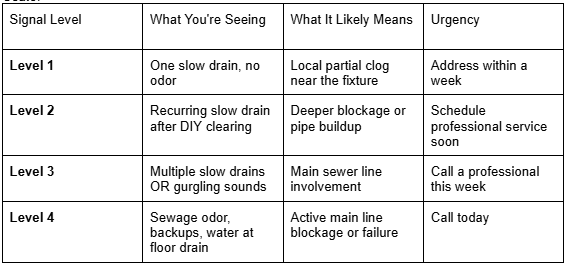
Most homeowners arrive at Level 4 because they treated Level 1 and Level 2 as optional. The scale matters because the fix at Level 1 takes 30 minutes. The fix at Level 4 can take days and cost thousands.
Single Drain vs. Multiple Drains: A Distinction That Changes Everything
This is the single most important thing to understand about drain problems: where the clog lives determines how serious it is.
Picture this. It's Saturday morning. You flush the upstairs toilet and hear a gurgling sound from the bathroom sink at the same time. You head to the basement and notice a ring of moisture around the floor drain. That's not three separate problems. That's one problem living in your main sewer line, and all three fixtures are showing you symptoms simultaneously.
If all the drains in your house are slow, the problem usually lies in the main drain or sewer line rather than an individual fixture. A blockage there restricts wastewater from leaving your home, causing sinks, showers, bathtubs, and toilets to drain more slowly than normal. Main line problems can't be fixed with a bottle from the hardware store. They need professional equipment and a trained eye.
A good drain cleaner with main-line experience will use hydro-jetting or a power auger to clear the obstruction and, ideally, a camera inspection to see exactly what caused it. Tree root intrusion, collapsed sections, and extreme grease buildup all look the same from inside your house. They don't all have the same solution.
The Odor You Keep Attributing to Something Else
Rotten egg smell near a drain. A faint sewer odor in the basement that you blamed on old carpet. A musty smell under the kitchen sink you figured was leftover from a cleaning product.
Sewer gas smells mean one of two things: a dried-out P-trap that's no longer blocking gas from rising through the pipe, or an actual breach somewhere in the line. The first is cheap to fix. Pour water into a floor drain you rarely use and the smell often goes away within hours. The second needs a professional inspection.
Don't let an odor you've grown used to be the thing that gets you. According to the EPA's WaterSense program, the average family can waste 180 gallons per week, or 9,400 gallons of water annually, from household leaks alone — and many of those leaks start exactly where drainage odors originate: at degraded pipe connections and worn fixture seals.
What to Do When You Spot These Signals
Acting on a drain warning is straightforward when you follow the right sequence. Here's what that looks like in practice.
Test the scope. Run water in every sink, shower, and tub simultaneously. Note which ones drain slowly. If it's one fixture, you're likely at Level 1. If it's three or more, you're at Level 3 or above.
Check for odors. Get close to floor drains and under-sink cabinets. A sewer smell in multiple locations on the same day is a red flag worth acting on immediately.
Try the P-trap fix first for odors only. If a floor drain smells and you know it rarely sees water, pour a gallon in. If the smell persists, it isn't the trap.
Skip the chemical drain products for anything beyond a very shallow local clog. Harsh chemicals can degrade older pipe materials and rarely reach deep blockages. They buy time, not solutions.
Call a professional at Level 3 or above, no exceptions. Main sewer line issues require camera inspection and mechanical clearing. A professional can also tell you if you're dealing with root intrusion or structural pipe damage before those problems get worse.
One more thing worth knowing: according to FEMA and the National Flood Insurance Program, just one inch of water in a typical home can cause up to $25,000 worth of damage. That's the ceiling you're protecting yourself from when you act on a Level 1 or Level 2 signal before it escalates.
Your Drains Are Talking. Are You Listening?
Slow water, gurgling sounds, recurring clogs, sewage odors, and backups at the floor drain are five signals that show up in order, like chapters of the same bad story. You can close the book early, or you can wait for the last chapter.
Most homeowners who end up with serious water damage and a four-figure repair bill didn't ignore a burst pipe. They ignored a drain that was slow for six months. The good news is that none of the five signals on this list are subtle once you know what you're looking for. So now you know. What's the slowest drain in your home right now, and when did you first notice it?
HOW DO YOU FEEL ABOUT FASHION?
COMMENT OR TAKE OUR PAGE READER SURVEY
Featured





Finding the right job in human resources or recruitment can take time, especially when you're searching online.