
How to Get More Heat for Less: A Homeowner's Guide to Heating System Efficiency
PAGE
By PAGE Editor
Most homeowners don't think about their heating system until something goes wrong at 11 p.m. on the coldest night of January. By then, the damage is done, literally and financially. The smarter move is understanding how your system loses efficiency in the first place, so you can stop bleeding money on fuel that never makes it to your living room.
This guide covers exactly that: where heat escapes before it warms a single room, what real efficiency ratings mean in everyday terms, which fixes pay off fastest, and how a simple annual routine changes the entire cost picture. No jargon, no vague advice.
Heating Is Your Biggest Home Energy Expense. Full Stop.
Before you fix anything, you need to know what you're dealing with. Space heating is the largest energy expense in the average American home, accounting for about 45% of the family's energy bills, according to the U.S. Department of Energy. That number should recalibrate how you think about home improvement priorities. A new backsplash looks great. Cutting nearly half your utility bill feels better.
If your heating system is old, undersized, or running dirty, that 45% share climbs even higher. And the waste isn't theoretical. Typically 43% of a home utility bill goes to heating and cooling, and by combining proper equipment maintenance and upgrades with appropriate insulation, air sealing, and thermostat settings, you can cut your energy use for heating and cooling from 20% to 50%, per the U.S. Department of Energy.
That's not a minor tweak. That's potentially cutting your annual heating cost in half.
The "Efficiency Drain Order": Where Your Heat Actually Goes
Here's an original framework worth keeping in mind: the Efficiency Drain Order. It ranks the places where heat leaves your system before it ever warms a room, from the most wasteful to the least. Fixing them in this sequence gets you the fastest return on every dollar you spend.
The boiler or furnace itself. An older system running below its rated efficiency is the biggest single drain. Compared to even 10 years ago, new boilers are substantially more efficient, often by as much as 20-30%. If your unit predates 2010, it's likely working harder than it needs to.
Neglected components. Clogged nozzles, dirty filters, and soot-coated heat exchangers all force a system to burn more fuel to produce the same output. Think of it as trying to breathe through a straw.
Distribution losses. Heat that travels through uninsulated ducts or pipes in a cold basement or crawl space loses a meaningful portion before it reaches any register or radiator.
The building envelope. Air leaks around windows, doors, and attic penetrations let treated air escape continuously.
Most homeowners jump straight to item four and buy weatherstripping. Smart ones start at item one.
What AFUE Actually Means for Your Wallet
Every boiler and furnace carries an AFUE rating. The Annual Fuel Utilization Efficiency number tells you what percentage of the fuel you pay for actually becomes heat in your home. Everything else goes up the flue. An AFUE of 80% means that 80% of the fuel energy becomes heat for your home and the other 20% escapes up the chimney or through the vent.
Older cast-iron systems can drop well below that threshold. Old cast iron boilers featuring continuous pilot lights and open combustion chambers are prime candidates for replacement, as these systems typically have AFUE ratings below 70%. If your system is sitting at 68% efficiency, you're throwing away 32 cents of every dollar you spend on fuel.
The table below shows how AFUE tier translates to real-world performance and typical eligibility for efficiency certifications.
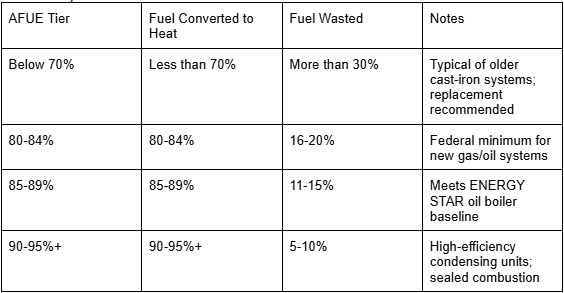
The jump from below-70% to 87%+ doesn't just feel warmer. It changes your monthly fuel bill in a way that shows up immediately.
Why Annual Service Is Not Optional
This is the section most homeowners skip mentally because maintenance feels like an administrative chore. Here's the actual math.
Picture a Northeast homeowner running an 8-year-old oil boiler through a six-month heating season. The system has not been serviced in two years. The nozzle has partial clogging, the heat exchanger has light soot accumulation, and the combustion settings have drifted slightly off spec. None of those issues trip an alarm. The system runs. It's just running inefficiently, burning roughly 15% more oil than a tuned version of itself would. Over a 600-gallon season at current prices, that's nearly 90 gallons of oil buying nothing except wasted combustion.
That scenario is not hypothetical. Dirt and neglect are the top causes of heating and cooling system failure and inefficiency, according to ENERGY STAR, and maintaining your equipment keeps your system operating at peak performance while preventing future problems and unwanted costs. The same resource recommends scheduling a professional heating system checkup each fall, before the season starts, when service windows are still open.
Staying on top of oil boiler maintenance is one of the highest-return moves you can make as a homeowner because the cost of a tune-up is almost always smaller than the fuel waste it prevents, let alone the cost of an emergency repair in February.
"Proper maintenance is equally critical, as even high-efficiency systems lose performance without regular care." This is the consistent finding across industry research, and it holds whether your system is brand new or approaching the end of its service life. The equipment grade matters less than the consistency of care.
A Practical Pre-Season Checklist
If you're heading into fall without a service appointment on the calendar, start here. This list is built around what a professional technician addresses during an annual tune-up, so you know what to expect and what to ask about.
Schedule the tune-up in September or early October, before emergency demand spikes. The best technicians book up fast once cold weather arrives.
Replace the oil nozzle annually. Nozzles wear and clog gradually. A fresh nozzle ensures correct spray pattern and combustion efficiency.
Ask for a combustion analysis. A technician with the right tools will measure actual flue gas percentages, not just visually inspect components. This catches efficiency drift that looks fine to the naked eye.
Check the expansion tank and pressure relief valve on a boiler system. These components fail quietly and can cause bigger problems if left unexamined.
Bleed radiators if you have a hot-water boiler. Trapped air creates cold spots and forces the system to cycle longer to satisfy the thermostat.
Test the thermostat calibration. A thermostat reading 2 degrees off can cost you in wasted run time across an entire season.
Do these things once a year, every year. The expense is predictable. The savings compound.
When Maintenance Isn't Enough: The Upgrade Question
An increasing share of U.S. households are using electricity for heating, though natural gas remains the most common heating fuel, with 42% of U.S. households reporting electricity as their main space heating fuel in 2024, according to U.S. Energy Information Administration data citing the Census Bureau's American Community Survey. Oil heat remains dominant in the Northeast specifically, where the existing infrastructure, distribution networks, and building stock make switching fuels a far more complex decision than a fuel-cost chart suggests.
If your oil boiler is over 20 years old and AFUE has degraded, or if you're paying for two or three emergency repairs per season, the math typically favors replacement. A high-efficiency condensing unit at 90%+ AFUE pays the difference in fuel savings over a few years, and the reliability alone eliminates the stress of unplanned breakdowns in the middle of winter.
But if your system is under 15 years old and hasn't been properly maintained, try a full tune-up before assuming replacement is necessary. You'd be surprised how much performance is hiding in a clean, well-adjusted boiler.
The Bottom Line
Heating efficiency is a home improvement project that pays you back every single month, not just when you sell. Start with your AFUE rating, commit to annual service before the season starts, and work through the Efficiency Drain Order before spending on anything else. Your furnace room is where the real renovation ROI lives.
HOW DO YOU FEEL ABOUT FASHION?
COMMENT OR TAKE OUR PAGE READER SURVEY
Featured





A decade ago, “rest day” was a line in a training plan.