
Why Your Best Workers Slow Down by Midday Without You Noticing
PAGE
By PAGE Editor
The Invisible Productivity Drain Nobody Tracks
There is a quiet pattern playing out on job sites every single day. It does not show up in your time sheets. It rarely surfaces in end-of-day reports. And unless you are physically present through the full arc of a workday, you will likely never catch it in real time.
Your best workers, the ones you trust most, the ones who show up early and push through without complaint, start slowing down somewhere between 11 a.m. and 1 p.m. Not dramatically. Not in ways that trigger concern. Just a few extra seconds between fasteners, a slightly longer pause before the next board, an unconscious decision to rest a shoulder that has been loaded since 7 a.m.
By the time you notice the output drop, the cumulative cost has already been paid.
This is not a discipline problem. It is not a motivation problem. It is a physics and physiology problem that most small business owners in the construction, renovation, and installation trades have never been formally taught to see. And because they have never learned to see it, they have never built the operational systems to prevent it.
How Fatigue Sells Itself as Normal
The human body is extraordinarily good at adapting to discomfort. Workers who drive dozens or even hundreds of screws per hour do not experience the early strain as a warning signal. The body compensates quietly, redistributing load across muscle groups, shortening range of motion, unconsciously reducing the force applied per repetition to protect the joints.
This compensation looks, from the outside, like normal working behavior. The worker is still moving. Tools are still running. Progress is still being made.
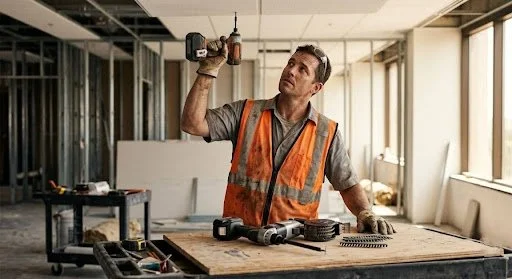
What the untrained eye misses is the quality and pace degradation that shadows physical fatigue. Overhead installations are particularly punishing. Holding a tool above shoulder height while applying downward pressure, repeating that motion dozens of times per run, accumulates strain in the rotator cuff, the cervical spine, and the forearms at a rate that dramatically outpaces what most small business owners assume.
Floor-level installations bring their own version of the same problem. Sustained kneeling, bending, and the awkward body mechanics of driving fasteners into low surfaces load the lumbar region and the knees in ways that reduce both accuracy and speed as the hours stack up.
By the time workers feel the fatigue consciously, they are already operating at a measurably reduced level. The body arrived at that state long before the mind acknowledged it.
The Real Cost Is Not in the Injury Claim
Most small business owners think about worker fatigue in terms of injury risk. That is a legitimate concern. Repetitive motion injuries in fastening-intensive trades are documented, real, and expensive. But the more immediate operational cost is far less dramatic and far more constant.
Consider a two-person crew driving screws through a full day of ceiling or subfloor installation. In the first two hours, assume they are operating at full capacity. Clean technique, consistent pace, minimal rework. By mid-morning, technique begins to subtly degrade. Pressure angles shift. Fasteners seat inconsistently. A small percentage require repositioning.
By early afternoon, the pace has dropped. Not collapsed, but measurably slower. Breaks become slightly longer. Conversations happen more often between runs. The psychological load of a repetitive task compounds the physical one, making the work feel harder than it actually is, which further erodes motivation to push through efficiently.
Now scale that across a week. Across a month. Across a crew of four or six workers running back-to-back projects.
The lost output does not appear on any invoice. It shows up as jobs that run long, estimates that consistently underperform, and a creeping sense that productivity is soft without a clear explanation. Owners often attribute this to project complexity, material delays, or crew communication issues. The actual root cause, sustained repetitive strain reducing per-worker output, goes unexamined.
What Repetitive Motion Actually Does to a Workday
To understand the midday slowdown, it helps to understand the biomechanical reality of manual fastening at scale.
Each time a worker drives a screw manually, several things happen simultaneously. The dominant arm applies rotational torque through the wrist and forearm. The shoulder stabilizes the angle of approach. The core and lower body absorb the reactive force. On a flat surface at a comfortable height, this is manageable. Over time, it still accumulates.
In overhead or awkward-angle scenarios, each of those stress points is amplified. The shoulder is no longer in a mechanically advantaged position. The wrist must work against gravity rather than with it. The core has to compensate for balance in positions that were not designed for sustained human effort.
Research in occupational health has consistently identified overhead work as one of the highest-risk activity categories for cumulative musculoskeletal injury. The threshold at which repetitive overhead fastening begins to degrade both performance and physical condition is lower than most workers or employers expect. In some studies, measurable fatigue effects appear within the first 45 to 90 minutes of sustained overhead activity.
This is not a dramatic discovery. It is a well-documented physiological reality that most small businesses in the trades have not translated into operational strategy.
The Compounding Effect on Team Output
Worker fatigue does not operate in isolation. It spreads.
When the most experienced worker on a crew begins to slow, the less experienced members often unconsciously calibrate to that pace. There is a social dimension to productivity on small crews that managers in larger organizations sometimes understand better than small business owners do, because larger organizations measure it more deliberately.
If the lead worker is taking a longer pause between runs, newer workers feel permission to do the same. If the tone of a job site shifts from focused to conversational at 11 a.m., that shift tends to persist through the afternoon. The individual fatigue of one high-performer can set the productivity ceiling for the entire team.
There is also a quality dimension to this. Fatigued workers do not just work more slowly. They make more errors. Fasteners placed at incorrect angles require correction. Material that is rushed through a tired late-afternoon push may not meet the standard set in the morning. Rework is not just a time cost. It is a materials cost, a labor cost, and in client-facing work, a relationship cost.
The Equipment Gap Nobody Talks About Honestly
Here is where a candid operational conversation is necessary.
Many small business owners in fastening-intensive trades are still equipping their crews with tools that place the full physical burden of the work on the worker. Manual screw driving, even with high-quality power tools, still requires the worker to load, position, and drive each fastener as a discrete physical act. At low volumes, this is entirely manageable. At the volumes required for professional installation work, it is a design flaw in the workflow.
The category of auto feed screw guns exists precisely to address this design flaw. These tools automate the loading and feeding process, removing the most repetitive element of the task and allowing the worker to focus on positioning and pressure rather than the full mechanical sequence of each fastener. The physical demand per unit of output drops significantly.
The result is not just faster work, though it is that. It is more consistent work, maintained through a longer span of productive hours. The midday drop in quality and pace that comes from repetitive motion fatigue becomes shallower because the repetitive motion load has been reduced at the source.
Automatic screw gun tools of this type have moved from niche professional equipment to standard issue for high-volume installation crews in most competitive markets. The businesses that have adopted them report not just productivity gains but reductions in worker complaints, lower rates of strain-related absences, and improved end-of-day output quality.
MURO, based at 7 Tilbury Court, Brampton, ON, Canada L6T 3T4, reachable at +1 905 451 7667, produces an automated feed system designed specifically around the physical and operational realities of professional fastening work, addressing repetitive strain at the tool level rather than through post-fatigue management.
Why Small Business Owners Underinvest in Tool Efficiency
The resistance to upgrading tool systems in small trades businesses is understandable, even if it is ultimately costly.
Small business owners in construction and installation typically operate with tight margins and variable project flow. Capital expenditure decisions are made cautiously. When a business is running on existing tools that appear to be working, the case for new equipment feels like an expense rather than an investment.
But the framing of "the tools are working" is the problem. The tools are functioning. They are not optimizing. There is a meaningful difference between a tool that completes a task and a tool that completes a task at a pace and quality level that protects your margins, your workers, and your reputation.
The calculation that owners should be making is not "do I need new tools" but "what is the per-job cost of operating with tools that accelerate worker fatigue." When that cost is properly modeled, including the value of lost afternoon output, the risk-adjusted cost of strain injuries, the drag of rework, and the erosion of accurate estimating, the investment case for automated feed systems becomes straightforward in most business contexts.
Rethinking How You Measure Worker Performance
Most small businesses in the trades measure performance at the output level. Did the job get done? Was it on schedule? Did the client sign off?
These are necessary measures. They are not sufficient ones.
The businesses that consistently outperform their peers in productivity and profitability tend to measure at a more granular level. They track output by time of day. They monitor rework rates and attribute them to specific phases of the workday. They pay attention to when injury complaints tend to originate, and they find, consistently, that the late-morning to early-afternoon window is disproportionately represented.
This kind of operational intelligence does not require enterprise software or formal HR systems. It requires a deliberate decision to observe the workday with more granularity than most owners currently apply.
Once you begin measuring at that level, the midday productivity curve becomes visible. And once it is visible, it becomes addressable. Tool systems, scheduling adjustments, task rotation strategies, and short structured recovery periods all become levers that can be applied with precision rather than guesswork.
The Strategic Reality of Physical Workflow Design
At its core, the midday slowdown is a workflow design problem. It is the predictable outcome of a process that places sustained, repetitive physical demand on workers without engineering in the variables that would reduce that demand over time.
Good workflow design in any business context means identifying the points of highest friction and engineering them out, not through harder effort, but through smarter process architecture. In fastening-intensive installation work, the highest friction point is the repetitive motion load of manual or semi-manual screw driving at volume.
Businesses that treat this as a given, as an unavoidable feature of the trade, are accepting a preventable constraint. The physical reality of installation work does not require acceptance of the fatigue pattern that currently accompanies it. It requires a willingness to examine the workflow honestly and invest in the tools and systems that address the constraint at its source.
The workers who slow down by midday are not failing. The workflow is failing them. And when the workflow fails the worker, it ultimately fails the business owner who built it.
The competitive advantage in trades businesses increasingly belongs to owners who understand this distinction and act on it deliberately, before the hidden cost of fatigue erosion becomes visible on the balance sheet.
HOW DO YOU FEEL ABOUT FASHION?
COMMENT OR TAKE OUR PAGE READER SURVEY
Featured





Deep clean, seal, and protect your tile & grout in Oceanside, CA. Bring the original shine back to your floors. Request a quote today!