
Antminer S23 vs Antminer Z15 Pro
PAGE
By PAGE Editor
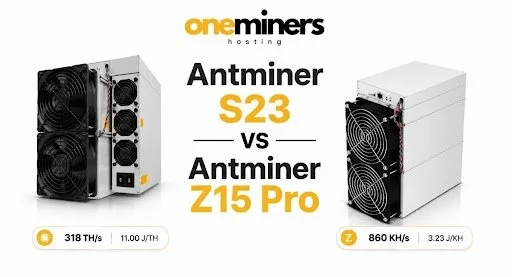
If you’ve searched “Antminer S23 vs Z15 Pro,” you’ve probably seen the two big numbers side by side: 318 TH/s versus 860 KH/s — and assumed the S23 must be the monster and the Z15 Pro the little one.
Here’s what most comparison pages get wrong: those two numbers measure completely different jobs. Ranking them against each other is like comparing a truck’s tow rating to a blender’s RPM. Both are real numbers. Neither tells you which one to buy.
Quick answer: The S23 and Z15 Pro aren’t rivals — they mine different coins on different algorithms. The Antminer S23 is a SHA-256 machine for Bitcoin. The Antminer Z15 Pro is an Equihash machine for Zcash and similar coins. The real decision isn’t “which makes more today?” — it’s which coin you want, what you pay for the machine, and what electricity rate you can get.
The two machines at a glance
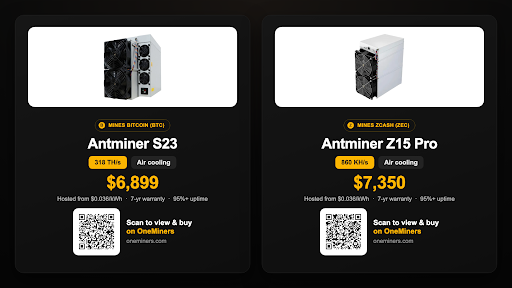
Same guide, two very different bets. Scan either card to see live pricing and availability on OneMiners.
318 TH/s vs 860 KH/s: why you can’t compare these numbers
This is the most important part of the guide, so let’s keep it dead simple.
A miner solves a specific type of math puzzle. The “algorithm” is just the kind of puzzle. Hashrate is how many guesses per second it makes at that puzzle.
Different puzzle. Different unit. So 318 trillion of one thing is not “bigger” than 860 thousand of a completely different thing. The only fair way to judge speed is within the same algorithm — S23 against other Bitcoin miners, Z15 Pro against other Zcash miners.
Head-to-head comparison
S23 figures are Bitmain’s announced numbers; Z15 Pro figures are the widely-cited manufacturer/retail specs. Profitability is a third-party snapshot at $0.06/kWh (August 2026) — an estimate, not guaranteed income.
The S23 and Z15 Pro mine different coins, so their hashrates can’t be directly compared.
S23: Mines Bitcoin (BTC) and uses about 3,498W.
Z15 Pro: Mines Zcash (ZEC) and uses about 2,800W.
At $0.06/kWh, estimated profit is $5.23/day for S23 vs $26.24/day for Z15 Pro.
Price: S23 is about $6,899, while Z15 Pro is about $7,350.
Based on this snapshot, the Z15 Pro earns much more per day while using less electricity.
Profit is not guaranteed and changes with coin prices, mining difficulty, and other factors.
No “winner” is marked on hashrate or efficiency: 318 TH/s and 860 KH/s measure different algorithms, and 11 J/TH vs 3.31 J/KSol are scores in different units.
What each machine mines
Antminer S23 — Bitcoin (SHA-256)
The S23 runs SHA-256, so it mines Bitcoin (BTC) first and foremost, plus technically Bitcoin Cash and other SHA-256 forks. Almost everyone points a machine like this at Bitcoin through a pool — you’re mining the asset with the deepest market and the most infrastructure behind it.
Antminer Z15 Pro — Zcash (Equihash)
The Z15 Pro runs Equihash (200,9). Its headline coin is Zcash (ZEC), and it can also mine Horizen (ZEN) and Komodo (KMD). It cannot mine Bitcoin. Equihash economics live and die on the Zcash price — the same data that shows a healthy profit at cheap power also shows the Z15 Pro running at a loss once electricity climbs toward $0.10/kWh.
Power consumption
Here the Z15 Pro clearly wins one round: it uses less electricity.
Antminer S23: ~3,498 W → about 84.0 kWh/day, ~2,519 kWh/month, ~30,642 kWh/year.
Antminer Z15 Pro: ~2,780 W (840 batch) → about 66.7 kWh/day, ~2,002 kWh/month, ~24,353 kWh/year. The 860 batch draws ~2,849 W.
Electricity cost comparison
Same machines, five electricity rates — what you’d pay just to keep them running.
Antminer Z15 Pro is cheaper to run than the S23.
At $0.04/kWh: S23 costs about $101/month, Z15 Pro $80/month.
At $0.06/kWh: S23 costs $151/month, Z15 Pro $120/month.
At $0.10/kWh: S23 costs $252/month, Z15 Pro $200/month.
Higher electricity prices = lower mining profit.
The Z15 Pro uses about 20% less electricity than the S23.
Profitability
A common third-party snapshot at $0.06/kWh showed roughly $5.23/day net for the S23 (~$157/month) and $26.24/day for the Z15 Pro (~$787/month). Please don’t multiply either by 365 and call it a yearly income — that’s the biggest mistake new buyers make.
What moves those daily numbers, often within a week:
Coin price — the biggest lever, especially ZEC for the Z15 Pro.
Network difficulty — more miners join, your slice shrinks.
Block rewards — Bitcoin’s halve roughly every four years.
Transaction fees — can boost Bitcoin revenue in busy periods.
Electricity rate — see the tables above.
Pool fees — small but constant.
Uptime — an offline machine earns exactly nothing.
S23 vs Z15 Pro ROI
A machine earning more per day does not automatically have better ROI. ROI is a three-way equation: purchase price + running cost + uptime.
Here the two prices are close ($6,899 vs $7,350), so under the snapshot the Z15 Pro’s higher daily net gives a much shorter illustrative payback — on the order of ~9 months versus ~3.6 years for the S23. But read that carefully: it leans entirely on ZEC holding up, and Zcash moves fast. The S23’s slower payback rides on Bitcoin, a far steadier network. Shorter payback on paper isn’t the same as the safer long-term bet.
Which one would we choose?
Choose the S23 if… you want Bitcoin exposure, you believe in BTC long-term, and you can get genuinely cheap, reliable power. You’re buying into the most durable network in mining and playing a long game.
Choose the Z15 Pro if… you specifically want Equihash/Zcash exposure, you like the lower power draw, and its current snapshot economics appeal to you — going in clear-eyed that ZEC’s swings can flip those economics fast.
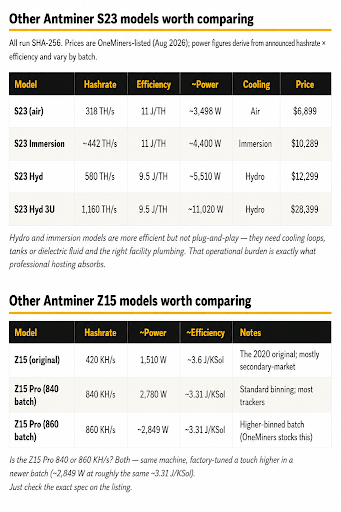
Consider another miner if… your real goal is “the best Bitcoin miner I can afford” or “the most efficient machine for my power rate.” Then look across the wider S23 family below or other current models.
FAQ
Is the S23 better than the Z15 Pro?
Neither is universally better — they mine different coins on different algorithms. It depends on which coin you want, your electricity rate, and what you pay for the machine.
Which is more profitable?
In a third-party snapshot at $0.06/kWh, the Z15 Pro showed a higher daily net (~$26.24 vs ~$5.23). But that’s a moment in time — Equihash profit swings hard with the Zcash price and can turn negative at higher power rates.
Can the S23 mine Bitcoin?
Yes. It’s a SHA-256 machine and Bitcoin is the main SHA-256 coin. Most people point it at Bitcoin through a pool.
What does the Z15 Pro mine?
Equihash (200,9) coins — primarily Zcash (ZEC), plus Horizen (ZEN) and Komodo (KMD). It cannot mine Bitcoin.
How much electricity does an S23 use?
About 3,498 W — roughly 84 kWh/day, ~2,519 kWh/month running 24/7.
Which miner has the better ROI?
You can’t tell from daily profit alone — ROI depends on purchase price, running/hosting cost and uptime together. Pull current prices before calculating.
Where can I host an S23 or Z15 Pro?
Both are loud, hot, industrial machines that are hard to run at home, where power is usually too expensive to profit. Professional hosting offers cheaper power, cooling and uptime — compare locations and rates through OneMiners.
Is ASIC mining still profitable?
It can be, but only when the numbers line up: a reasonable hardware price, cheap electricity, decent uptime and a cooperative coin price. Run the current numbers yourself rather than trusting an old screenshot.
The bottom line
Don’t pick an ASIC from a hashrate number or today’s profit screenshot — the two most misleading figures in mining. What decides your result is the boring stuff: the price you pay, the electricity rate you get, whether it stays online, and which coin you believe in.
For general information only — not financial or investment advice. Mining profitability, specifications, prices and availability change constantly and vary by source. Figures include manufacturer spec-sheet numbers, third-party estimates and company-reported information, current as of August 2026 — verify all specs, prices and rates before purchasing. Cryptocurrency mining carries risk, including the risk of loss.
HOW DO YOU FEEL ABOUT FASHION?
COMMENT OR TAKE OUR PAGE READER SURVEY
Featured



Finding the right job in human resources or recruitment can take time, especially when you're searching online.