
Buy Research Peptides Online: 7 Checks Before Choosing a U.S. Supplier
PAGE
By PAGE Editor
Research peptides for sale can be found across hundreds of online stores, but a polished product page does not establish compound identity, chromatographic purity or batch consistency. Vendors may list identical chemical names while providing very different analytical documentation, labeling and shipping information. Checking seven core criteria can help buyers distinguish a well-documented supplier from a poorly documented storefront.
Quick Answer: Before ordering research peptides online, check whether the product page identifies the compound, batch, analytical method, stated amount, storage requirements, shipping origin and research-only restrictions.
Check #1: Is the Compound Clearly Identified?
A legitimate research catalog provides comprehensive chemical identification beyond a common trade name. Inspect the product page for the full chemical title, amino acid sequence (where applicable), molecular formula, molecular weight, and CAS number. Counterion or salt form should also be reported because it can affect molecular-weight interpretation, quantitative content reporting and comparison between analytical documents.
It is vital to recognize that listing a public CAS number or theoretical molecular weight merely confirms standard reference values; it does not verify what is inside the physical vial. Clear identification represents the bare baseline for technical compliance rather than proof of physical inventory quality.
Check #2: Does the COA Match the Batch?
A Certificate of Analysis (COA) must correlate directly with the physical lot delivered to the laboratory. Review the document for a matching batch or lot number, testing date, and the distinct name of the issuing analytical laboratory. A static report displayed across multiple batches without matching lot identifiers warrants additional scrutiny because it may not represent the material currently being sold.
Furthermore, avoid treating a standard COA as a catch-all safety certificate. A standard analytical report verifies specific chemical metrics but does not automatically confirm sterility, endotoxin levels, long-term degradation rates, or biological activity unless explicit assays for those parameters are included in the document.
Check #3: Understand HPLC and Mass Spectrometry
Evaluating analytical documentation requires distinguishing High-Performance Liquid Chromatography (HPLC) from Mass Spectrometry (MS). HPLC separates compounds to measure purity relative to side-products or contaminants under specific column conditions, while MS determines whether the observed molecular mass is consistent with the expected compound, accounting for charge states, salt form and analytical method.
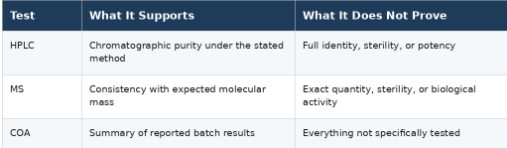
An HPLC trace showing high chromatographic purity does not by itself establish that the principal detected compound has the expected molecular mass or amino-acid sequence.
Check #4: Is the Labeled Amount Unambiguous?
Product labels must clearly differentiate total lyophilized cake weight from actual net peptide content. Lyophilized powders naturally contain residual moisture, counterions, and optional bulking agents like mannitol.
Consequently, a 99% HPLC purity rating does not guarantee that a 5 mg vial yields exactly 5.0 mg of net target peptide mass. Reputable suppliers clarify whether stated values refer to overall powder mass or quantitative content assay results. Disambiguating mass labeling ensures precise concentration calculations during laboratory preparation.
Check #5: Where Is the Order Shipped From?
Logistics directly impact peptide integrity during transit. Working with a U.S.-based research peptide supplier can shorten transit routes and simplify communication about orders, batch records and returns.
However, buyers must distinguish domestic fulfillment from manufacturing origin: "shipped from a U.S. warehouse" does not equate to synthesis within the United States. Domestic dispatch reduces customs delays, but researchers should still inspect thermal packaging details to ensure environmental conditions do not compromise material during transport.
Check #6: Does the Marketing Remain Research-Focused?
Intended-use labeling and marketing practices are important factors when evaluating a supplier. Red flags include human administration guidelines, dosing protocols, cycle suggestions, therapeutic claims, or before-and-after imagery.
Claims that research-only compounds are "safe," "clinically proven" or suitable for human administration conflict with research-only positioning and warrant additional scrutiny. Legitimate vendors maintain strict research-only disclaimers consistently across all product pages, Terms of Service, and documentation—not just as hidden footer boilerplate.
Check #7: Inspect One Real Product Page
Buyers planning to buy GHK-Cu for research can use its product page as a practical checklist: compare the declared sequence, molecular formula, molecular weight, product form, purity specification, storage information and available analytical report.
GHK-Cu (copper glycyl-L-histidyl-L-lysine) serves as an instructive example. As a copper-binding tripeptide, its documentation should specify copper complexation status and storage temperature requirements. In vitro or topical research models should not be conflated with systemic administration claims.
Final Supplier Verification Checklist
Before placing an order, run through this concise technical evaluation:
Product Identity: Full sequence, CAS number, formula, and counterion stated clearly.
Batch Match: COA lot number matches physical vial labeling.
Analytical Rigor: Separate HPLC (chromatographic purity) and MS (molecular-mass consistency) reports provided.
Quantity Clarity: Net peptide mass distinguished from total lyophilized weight.
Fulfillment Details: Shipping origin, transit estimates, and thermal packaging disclosed.
Storage Specifications: Temperature and handling requirements explicitly outlined.
Compliance Alignment: Marketing strictly adheres to research-only boundaries without human-use instructions.
Frequently Asked Questions
Does 99% HPLC purity prove peptide identity?
No. HPLC measures chromatographic purity under specific solvent and column conditions, separating the primary target from related impurities. It confirms relative purity but does not verify molecular structure or sequence mass; Mass Spectrometry supports identity assessment by showing whether the observed molecular mass is consistent with the expected compound. MS alone does not necessarily confirm the complete amino-acid sequence or distinguish every possible structural variant.
Does U.S. shipping mean the peptide was manufactured in the USA?
No. "Shipped from a U.S. warehouse" refers strictly to domestic fulfillment location. Global supply chains mean raw synthesis, purification, and final lyophilization may take place elsewhere before being stocked domestically for faster dispatch.
Does a standard COA confirm sterility?
No. Standard HPLC and MS reports generally address chromatographic purity and consistency with the expected molecular mass. Unless separate assays for bioburden, sterility or endotoxins are reported, a standard COA should not be interpreted as evidence of microbiological sterility.
HOW DO YOU FEEL ABOUT FASHION?
COMMENT OR TAKE OUR PAGE READER SURVEY
Featured





Finding the right healthcare provider can take time, especially when symptoms do not have one simple explanation.