
Copper Peptides vs Retinol: What the Research Says About Each
PAGE
By PAGE Editor
For more than three decades, retinol has been the ingredient dermatologists mention first for ageing skin, and almost every brand sells one. Lately, though, a bright blue challenger keeps turning up on social feeds: copper peptides, pitched by some creators as "the gentler retinol".
Searches for "copper peptides vs retinol" keep climbing, and most of the answers come from brands that sell one or the other. That makes it hard to tell what the science says and what the marketing says.
So this piece skips the verdict on what to buy. It sets out what published studies measured for each ingredient, who took part, for how long, and how much weight each finding can carry. For more on separating skincare trends from evidence, see our guide to rice water.
Quick answer: Retinol has the larger body of human research, and its prescription cousin, tretinoin, has controlled trials dating back to 1988. Copper peptides (GHK-Cu, listed on labels as copper tripeptide-1) have deep lab research on collagen and skin-cell signalling, plus a handful of small human studies. The two work through separate pathways, so researchers treat them as different ingredients, each with its own evidence base.
Meet the Two Ingredients
Copper Peptides (GHK-Cu)
GHK-Cu is a tiny peptide, just three amino acids long (glycine, histidine and lysine), holding a single copper ion. The copper is what turns it blue. On an ingredient list, it appears as copper tripeptide-1.
It was first identified in human blood plasma in 1973 by the biochemist Loren Pickart, who noticed it changed how ageing liver tissue behaved in the lab. Most of what we know about it in skin still traces back to his group's work.
One naming trap catches a lot of people. Copper PCA and other "copper complexes" are different ingredients. They contain copper, but not the GHK peptide, and the research on GHK-Cu doesn't automatically apply to them.
Retinol and the Retinoid Family
Retinol is a form of vitamin A, and it belongs to a family called retinoids. Think of the family as a ladder, from gentlest to strongest:
Retinyl esters (such as retinyl palmitate)
Retinol
Retinal (retinaldehyde)
Retinoic acid (tretinoin)
Retinoic acid is the form skin cells actually respond to. Everything lower down the ladder has to be converted into it first, step by step, and some potency is lost along the way. In the UK, tretinoin is a prescription-only medicine, while retinol is sold as a cosmetic ingredient.
How Each Is Thought to Work
Retinol: Speeding Up Cell Renewal
Once retinol is converted to retinoic acid, it binds to retinoic acid receptors (RARs), which pair with partner receptors called RXRs inside the cell nucleus. That pairing switches genes on and off.
Two effects get the most attention. Skin cells turn over faster, and fibroblasts, the cells that make the skin's support structure, produce more collagen. Lab work mapped these pathways, and human biopsy studies on retinoic acid confirmed the changes in real skin samples.
Copper Peptides: A Signalling Molecule
GHK-Cu works more like a messenger. In cell-culture studies, it prompted fibroblasts to make more collagen and glycosaminoglycans, the water-holding molecules that give skin its plumpness, while also regulating the enzymes that clear away worn-out collagen. Researchers describe it as a remodelling signal.
Copper itself plays a part. Lysyl oxidase, the enzyme that cross-links collagen and elastin fibres, needs copper to work.
Pickart's team has also reported that GHK switches thousands of human genes up or down. Those findings come from lab and computer-based (in silico) analyses of gene-expression databases, so they describe what GHK can do in a dish, and they still need testing in living skin.
The Penetration Question
Both molecules struggle to get through the skin's outer layer. GHK-Cu is water-loving and carries a charge, and retinol breaks down in light and air. That's why formulation, meaning the stability, delivery system and pH of a product, has such a big effect on how much reaches the skin, and why two products with the same ingredient can perform very differently.
Side-by-Side Comparison
Put the two next to each other and the differences go well beyond the colour of the bottle:
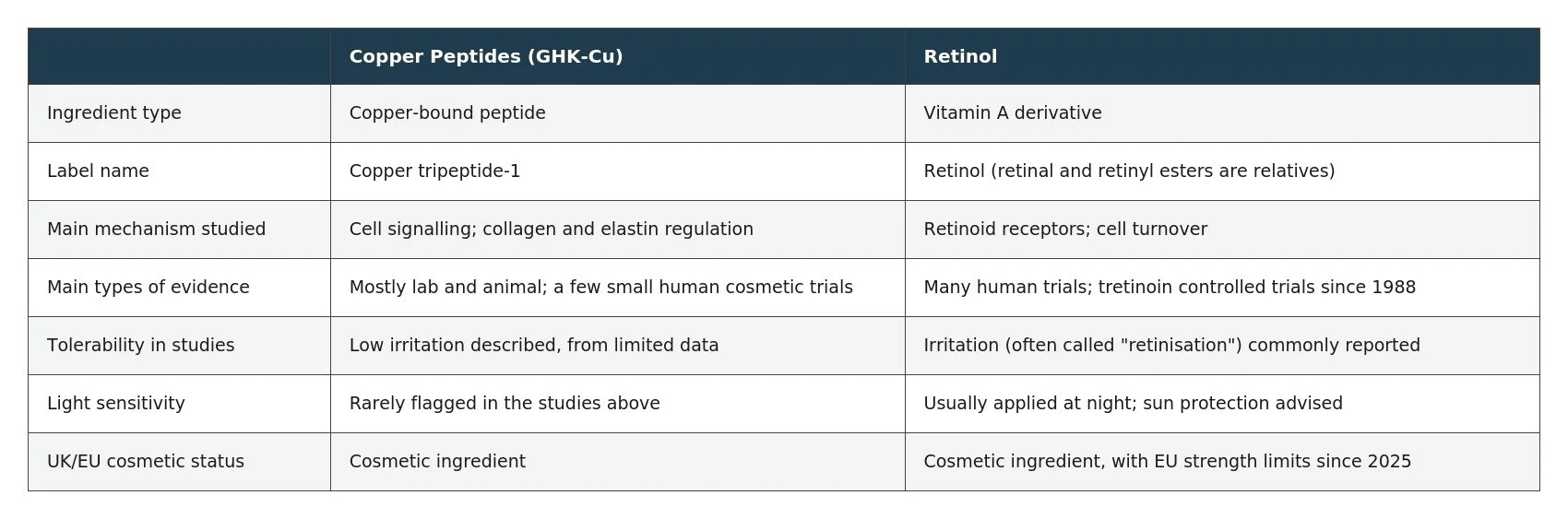
What the Research Has Measured, Ingredient by Ingredient
Retinol and Retinoids: The Human Evidence
The retinoid story starts with tretinoin. In 1988, Weiss and colleagues at the University of Michigan ran a 16-week, double-blind, vehicle-controlled trial published in *JAMA*. Thirty people who completed the study applied tretinoin to one forearm and a plain cream to the other. Every one of them showed significant improvement in sun-related skin changes on the tretinoin side, and 14 of the 15 who also used it on the face improved there too.
Retinol got its own controlled test in 2007. Kafi and colleagues gave 36 older adults (average age 87) a 0.4% retinol lotion on one arm and a plain lotion on the other, applied up to three times a week for 24 weeks. Published in *Archives of Dermatology*, the trial found significantly better fine-wrinkle scores on the retinol arm. Biopsies from a small subgroup showed more glycosaminoglycans and procollagen, a collagen building block. The authors concluded that "topical retinol improves fine wrinkles associated with natural aging."
One caution applies here. Tretinoin results don't automatically carry over to cosmetic retinol. The forms and strengths differ, and retinol has to be converted first.
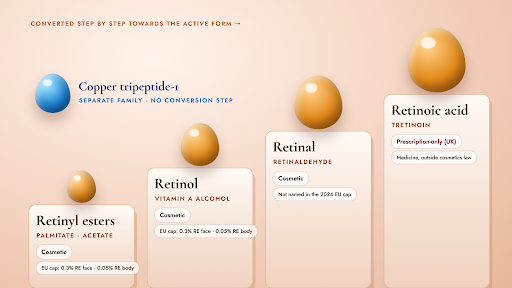
The vitamin A ladder: retinyl esters, retinol, retinal and retinoic acid (tretinoin) as rising steps, showing which are cosmetic, which fall under the 2024 EU strength cap, and that tretinoin is prescription-only in the UK, with copper tripeptide-1 shown as a separate family
Copper Peptides: Lab-Heavy Evidence
Most copper peptide data comes from cell culture. According to a 2015 review by Pickart and colleagues, GHK-Cu at very low nanomolar concentrations increased both the making and the breakdown of collagen and glycosaminoglycans in fibroblasts.
The much-repeated claim that "copper peptides beat retinoic acid and vitamin C" comes from a small 1998 pilot study by Abdulghani and colleagues, as summarised in that review. Women applied creams to their thighs for one month, and biopsies measured collagen. Collagen rose in 70% of those using GHK-Cu, 50% using vitamin C and 40% using retinoic acid.
That's an interesting result, and a thin one to build a comparison on. It was a pilot study, the review doesn't give the number of participants, it ran for a month, and thigh skin behaves differently from facial skin. Its readout was collagen in a biopsy, which tells us nothing about visible change.
Facial studies exist too. The same review describes 12-week trials of GHK-Cu creams in 71 women and in 67 women aged 50 to 59, and a 12-week eye cream study in 41 women. Several appeared only at conferences or in book chapters, so their methods are harder to check.
Why a Fair Head-to-Head Doesn't Exist Yet
Few studies compare the two directly. The products tested used different formulations and strengths, and many copper peptide studies were run or funded by companies with products to sell. Until an independent trial tests both on facial skin over months, any "winner" is a guess.
How Strong Is the Evidence for Each?
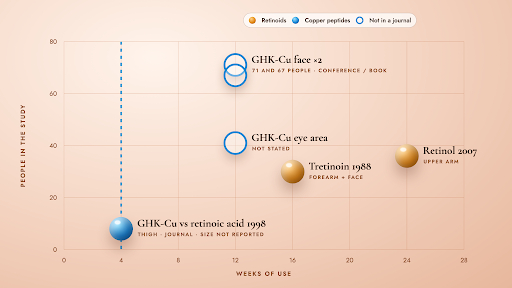
Evidence map plotting study length in weeks against number of participants: tretinoin 1988 and retinol 2007 as journal-published amber points, three 12-week GHK-Cu studies as hollow points published outside journals, and the 1998 GHK-Cu thigh pilot at four weeks with size not reported
Below is a simple scale:
Retinoids: strong. Decades of controlled human trials, independent research groups and consistent biopsy findings.
Copper peptides: promising but thin. Strong lab data, a few small human studies, and little independent replication.
You can judge any skincare claim with five questions:
How many people took part? Dozens is a start; hundreds is better.
Was there a control group? A plain cream or untreated side shows what would have happened anyway.
How long did it run? Skin renews over weeks, so a month is short.
Who paid for it? Independent funding carries more weight than brand funding.
Was it lab, animal or human? A result in a dish is an early lead.
Dermatologists still find copper peptides interesting. As board-certified dermatologist Dr Brendan Camp told TODAY: "Copper peptides are thought to possess antioxidant properties that protect skin cells from free oxygen radicals."
Dr Hillary’s view: "Retinoids have one of the deepest evidence bases in cosmetic science. Copper peptides are scientifically interesting, but much of the data comes from the lab. They answer different questions, so 'which is better' often isn't the right question."
Tolerability: What Studies Reported
Retinoids have a well-known adjustment phase. Dryness, redness and peeling are widely reported in the first weeks of use, and the 1988 tretinoin trial listed irritation as its only side effect. Retinoids can also make skin more sensitive to sunlight, which is why retinoid products advise sun protection and why many are applied at night.
Labels now carry official wording too. Under EU rules, products containing retinol or retinyl esters must state: "Contains Vitamin A. Consider your daily intake before use."
Copper peptides have less tolerability data, simply because there are fewer studies. One dermatologist interviewed by TODAY described a low risk of irritation. As with any active ingredient, irritation is still possible, and the small number of studies limits what anyone can say for certain.
Can Copper Peptides and Retinol Be Combined? What the Chemistry Suggests
The old "don't mix them" advice comes from chemistry. Copper ions can react with other actives, and changes in pH or oxidation can make a formula less stable. When copper meets an unstable ingredient, one or both may break down before they ever reach the skin.
Brands still flag combinations. The Ordinary's guidance for its copper peptide serum recommends avoiding use with direct acids, retinoids and strong antioxidants such as vitamin C. Treat lists like this as stability concerns from the formulator, since they describe what keeps that particular product working as designed.
Other pairings brands mention:
Strong acids (AHAs and BHAs), because low pH can loosen copper's grip on the peptide
Vitamin C (L-ascorbic acid), because it reacts readily with copper ions
Some antioxidant blends, for similar reasons
The research difference is wide. Published research has barely touched what happens when copper peptides and retinol are used in the same routine. Product labels and a dermatologist are the right sources for an individual routine.
The UK and EU Rules Most People Don't Know
The EU has tightened the rules on vitamin A. Under Regulation (EU) 2024/996, retinol, retinyl acetate and retinyl palmitate are capped at 0.3% retinol equivalent in face and other products, and 0.05% in body lotions. New products have had to comply since 1 November 2025, and older stock must be off EU shelves by 1 May 2027.
Great Britain has kept its own cosmetics rules since Brexit, so EU changes don't apply there automatically, while Northern Ireland follows EU cosmetics law. The Office for Product Safety and Standards publishes the current GB position.
Copper tripeptide-1, meanwhile, is a listed cosmetic ingredient, and tretinoin stays prescription-only in the UK.
Research-grade GHK-Cu is a separate category again. Supplied to laboratories as a research material, it isn't a cosmetic and isn't intended for skin.
Why Purity and Testing Matter for Copper Peptides
For anyone studying GHK-Cu, two checks count:
Peptide purity and identity, measured by HPLC and mass spectrometry
Copper content and ratio, confirming one copper ion per peptide, often by ICP-MS
A blue colour alone proves very little. Copper salts are blue too, and a sample with extra unbound copper looks the same as a correctly made one. UK research supplier Atlas Peptides publishes a certificate of analysis for each batch, showing how purity and copper content are verified.
Summing Up Copper Peptides VS Retinol
Retinol and its relatives have the deeper human evidence, built over more than 35 years of controlled trials. Copper peptides have fascinating lab science and a small set of human studies, many of them short, brand-linked or hard to check.
They aren't interchangeable, and the "copper peptides beat retinol" headlines rest on a one-month pilot study on thigh skin. Read the label, check the study behind the claim, and be sceptical of any ingredient sold as a miracle.
FAQs
Is copper tripeptide-1 the same as GHK-Cu?
Yes. They're two names for one molecule: copper tripeptide-1 is what appears in ingredient lists, while scientists write GHK-Cu, after the peptide's three amino acids and its copper ion. Copper PCA is a different ingredient.
Which has more research: copper peptides or retinol?
Retinol and the wider retinoid family, by a wide margin. Tretinoin has controlled human trials going back to 1988, and retinol has its own. Copper peptide research is mostly lab-based, with a few small human studies.
Do copper peptides work faster than retinol?
No published head-to-head trial shows that. The "11 times faster" figure circulating online is a brand marketing line about retinal, another vitamin A form, and it has nothing to do with copper peptides.
What do Korean skincare brands use instead of retinol?
Korean brands often feature bakuchiol, a plant extract, along with adenosine, peptides and fermented ingredients. Each has its own, generally smaller, research base, and none has been tested head to head against retinol at scale.
Can copper peptides and retinol be in the same routine?
Brands such as The Ordinary advise against combining their copper peptide serum with retinoids, mainly for stability reasons. Almost no published research tests the combination, so follow product labels and ask a dermatologist about an individual routine.
Natalie Brooks writes about ingredient science for Atlas Peptides, a UK supplier of independently tested research compounds. Every Atlas product is supplied strictly for laboratory research and is not for human use.
HOW DO YOU FEEL ABOUT FASHION?
COMMENT OR TAKE OUR PAGE READER SURVEY
Featured




Jackets have always been an important part of fashion.