
Electric Dirt Bike Range: How Far Can You Really Ride Off-Road?
PAGE
By Finixio Digital
Range is one of the first numbers people look at when shopping for an electric dirt bike. A bike might be advertised with a 40-, 50-, or even 60-mile range, and it is tempting to treat that number as a simple answer to the question: “How far can I ride?”
Off-road riding makes the answer much less straightforward.
A dirt bike climbing loose hills, accelerating out of corners, crossing soft ground, and carrying a heavier rider can use energy at a very different rate from a bike cruising steadily on flat ground. That is why two riders on the same electric dirt bike can finish the day with very different battery levels.
The better way to think about range is not as a fixed mileage number. Think of the battery as an energy budget that you spend during a ride.
Start With Battery Energy, Not Just Amp-Hours
Battery capacity is usually listed using voltage and amp-hours, such as 52V 26Ah.
Multiplying those numbers gives you the approximate battery energy:
52V × 26Ah = 1,352Wh
Watt-hours, or Wh, are more useful for comparing batteries than amp-hours alone because they account for both voltage and capacity.
For example, a 48V 30Ah battery and a 60V 24Ah battery both have different voltage and amp-hour ratings, but their nominal energy capacity is relatively similar:
48V × 30Ah = 1,440Wh
60V × 24Ah = 1,440Wh
That does not mean the two bikes will have identical real-world range. Motor efficiency, controller settings, bike weight, tires, riding style, and terrain still matter. But Wh gives you a better starting point for understanding how much energy the bike has available.
This is one reason simply comparing “26Ah vs. 30Ah” can be misleading.
The Range Number on the Spec Sheet Is a Starting Point
Manufacturers need a consistent way to describe range, but maximum range figures should not be treated as a promise for every trail.
A rider traveling at a moderate pace on relatively smooth terrain can use energy very differently from someone repeatedly accelerating, climbing steep sections, and riding through loose soil.
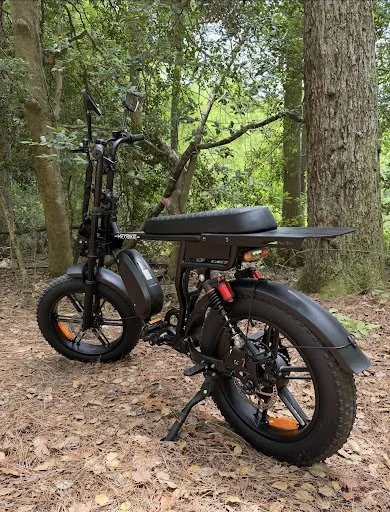
Current electric dirt bikes illustrate this well. For example, Heybike Sports lists the V1 with a 52V 26Ah battery and a claimed range of up to 50 miles. The bike is also built around a high-output mid-drive system, so its appeal is more about combining strong off-road performance with useful battery capacity than chasing a range number in isolation.
That distinction matters when comparing performance-oriented electric dirt bikes.
The useful question is not:
“Can this bike go 50 miles?”
It is:
“How much of those 50 miles can I realistically use on the type of trail I ride?”
Off-Road Range Can Change Dramatically
Terrain is often more important than riders expect.
Imagine two rides that are both 30 miles long.
The first is a relatively smooth trail with moderate elevation changes and long sections where you can maintain a steady speed.
The second includes steep climbs, loose dirt, sand, repeated acceleration, tight turns, and technical sections where you constantly change speed.
They are both 30-mile rides on a map, but they are not 30 miles from the battery's perspective.
Steep climbs require substantially more energy because the motor is doing work against gravity. Loose surfaces also increase resistance. Sand is particularly demanding because the tires can sink and spin rather than converting all of the motor's energy into forward movement.
This is why a route's difficulty profile can be more useful than its mileage.
Speed Is Another Hidden Range Killer
High-speed riding does not simply use “a little more” energy.
The faster you ride, the more frequently you accelerate and the more energy you can spend overcoming air resistance and maintaining speed. On an off-road bike, aggressive throttle use can make the difference even more noticeable.
A rider spending most of a trail ride at moderate speeds may get substantially more usable range than someone repeatedly accelerating hard to reach the bike's top speed.
This creates an interesting trade-off with high-performance electric dirt bikes.
A powerful motor gives you more capability when you need it. But having more power available does not mean you should use maximum output continuously if your priority is distance.
Think of power as your reserve capacity, not your default setting.
A Better Way to Plan a Trail Ride
One of the biggest mistakes riders make is planning around the advertised maximum range.
Suppose a bike is rated for 50 miles.
It would be risky to plan a 48-mile trail ride simply because the number looks close.
You need to account for:
Terrain changes
Rider weight and equipment
Temperature
Tire pressure
Riding speed
Acceleration
Elevation
Battery age
Unexpected detours
A safe battery reserve
There is also an important difference between total route distance and distance from your charging point.
Consider a 30-mile loop. You might think you are safe because the bike only needs to cover 30 miles.
But if the most difficult section occurs 20 miles into the ride, you need enough battery to get through that section and still return. A battery that looks comfortable at the halfway point can disappear quickly when the trail suddenly becomes steep or soft.
For unfamiliar trails, a conservative reserve is much smarter than trying to use every last percentage of battery.
Use Your Own Riding Data
After a few rides, you can build a much more useful range estimate than the number on a product page.
Record four simple things:
1. Starting battery percentage
2. Ending battery percentage
3. Total miles ridden
4. Type of terrain and riding style
For example, suppose you ride 18 miles and use 45% of the battery.
That gives you a rough consumption rate of:
18 ÷ 45% = 0.4 miles per 1% battery
At that pace, a theoretical full charge would equal around 40 miles.
But don't stop there.
Do the same calculation across several rides. You might discover that your bike averages around 40 miles during normal trail riding, but only 28–30 miles during aggressive riding on steep terrain.
That information is far more useful than a single maximum-range figure.
Don't Confuse Battery Size With Usable Range
A larger battery generally gives you more energy to work with, but bigger is not automatically better for every rider.
A larger battery can also add weight. More weight means the motor has more mass to move, particularly noticeable when climbing or accelerating.
The goal is therefore not to find the biggest battery possible.
It is to find a battery and bike setup that matches your actual riding.
A rider doing short technical sessions may value power, suspension, and handling more than maximum range. Someone planning long trail days may be willing to accept additional weight in exchange for greater energy capacity.
Your riding style should determine the priority.
Temperature and Battery Condition Matter Too
Battery performance can change with temperature, particularly in colder conditions.
Battery age also matters. A battery that has been through many charging cycles may not deliver the same usable capacity as when it was new.
That means your range estimate should be based on the bike's current condition rather than assuming it will always perform like a brand-new battery.
Tire pressure and basic maintenance are also worth checking before a long ride. Excessive rolling resistance, dragging brakes, or other mechanical problems can turn battery energy into wasted heat rather than useful movement.
So, How Far Can You Really Ride?
There is no single number that applies to every electric dirt bike.
A better way to think about practical range is in terms of riding conditions.
A moderate ride on relatively smooth terrain may get much closer to the manufacturer's claimed range. Mixed trail riding will usually require a larger margin. Aggressive riding with steep climbs, loose surfaces, and frequent acceleration can reduce practical range significantly.
The exact numbers depend on the bike and rider, but the principle stays the same:
The harder the trail makes the motor work, the faster your battery budget disappears.
For that reason, experienced riders don't simply ask how many miles a bike can travel.
They ask how much energy their normal riding consumes, how difficult the route will be, where the biggest climbs are, and how much battery they want left when they reach the farthest point.
That is the difference between knowing a bike's advertised range and actually knowing how far you can ride.
If you are comparing electric dirt bikes, treat the published range as a reference point. Then look at battery energy, motor efficiency, riding modes, terrain, and your own riding habits. Once you start measuring your real-world consumption, range becomes much easier to predict—and running out of battery miles from the trailhead becomes much less likely.
HOW DO YOU FEEL ABOUT FASHION?
COMMENT OR TAKE OUR PAGE READER SURVEY
Featured




Albert Kriemler’s latest Akris collection translates Martha Jungwirth’s emotionally charged paintings into fluid tailoring, expressive textiles and deeply personal details that explore clothing as an intuitive record of memory, movement and human gesture.