
Free AI Models in 2026: A Field Guide to What's Real
PAGE
By PAGE Editor
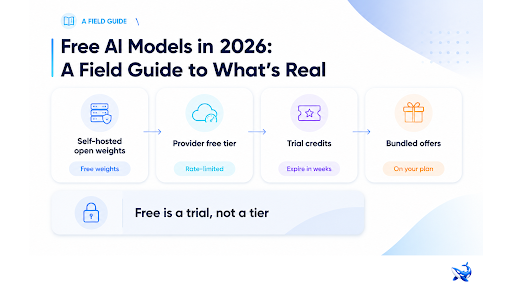
Every route to free AI models in 2026 is a subsidy with an expiration date: open-weight models you self-host, provider free tiers with rate limits, sign-up trial credits, and credits bundled into platforms you already pay for. None of them is a permanent free API, and the question that actually matters is not "is it free?" but "who is paying, and for how long?" This field guide is the short version of the answer, and the live rate card for Claude Sonnet 5 shows what the paid side of the market bills per million tokens once those subsidies expire.
Search "free AI models" in 2026 and the results follow a script. A self-hosted model that is free to download but assumes you own a GPU. An API tier labeled free that stops being useful after the tenth request of the day. A sign-up credit that evaporates in an afternoon. A bundle that is "free" only because you already pay for the plan it is attached to. This guide sorts those four routes into what they actually are — evaluation tools with different budgets and different lifespans — so you can pick the right one instead of trusting the label.
What "free AI models" actually means in 2026
The word "free" now covers four different products, and they share nothing but the price tag.
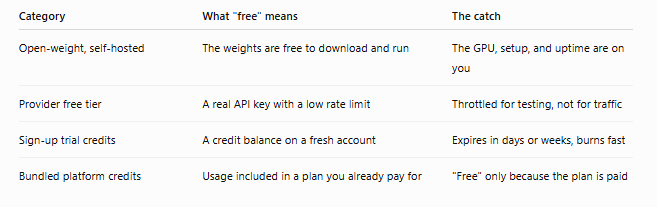
Open-weight models are the only category where "free" is literal at the license level: the weights are published, you run them on your own hardware, and no invoice ever arrives. But the model is the smallest cost in the stack. A serious open-weight deployment is a GPU you rent or own, a serving stack you operate, and a security posture you own end to end. The quality ceiling is real too: open-weight leaders are strong, but the frontier flagships at the top of independent intelligence indexes are closed-weight, and no amount of self-hosting changes that.
Provider free tiers are what most people picture when they search "free AI models": a provider hands you an API key and a rate limit that is generous enough to feel like a product and small enough to never threaten their bill. The tier is genuinely useful for a script that makes a few calls a day. It is also a ceiling you will hit the moment anything real depends on it.
Trial credits are a marketing expense the vendor writes down: a small balance on a new account, sized for a few serious experiments, expiring on a schedule. They are the best way to test a flagship model at $0 — for about a week.
Bundled offers are the quietest category. A platform you already pay for folds model usage into the plan, so the marginal cost of a request is zero. It is not a free tier; it is a discount on a bill you already have, which makes it the easiest "free" to confuse yourself with.
The real tradeoffs: infrastructure, throttling, expiry
Each category's hidden cost is different, and naming the one you are accepting is the whole game.
Self-hosting trades money for control. The invoice is infrastructure: a GPU that bills by the hour, storage, and your own time maintaining a serving stack. In exchange you get privacy, request volume limited only by your hardware, and a price that is genuinely flat. The failure mode is overconfidence — people price the model, not the machine, and a "free" model on a rented GPU stops being free very quickly.
Provider free tiers trade capacity for rate limits. The tier is designed to be survivable by a human and useless to a workload. You will meet caps per minute, per hour, and per day; no concurrency; no burst; no failover when the shared tier degrades. It is an excellent way to learn a provider's API surface and a terrible foundation for a product.
Trial credits trade depth for time. The balance is the constraint: a frontier flagship bills out at dollars per million tokens, so credits evaporate far faster than people expect on their first long output. The deadline is the second constraint. Evaluation is exactly what trial credits are for; anything that still needs to be running next month is not.
Bundled offers trade flexibility for lock-in. The "free" usage is attached to the plan, so it disappears the month you cancel, and it only covers the models the platform chooses to give away. Treat it as a bonus, never as your architecture.
The traps hiding in "free AI models" results
The label does the marketing, and the fine print does the pricing. The recurring patterns are consistent: a page promising "free unlimited" access that is really a smaller model wearing a better name; a "free API key" that dies after the first request or harvests credentials; a free tier presented without its rate limits; and a tutorial that ranks for "free" and quietly routes you into a subscription you did not ask for. The tell never changes: if a model genuinely costs the vendor money to serve, someone is paying, and it is not the search result claiming otherwise. Read the terms before you hand over a key or a credit card, and assume any "free forever" claim about a frontier model is a trial in disguise.
A decision framework: free for evaluation, paid for production
The framework is short and it applies to everyone from a solo developer to a team choosing a stack: free for evaluation, paid-for-what-you-use for production at list price with no markup.
Use the four free categories where they are strong. Self-host an open-weight model when you need privacy or volume and you have the ops to run it. Use a provider free tier to learn an API surface before committing to it. Spend trial credits on the one or two serious experiments that decide your architecture. Treat bundled credits as a bonus on a plan you already pay for. All four are evaluation instruments, and treating them as anything else is where the "free" bill arrives.
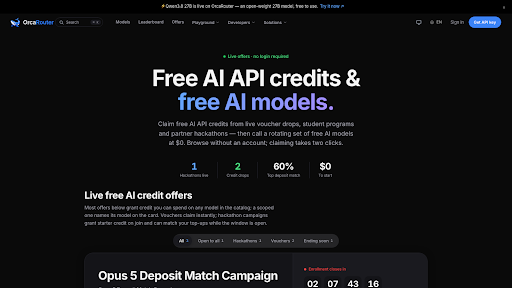
When something reaches production — a request your customers depend on, a job that runs unattended — switch to paying for what you use, at list price, with no markup. The "no markup" part matters most, because a vendor's list price is a fixed point you can verify, and any premium on top of it is pure margin with no added capability. OrcaRouter is a concrete example: one API key reaches 200+ models, every prompt is graded in under a millisecond and routed to the cheapest model that meets your quality bar, automatic failover absorbs a provider's outage, and the bill is the vendor's own list price passed through at 0% markup. A router does not change what models cost; it changes what it costs to reach them — which is exactly the variable the free-tier hunt was trying to optimize in the first place.
The takeaway
Free AI models in 2026 are not a tier; they are four different evaluation tools with four different expirations. Self-hosting is the only route with no vendor clock, and its meter runs on GPUs and ops instead. Provider free tiers, trial credits, and bundled offers all end by design, which makes them right for evaluation and wrong for production. So the decision is simple: run your experiments on whatever free route fits, and the moment something becomes a product, pay for what you use at list price with no markup — and if you route through a platform, pick one whose bill matches the vendor's rate card. Free tells you whether a model can do the job. The list price tells you what the job costs.
Sourcing note: the category descriptions of provider free tiers, sign-up trial credits, and bundled platform offers reflect vendor-documented behavior as of August 2026, described generically without vendor-specific rate figures. The characterization that frontier flagship models are closed-weight and rank top on independent intelligence indexes is a general one; no specific benchmark or vendor was cited. OrcaRouter's own figures — the /offers free tier and offers page, one API key across 200+ models, sub-millisecond prompt grading, automatic failover, and 0% markup pass-through of vendor list prices — are OrcaRouter's own product data, verified on August 22, 2026.
HOW DO YOU FEEL ABOUT FASHION?
COMMENT OR TAKE OUR PAGE READER SURVEY
Featured




Flyknit and leather sit at opposite ends of the handbag world, and buyers get pushed into picking a side too early. One sounds modern and light. The other sounds premium and safe.