
How AI Is Shaping the Future of Fashion Content

PAGE
By Finixio Digital
A collection no longer ends at the runway. It continues into an e-commerce grid, a paid social rotation, regional adaptations, retail screens, affiliate placements and a feed that resets several times a day.
A drop that once travelled on a single campaign shoot now requires hundreds of finished assets, each cropped, graded and versioned for a different surface. That expansion in demand, more than any single technical breakthrough, explains why generative image and video tools moved from novelty to production infrastructure inside fashion between 2024 and 2026.
The shift is documented in named work rather than speculation. Mango generated a full campaign for its teen line in 2024, photographing every real garment first and training a model on those images so the clothing could be positioned on generated figures across 95 markets.
Gucci commissioned a digital artist for an AI led Fall and Winter campaign in 2025, then released a labelled hybrid campaign in 2026 that combined generated visuals with conventional photography. H&M built digital twins of its models. Levi's, Moncler and Collina Strada arrived from different directions again: body and size representation, generative outerwear concepts, and archive trained design experiments.
Adoption figures track the same curve. Research from McKinsey and The Business of Fashion has been cited as showing that 73 percent of fashion executives now place generative AI among their priorities, with 62 percent of fashion businesses already using it somewhere in the workflow. The open question is no longer whether the technology functions inside a fashion pipeline. It is which parts of the craft transfer into a text field, and which parts refuse to.
IN BRIEF
Generated imagery has settled into five production roles: concepting, editorial extension, lookbook sets, catalogue volume and short form video.
The campaigns that worked began with conventional photography of the physical garments, not with a text description of them.
Prompt quality now performs the function a creative brief performs on set, and every layer left unspecified is filled by a generic default.
Tool selection sets the visual house style before the brief is written, because each model carries its own rendering tendencies.
Disclosure requirements tightened materially through 2026 across the EU, New York and platform advertising policy.
The Volume Problem That Arrived Before the Technology
Content velocity, not cost, was the first pressure point. Seasonal lookbooks and quarterly campaigns no longer fill a channel mix that expects styling clips, fit videos, colour comparisons, behind the scenes fragments and try on content in continuous supply. Conventional production is poorly shaped for that rhythm. Studio days are booked in advance, talent is contracted per shoot, and a reshoot for one missing colourway is rarely economic.
The cost profile explains the pull. Industry sources place a traditionally produced and retouched fashion image in a band of roughly 80 to 250 US dollars, while a generated equivalent is commonly reported at a few dollars of tool cost. The comparison flatters the technology, because it counts only the generation step. Creative direction, sampling, styling decisions, colour verification and review time survive the change intact, and in disciplined teams those stages absorb most of the schedule.
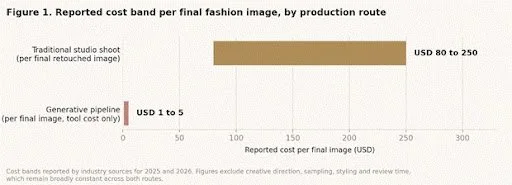
Figure 1. Cost bands reported across 2025 and 2026 production coverage. The generated figure covers tool cost only and excludes the direction, styling and review stages that persist in both routes.
Where the saving actually lands is in variation rather than origination. Producing the first strong image of a garment remains slow. Producing the next forty versions of it, sized for six placements and graded for three regional palettes, is where generated workflows compress weeks into days.
Where AI Has Entered the Fashion Content Stack
Generative tools have not arrived evenly. Adoption is deepest where output is repetitive and specification is tight, and shallowest where the work depends on cultural judgement or on a relationship with talent.
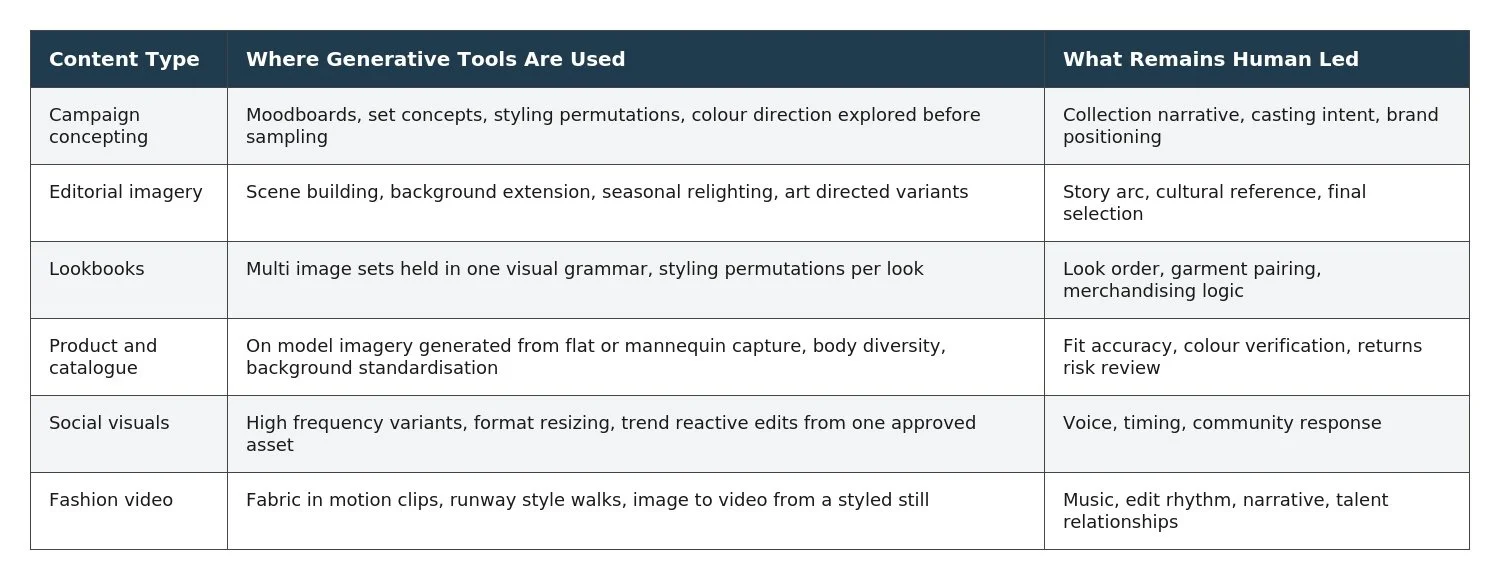
Table 1. Distribution of generative tooling across the fashion content stack, with the decisions that have stayed with people.
Campaign concepting
The earliest and least contested use sits before anything is photographed. Generated moodboards, set concepts and styling permutations let a creative team see a proposal rendered rather than described, which shortens the distance between a reference pull and an approved direction. Nothing produced at this stage is intended for publication, which removes most of the accuracy and disclosure pressure that applies later.
Editorial and lookbook imagery
Editorial work has proved the most divisive application. The 2026 Gucci hybrid campaign drew a split response, with some observers reading the ambition as a legitimate extension of a runway narrative and others judging the generated frames as short of the standard expected from a house at that level.
The variable that separates the two readings is intent. Generated imagery used as a medium, commissioned from an artist with a point of view, has been received very differently from generated imagery used as a substitute for a photographic budget.
Lookbooks sit in easier territory. A lookbook's core requirement is internal consistency, a set of frames that plainly belong to one shoot, and that is precisely the property reference driven generation delivers well.
Product and catalogue imagery
Catalogue photography is where volume, cost and repetition converge, and it carries the clearest operational case. Retailers have used generated on model imagery to show a garment on more bodies without booking additional casting, and to standardise backgrounds across a range assembled from many suppliers.
The constraint is unforgiving. The garment is the product, so print scale, trim placement, stitch detail and true colour must survive generation exactly. Any drift moves straight into return rates.
Social first visuals
Social output rewards volume and speed over polish. One styled still now yields a colour comparison, a styling tip, a trend edit and a vertical hook. The value of generation at this tier lies almost entirely in how many variants a single approved asset can support without another shoot.
Fashion video
Video has historically been the most expensive asset in the stack, which restricted motion to hero pieces. Generated video changes that arithmetic, and fashion has a specific reason to care: how a fabric moves is a substantial part of why a garment sells. The workflow that has settled in practice starts from a real or approved still and animates it, rather than generating clothing from text, because text to video offers no guarantee of garment accuracy.
What the First Wave of Brands Learned
Four patterns recur across the campaigns that were completed rather than abandoned.
1. Photograph the garment first. The most repeated pattern across successful work is that generation begins from real product photography rather than from a written description of the product. Mango's campaign was built on studio capture of every physical piece before any image was generated.
2. Keep the art department in the loop. Generated outputs were selected, retouched and finalised by the same teams that would have handled a conventional shoot, with design, art direction, styling, dataset management and the photography studio all still involved.
3. Label the origin. Brands that marked which frames were generated absorbed less criticism than those that left audiences to work it out, and labelling has since moved from reputational choice to regulatory requirement in several markets.
4. Treat representation as a directed decision. Generated imagery drifts toward a narrow physical norm unless body type, age and skin tone are specified deliberately, which places diversity in the brief rather than in the casting call.
The common thread is that the brief carried the work. Which leads directly to the part of the craft that has changed most.
The Prompt Has Become the Creative Brief
A prompt is not a search query. In production use it functions as a call sheet, a styling note, a lighting plan and a camera order compressed into one paragraph. Detailed prompts outperform short ones not because models reward length, but because every element left unspecified is supplied by a statistical default, and defaults in fashion are reliably generic: flat even light, symmetrical posing, over smoothed skin, and an unnamed satin that reads as neither silk nor polyester.
The ten layer prompt stack
A workable structure for fashion image prompts moves from the subject outward to the finish, then closes with an exclusion pass.
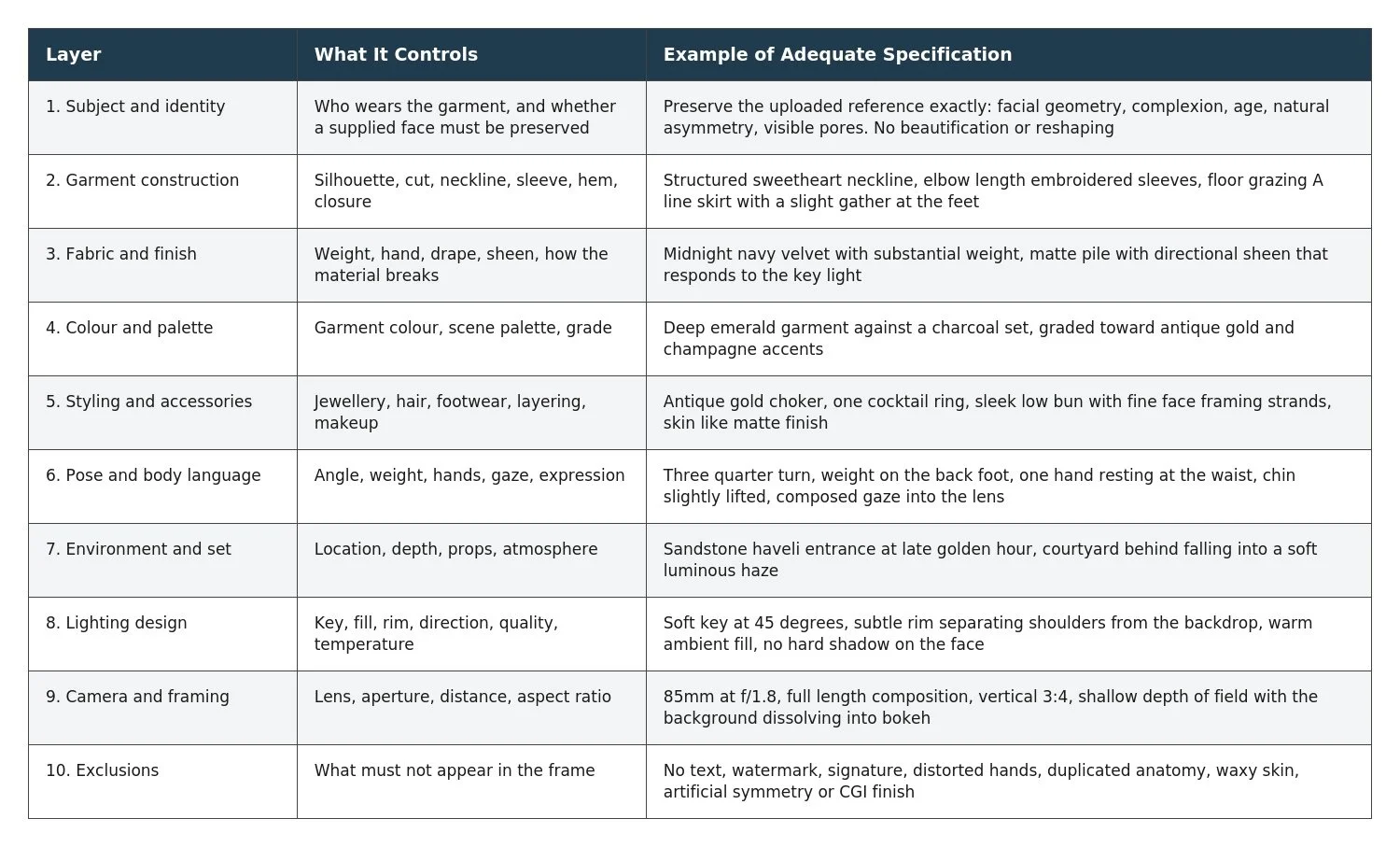
Table 2. The ten layer prompt stack. Layers one through nine describe the frame. Layer ten removes the failure modes that recur in garment led imagery.
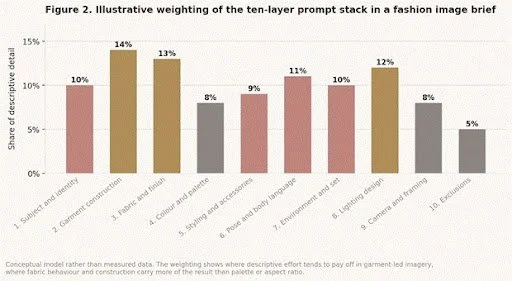
Figure 2. An illustrative weighting rather than measured data. In garment led work, construction and fabric behaviour carry more of the result than palette or aspect ratio, which is where descriptive effort earns most.
Fabric vocabulary carries more weight than colour
Colour is easy to specify and easy to render. Fabric is neither, and fabric is what separates an image that reads as clothing from one that reads as an illustration of clothing. Weight, hand, drape, sheen and the way a material breaks when it folds are the descriptors doing the work.
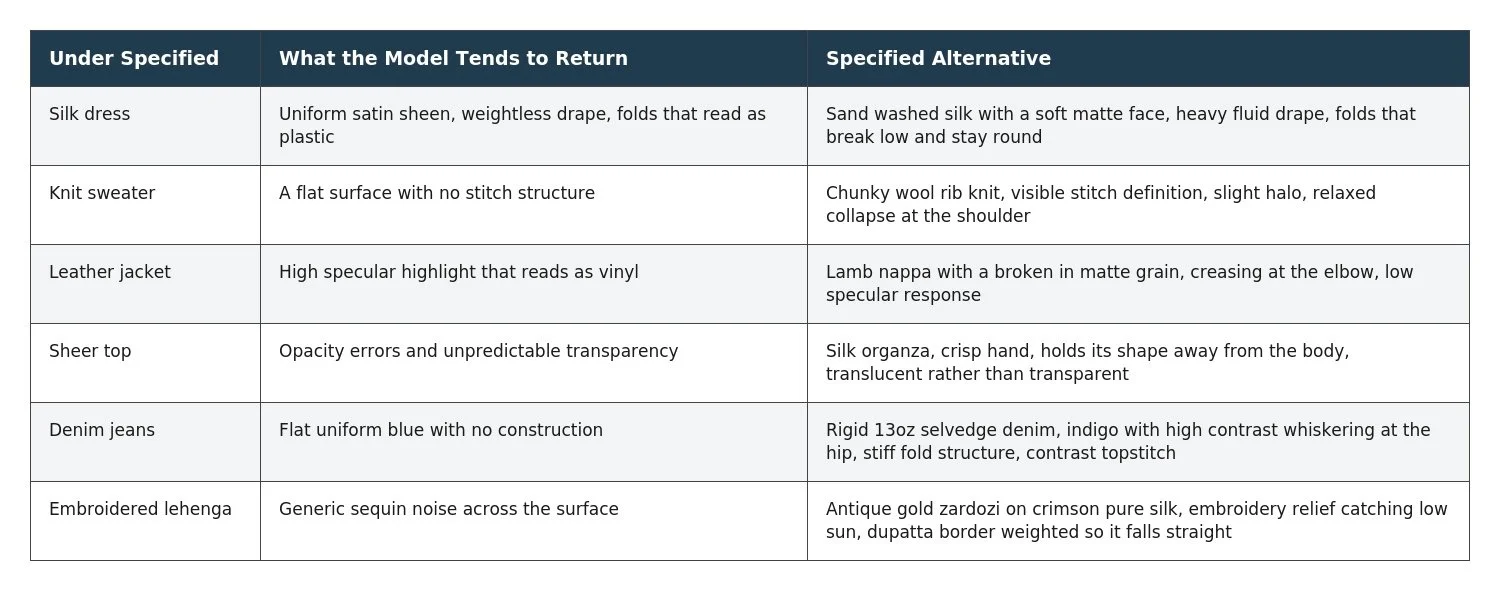
Table 3. The pattern in the right hand column is consistent: material named precisely, weight or construction stated, behaviour described rather than implied.
Light, pose and camera as written direction
Lighting instructions transfer from set language almost intact. Key direction, fill ratio, rim separation, colour temperature and quality all register, and time of day carries a full lighting setup in a few words, since late golden hour, overcast noon and blue hour each imply a different scheme.
Pose instructions work best as body mechanics rather than adjectives. Confident is weak direction. Weight on the back foot, torso at three quarters, one hand on the balustrade, chin slightly lifted, gaze into the lens is direction a model could be posed into and a generator can render.
Camera language remains the most underused layer. A focal length and an aperture set the relationship between subject and background far more reliably than a request for a blurred backdrop, and stating aspect ratio at the outset prevents the crop that destroys a full length composition.
The exclusion pass
Closing a brief with what must not appear is the cheapest available quality improvement. Common exclusions in fashion work cover typography and watermarks, identity drift when a reference face has been supplied, duplicated or distorted anatomy, over smoothed skin, artificial symmetry, and any finish that reads as rendering rather than photography. Exclusions do not remove the need for review, but they measurably reduce how many generations are discarded before a usable frame appears.
Reading prompts before writing them
Prompt construction is learned faster by reading working examples than by reading rules. Prompt Seen publishes copy ready image and video prompts arranged into style collections, and the fashion and portrait entries repay study for their structure rather than their aesthetic.
The stronger examples handle identity first, describe garment construction and fabric before the set, give pose as mechanics, specify lighting by direction and quality, state the camera as a lens and an aperture, and close with an exclusion list. Reading a dozen briefs built that way makes the omissions in a short prompt obvious.
Prompting for Motion: Time Becomes a Variable
Video prompts inherit every layer of the image stack and add four more: what moves, how the fabric behaves, where the camera goes, and how long the shot runs. Continuity is the constraint that catches teams first, because a lookbook of twelve clips is only usable if the same model, styling and set light hold across all twelve.
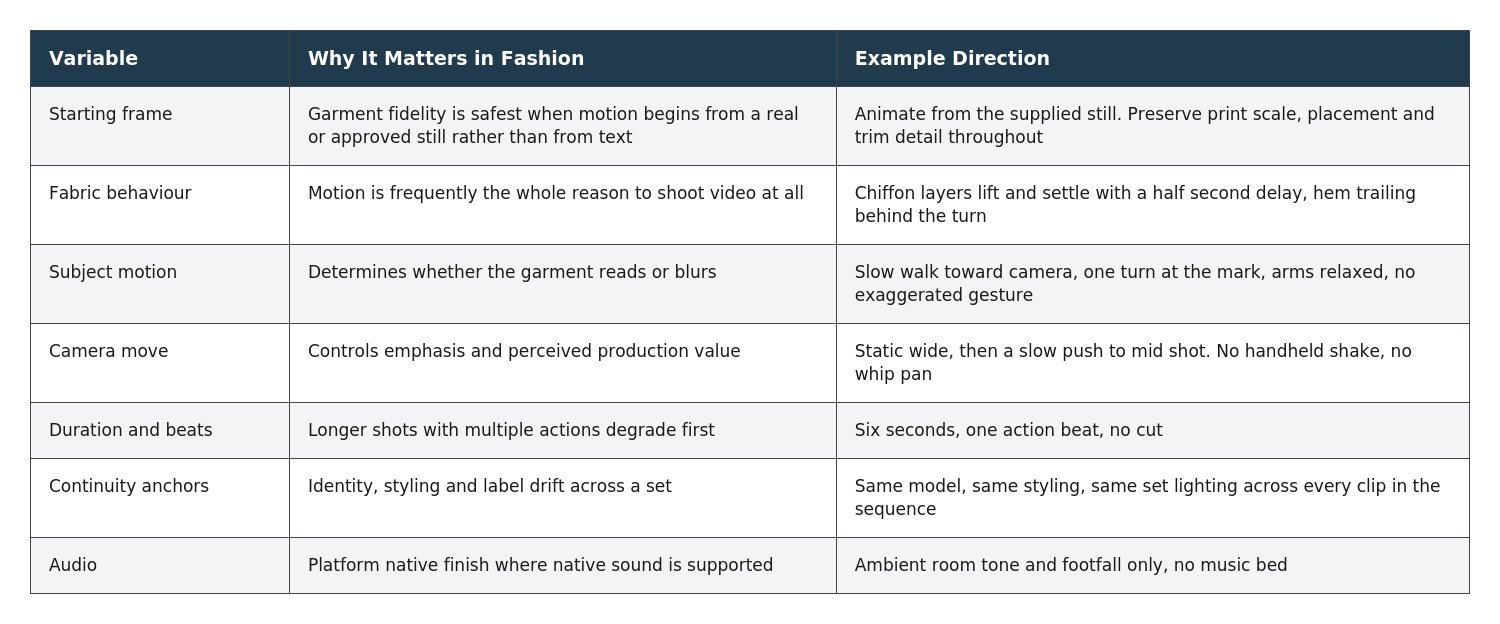
Table 4. Video specific variables that sit on top of the ten layer image stack.
Model families differ sharply on these points. Some hold garment detail through close ups but weaken on complex camera moves. Others produce fluid motion and convincing scene light while drifting on labels and prints.
Some generate synchronised audio and some do not. Testing on the actual garments matters more than any leaderboard position, because a model that renders wool and denim convincingly may still fail on sequins, chiffon or fine repeating print.
Tool Choice Is a Style Decision, Not Only a Technical One
Every generator carries a visual default. One renders skin with a polished commercial finish, another leans cinematic and contrasty, a third handles fabric texture unusually well and faces unremarkably.
Those tendencies persist through prompting, which means tool selection sets the house style of the output before a single word of the brief is written. A label built on a soft documentary aesthetic and a label built on high gloss studio work should not expect the same tool to serve both.
Version churn compounds the problem. Model families are replaced, deprecated or repriced on a timescale shorter than a fashion season, and a workflow anchored to one product can be stranded mid campaign. Capability categories are the safer unit of planning: garment fidelity, identity consistency, directorial control and licensing terms outlive any particular release.
The five gate tool test
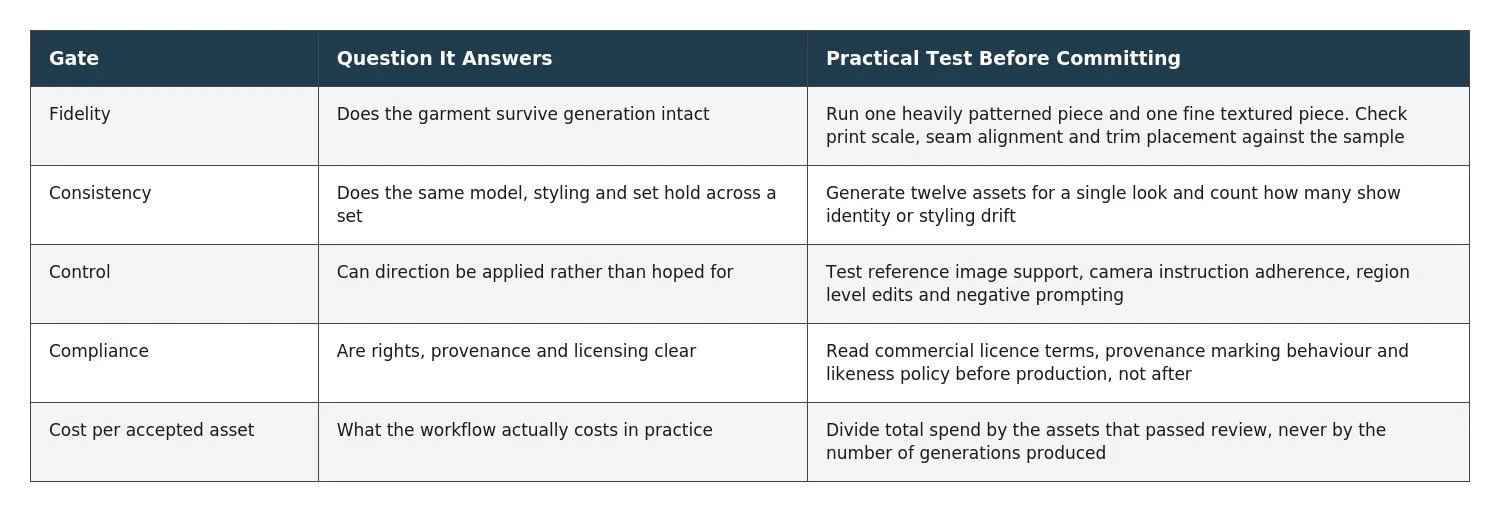
Table 5. Five gates that separate a tool that demonstrates well from a tool that survives a production calendar.
Independent review coverage shortens the shortlist before hands on testing begins. Websites like goodfirms.co, firmcritics.com and G2.com publish tool by tool reviews across image generator and video generator categories, covering pricing, feature limits, watermark and credit restrictions and comparisons against alternatives, which is the information least likely to appear on a vendor's own page. Reviews narrow the field. Only testing against the actual product range settles it, since a tool that excels on tailoring can still fail on knitwear.
Where Output Still Breaks
Six failure modes account for most discarded fashion generations, and all six are predictable enough to plan around.
• Prints and repeats. Pattern scale drifts, motifs distort across seams and directional prints reverse.
• Hands and fine hardware. Fastenings, buckles, zip pulls and jewellery joins remain the most common giveaway.
• Text. Labels, logos, care tags and any typography in frame stay unreliable.
• Identity drift across a set. Faces shift subtly between frames, which is invisible in one image and obvious in a grid of twelve.
• Fabric misreads. Chiffon behaving with the weight of cotton, sequins rendering as noise, knitwear losing stitch structure.
• Anatomy under motion. Fast movement and complex poses degrade before anything else in video.
None of these argue against the technology. They argue for review stages inside the workflow, and for keeping the highest risk pieces, heavily patterned garments, technical outerwear and anything carrying visible branding, on conventional capture.
Disclosure, Provenance and Consumer Trust
The regulatory position changed considerably through 2026, and it changed in one direction. Disclosure has moved from reputational preference to legal obligation across several of the markets fashion sells into.
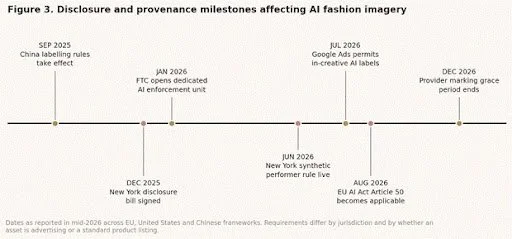
Figure 3. Disclosure and provenance milestones as reported in mid 2026. Obligations differ by jurisdiction and by whether an asset is advertising or a standard product listing.
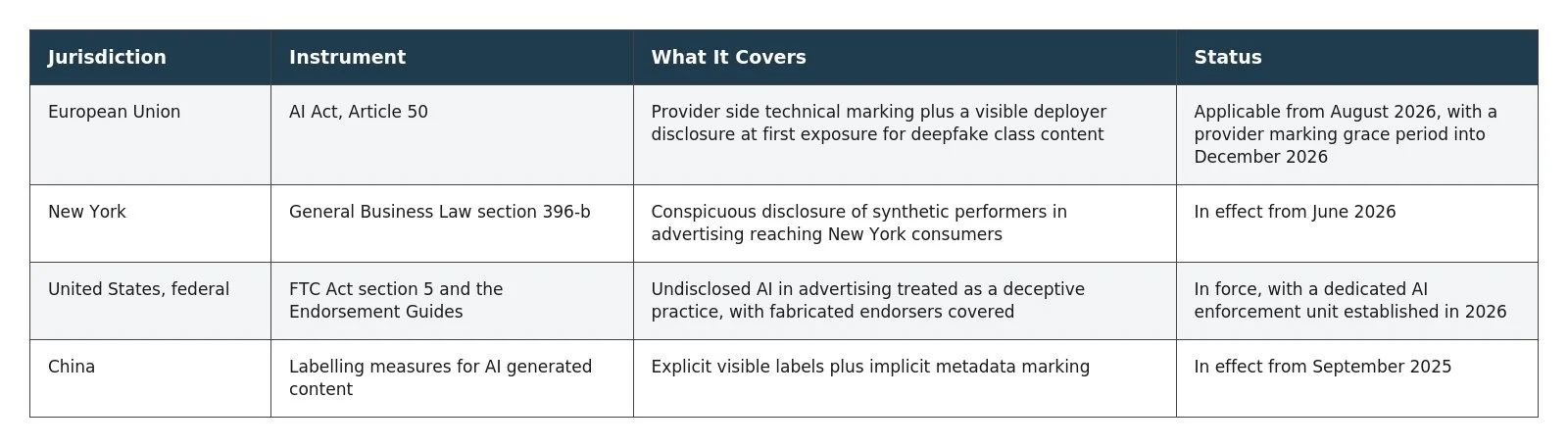
Table 6. A summary of the principal disclosure frameworks affecting fashion imagery. Requirements evolve, and specific campaigns warrant specific legal advice.
Two duties are worth separating, since they are frequently confused. Provider side marking is technical: machine readable provenance travelling with the file. Deployer side disclosure is human facing: a visible label at first exposure, which cannot be satisfied by metadata alone or buried in terms and conditions. A photorealistic synthetic model published to an EU audience is likely to require both.
Consumer research points the same way. A 2026 survey of 502 United States consumers found that 85 percent could not reliably separate AI generated images from photographs, while 75 percent held that AI imagery should be disclosed regardless. The gap between those two figures is the commercial argument for labelling. Audiences largely cannot detect synthetic imagery, and still want to be told.
A separate exposure sits alongside disclosure. A label does not cure a likeness problem. A generated face resembling a real, identifiable person can create a rights claim however clearly the frame is marked as synthetic, and several jurisdictions extended personality rights to synthetic likenesses during 2026.
How Fashion Roles Are Shifting
The roles least affected are the ones that were never about operating a camera. Creative direction, casting intent, styling judgement, colour approval and edit selection remain human decisions, and generated workflows increase rather than reduce the number of decisions requiring them, because volume expands faster than judgement can be automated.
The roles changing most are production adjacent. Retouching shifts toward selection and correction. Studio time concentrates on hero capture and garment reference rather than on volume. A new function has appeared in several teams, sitting between art direction and production and responsible for prompt libraries, reference sets, model selection and consistency across a season. In practice it resembles a digital imaging technician's role more than a copywriter's.
Stylists and designers have gained an unexpected advantage. The vocabulary that makes a strong prompt, fabric behaviour, construction, silhouette, proportion, drape, is stylist and designer vocabulary. Teams routing prompt writing through people who already describe clothes for a living tend to produce better first drafts than teams routing it through marketing.
A Working Production Sequence
The sequence below reflects the pattern common to the campaigns that reached publication rather than the ones abandoned at review.
5. Photograph the garment properly. Flat, mannequin or on model capture in controlled light, covering print scale, trims, texture and true colour under a known light source.
6. Fix the reference set once. Model identity, set language and lighting agreed at the start of a season and reused, so a campaign holds together across months of output.
7. Write the brief in layers. The ten layer stack, with the exclusion pass appended and the aspect ratio stated before generation rather than fixed by cropping afterwards.
8. Generate in small batches. Twelve variants against one precise brief reveal more than a hundred against a loose one, and the failures are diagnostic.
9. Review against the physical sample. Colour, print scale and construction checked against the garment itself, not against the brief that produced the image.
10. Correct rather than regenerate. Region level edits preserve what already worked. Full regeneration resets every variable, including the ones that were correct.
11. Label and record provenance. Disclosure applied at publication in the form each market requires, with generation records retained per asset for audit.
What the Next Two Seasons Suggest
Three directions look reasonably firm. The first is that hybrid production becomes standard rather than notable: real garment capture combined with generated environments, extensions and variants, with fully synthetic campaigns remaining a deliberate creative statement rather than a default setting.
The second is that consistency tooling matters more than headline image quality, because fashion needs sets of images that agree with one another far more than it needs single impressive frames. The third is that disclosure becomes a design problem, since a label applied at first exposure has to live inside the creative without reading as a warning sticker.
The craft question underneath all of it has not moved. A generated image is only as considered as the direction behind it, and fashion has spent a century refining a language for describing clothes on bodies in light. That language transfers almost without loss. The tools reward the people who already speak it.
HOW DO YOU FEEL ABOUT FASHION?
COMMENT OR TAKE OUR PAGE READER SURVEY
Featured



Jackets have always been an important part of fashion.