
How Do Height Growth Gummies Work?

PAGE
By PAGE Editor
Height growth supplements work by supplying nutrients tied to bone formation, protein synthesis, and mineralization — not by triggering extra growth on their own. Whether that matters depends on age, genetics, current nutrition, and one hard biological fact: whether the growth plates are still open. A supplement can help close a nutritional gap. It can't rewrite a genetic blueprint or make a skeletally mature adult taller.
That gap is exactly why the supplement aisle looks the way it does — calcium, vitamin D, zinc, protein, collagen, stacked into one bottle and marketed at parents who want their kid to hit every inch of their potential, and at adults who never quite got there. None of those ingredients are mysterious. What's less obvious is what they're actually doing once swallowed, and where the line sits between "supports normal development" and "adds height that wasn't coming anyway."
How Does the Human Body Grow Taller?
Height increases through longitudinal bone growth — long bones like the femur and tibia getting longer, not denser or wider. That process happens at the growth plates near each end of the bone, and it's the whole story of how a person gets taller during childhood and puberty.
Inside each growth plate sits a layer of cartilage packed with chondrocytes, cells that multiply and organize themselves into columns. As new chondrocytes form on one side, older ones on the other side calcify and convert to bone — a process called ossification. The bone effectively grows length by pushing itself apart from the inside, one thin layer at a time. It's less "stretching" and more "manufacturing," which is part of why the process needs a steady supply of raw material to keep running.
Genetics, Hormones, and Nutrition
Genetics sets the boundaries, and nothing eaten, injected, or supplemented moves those boundaries. What genetics doesn't guarantee is that a person actually reaches the top of their own range — that part depends on growth hormone and IGF-1 signaling, thyroid function, and whether nutrient intake keeps pace with a growing skeleton.
Genetics doesn't work in isolation from environment, either — genetics and height turn out to be a looser relationship than most people assume, which is part of why two siblings with the same parents can land at noticeably different heights. Think of genetic potential as a ceiling and nutrition as the ladder. A tall ceiling with a broken ladder still gets you a shorter adult than the genes allowed for. Malnutrition, chronic illness, and poor sleep during key developmental windows can all shave real height off that ceiling — which is exactly the gap supplements are positioned to close, and only that gap.
What Are Height Growth Supplements?
Height growth supplements are combinations of vitamins, minerals, amino acids, and protein-related ingredients sold to support bone health and normal development — not medications. That distinction matters more in the U.S. than almost anywhere else, because dietary supplements and FDA-approved drugs sit in entirely different regulatory categories.
A drug has to prove it treats a specific condition before it reaches a pharmacy shelf. A supplement doesn't carry that burden — it's regulated more like food, expected to be safe and accurately labeled, but not required to prove it does what the marketing implies. That's not automatically a red flag. It just means the label on a supplement facts panel deserves more scrutiny than the label on a prescription bottle.

How Do Height Growth Supplements Work in the Body?
Nutrients from a supplement follow the same path as nutrients from food: intake, digestion, absorption into the bloodstream, then use in whatever tissue needs them — bone, muscle, connective tissue. That's the entire mechanism, and it's worth sitting with, because it explains both what supplements can do and where they stop being useful.
A supplement doesn't have a "grow taller" switch. What it has is calcium that might end up in bone matrix, or protein that might end up as muscle and connective tissue, provided the body was short on those inputs to begin with. Someone already eating enough of everything gets very little marginal benefit from adding more. Someone running a genuine deficiency gets a real one.
Supporting Bone Formation and Mineralization
Calcium, vitamin D, phosphorus, and magnesium participate directly in building and maintaining bone tissue, and the evidence for that role is solid. The evidence for those same nutrients adding extra final height, in someone who wasn't deficient, is much thinner — mineralization keeps bone strong and dense, but it isn't the same mechanism as the longitudinal growth happening at the plates.
That's a distinction most product pages skip. Stronger bones and taller bones aren't automatically the same outcome, and conflating them is where a lot of supplement marketing overreaches.
Supporting Protein and Tissue Development
Adequate protein and amino acid intake matters during any period of rapid physical development, since bone, muscle, and connective tissue are all built from it. Collagen supplements fit here too — supplying amino acids that support tissue formation, not acting as a separate growth signal.
None of that replaces food. A supplement is a complement to dairy, eggs, fish, lean meat, beans, and fortified foods already common in U.S. diets — not a substitute for a teenager who skips meals and expects a bottle to make up the difference.
Which Ingredients Are Common in Height Growth Supplements?
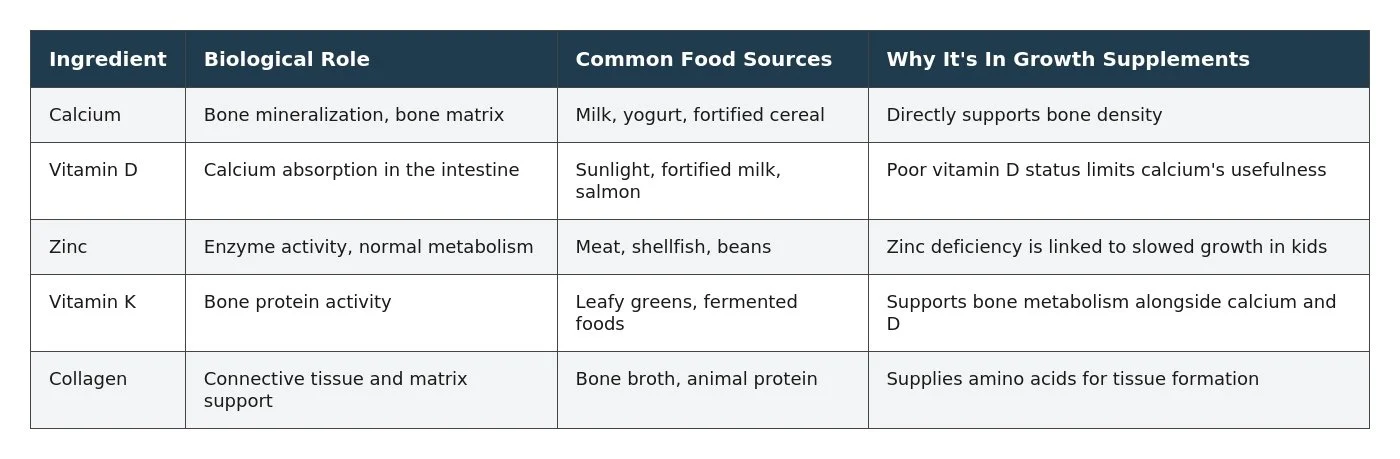
None of these ingredients works in isolation, and none of them independently "adds inches." They're inputs to a system that already knows how to build bone — supplements just make sure the system isn't running short.
Calcium and Vitamin D
Calcium and vitamin D work as a pair, not independently — vitamin D governs how much calcium the intestine actually absorbs, so low vitamin D status can leave someone calcium-deficient even on a calcium-rich diet. That's the more common real-world problem in the U.S., where sun exposure and dietary vitamin D both run low for a lot of people, especially in winter months.
Zinc, Magnesium, and Vitamin K
Zinc, magnesium, and vitamin K support enzyme activity and bone metabolism broadly, and deficiency in any of them can slow normal development in children specifically. They're supporting cast, not headline nutrients — useful to correct if low, unlikely to do much if intake was already adequate.
Do Height Growth Supplements Actually Make You Taller?
Supplements don't reliably add height to someone who's already well-nourished — their real value is correcting a deficiency that was quietly limiting normal growth. Three separate questions get collapsed into one here, and untangling them is the whole point of this section.
Can nutrients support normal growth? Yes — that's basic physiology. Can correcting a deficiency help a malnourished child grow closer to their genetic potential? Also yes, and that's well documented. Can an adequately nourished person exceed their genetically influenced adult height by taking a supplement? No — there's no mechanism for that, and no credible evidence supporting it.
Why Results Can Differ From Person to Person
Age, puberty timing, baseline nutrition, sleep, and physical activity all shift how much room a supplement has to help. A 12-year-old with a marginal diet and years of growth left has far more to gain than a 22-year-old who finished puberty a half-decade ago — same bottle, completely different ceiling.
Can Height Supplements Work After Growth Plates Close?
Once the growth plates fuse, dietary supplements can't restart longitudinal bone growth — that door closes with skeletal maturity, and no ingredient combination reopens it. This is the single clearest limit in the entire category, and it's the one most red-flag marketing tries to blur.
What a supplement can still do for an adult is support bone density and posture-related comfort — genuinely useful, just not the same thing as gaining height.
At What Age Do Growth Plates Close?
Growth plate closure follows pubertal development more than a fixed birthday, which is why there's no single universal age. It typically wraps up in the late teens for most people, tends to finish earlier in females than males, and a bone age assessment — not a calendar — is the only way to know for sure whether someone's plates have fused.
Height Supplements vs. Diet, Sleep, and Exercise
Supplements sit inside a bigger system — diet, sleep, and exercise all move the needle more than any single bottle, because they address the underlying biology directly rather than patching one nutrient at a time.
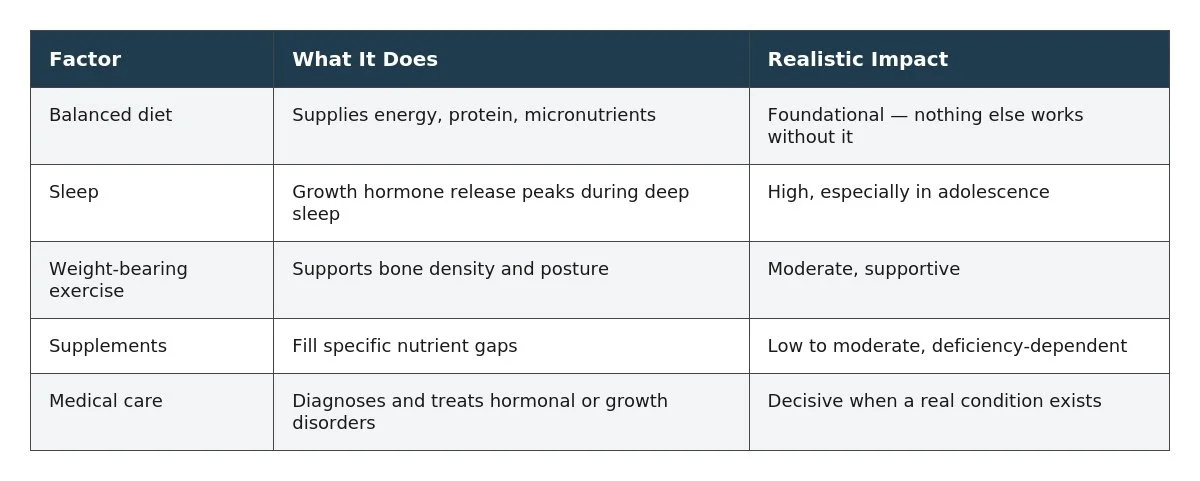
Fortified milk, yogurt, eggs, salmon, lean meats, beans, and fortified cereals cover most of what a growing teenager needs. A supplement earns its place when one of those categories is consistently missing, not as a blanket addition on top of an already solid diet.
How NuBest Nutrition Fits Into a Height-Support Routine
NuBest Nutrition positions its products as nutritional support for a broader growth-and-wellness routine, built around the same categories covered above — calcium, vitamin D, zinc, protein, and related nutrients. That framing matters: it's support alongside meals, sleep, and activity, not a replacement for any of them.
The useful move for a shopper is checking the specific product's label rather than the brand's marketing copy — serving size, ingredient amounts, and the age range it's formulated for all vary between products even within the same line.
What to Check Before Choosing a NuBest Nutrition Product
Start with the intended age range and the Supplement Facts panel, then check ingredient doses against what's already coming from food, plus allergens and directions for use. If a household is already using another multivitamin, cross-checking overlap matters more than most shoppers realize — doubling up on fat-soluble vitamins in particular isn't harmless.
A quick conversation with a pediatrician or healthcare professional is worth it before adding any supplement to a child's or teenager's routine, especially when multiple products are involved.
Are Height Growth Supplements Safe?
Safety depends on ingredients, dosage, age, and what else someone is already taking — not on the supplement category as a whole. More vitamins isn't automatically better; several nutrients common in these formulas have a tolerable upper intake level, and exceeding it repeatedly causes its own problems rather than extra growth.
Dietary supplements in the U.S. aren't FDA-approved the way medications are, which puts more responsibility on the buyer to read labels carefully. For children and teenagers specifically, checking with a pediatrician before starting a new supplement is the safer default, not an optional extra step.
How to Choose a Height Growth Supplement in the United States
Look for a transparent Supplement Facts label with specific ingredient amounts, clear age suitability, third-party testing information, and a price per serving that's easy to calculate — vague "proprietary blends" hide exactly the information a buyer needs. Realistic marketing language is itself a quality signal; a brand that talks about nutritional support reads as more credible than one promising a fixed number of inches.
Red Flags to Avoid
Guaranteed height increases, precise inch-based promises, and claims that a product can reopen fused growth plates are the clearest signs of a product overselling what supplements can do. Add unclear ingredient quantities and any suggestion that a supplement replaces medical evaluation, and that's most of the list — the FTC treats those exact claims as deceptive advertising for a reason.
The honest version of this category is narrower than the marketing suggests, and that's fine. A supplement that closes a real nutritional gap during a genuine growth window is doing real work. One promising more than that is selling a bottle, not biology.
HOW DO YOU FEEL ABOUT FASHION?
COMMENT OR TAKE OUR PAGE READER SURVEY
Featured





Preparing a home for overnight guests creates different priorities from ordinary weekly upkeep.