
How Men Can Dress Better When Returning to Dating After 40

PAGE
By PAGE Editor
A man who has been out of dating for fifteen years rarely needs a new wardrobe. He needs a tailor, one free afternoon, and about $200. Most of what hangs in his closet still works. It stopped fitting somewhere around year eight of the marriage, and nobody said anything at the time.
In one study of male attire, participants saw a photograph of a man for three seconds with his face blanked out. He was rated as more confident and a higher earner when the suit had been cut to him, compared with the same man in a wider off-the-rack version. The face was hidden, so the entire judgment came from the seams.
Those judgments form in well under a second and settle before anyone speaks. Men over 40 are walking into a market with plenty of room in it, since 42% of men in that age group say they are open to dating and 29% of adults between 40 and 54 are unpartnered. Clothing buys the first few seconds of attention and nothing beyond them.
Fit Before Anything Else
Three measurements matter more than the rest. The shoulder seam should end where the shoulder ends. The jacket should cover the seat of the trousers. The trouser hem should meet the top of the shoe with a small break or none.
Alterations cost less than most men assume. Hemming trousers costs $15 to $30, and a waist adjustment costs $20 to $40. A two-piece suit taken in properly, covering hem, jacket waist, and sleeve length, generally comes to between $80 and $200. Shoulder work is the exception, since it can cost $800 and is rarely worth paying on a garment that was inexpensive to begin with.
Shirts follow the same logic and get ignored more often. A collar should admit one finger and no more. The cuff should end at the base of the thumb, and the body should skim the torso without pulling at the buttons when a man sits down. Most men over 40 are wearing a shirt one full size too large, usually the size they bought in their thirties and never revisited. A tailor can take in the side seams of an existing shirt for $25.
A $150 jacket that has been altered will look better than a $900 jacket that has not. Plenty of expensive coats hang off the collarbone and get worn anyway, which is the most common way men in this age group waste money on clothing.
Dressing for the Present Decade
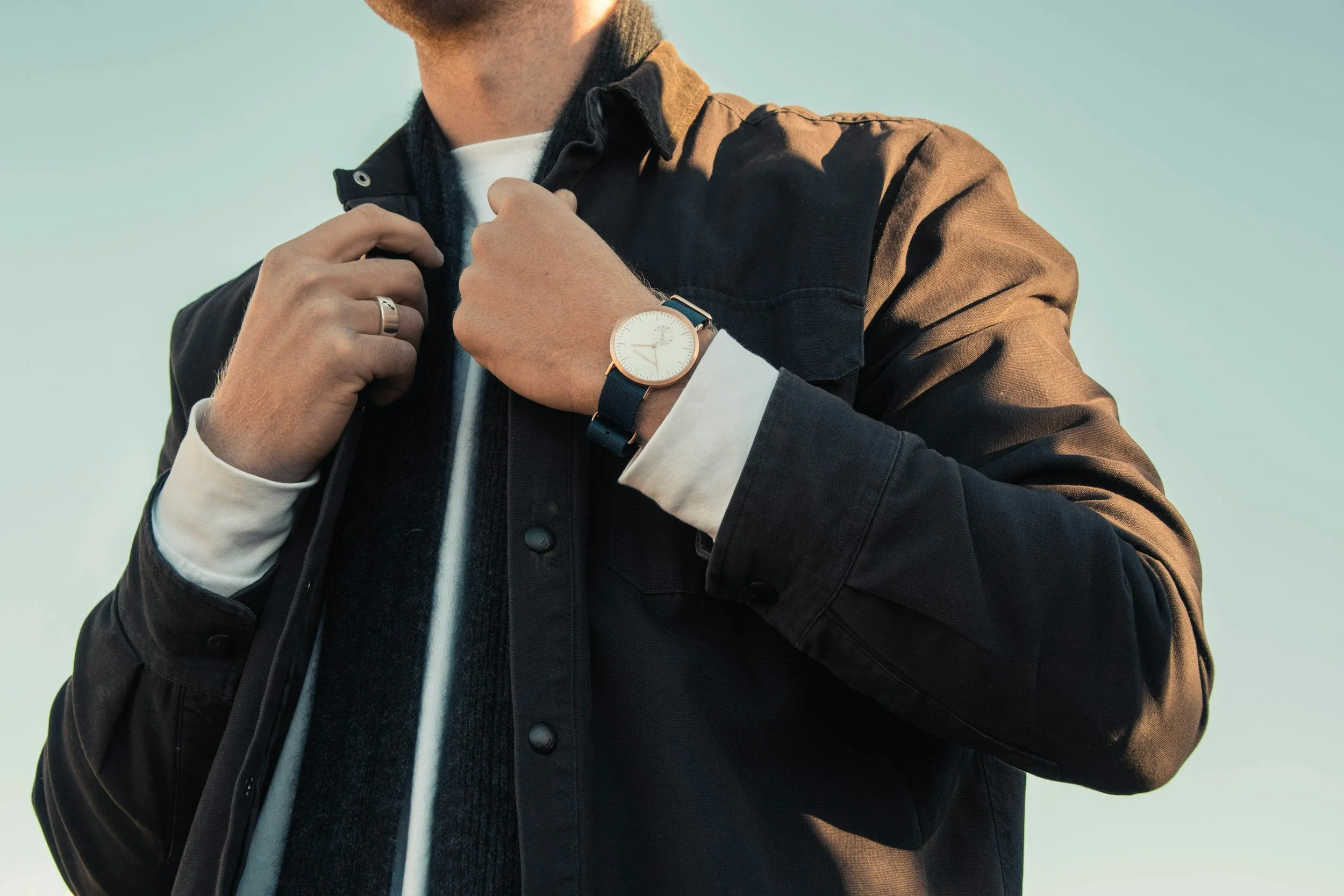
A man reaches for what worked at 28 because that was the last period when he was choosing clothes with a date in mind. The going-out shirt with contrast stitching comes back out. So do the boxy tees and the distressed denim.
His body has changed since then, and so has the room he is walking into. Dark denim with no distressing, a merino crew neck instead of the going-out shirt, a plain oxford in white or pale blue. None of this is fashion, and none of it will look dated in two years. It also will not look like an attempt to appear younger, which is the specific failure that older men get judged for hardest.
Color follows the same restraint. Navy, charcoal, olive, stone, and white cover almost every occasion and forgive almost every pairing. A man who wants one item with personality in it should put that item on top, where it can be removed, and keep the rest quiet underneath. A jacket in a soft check works over plain trousers. Two patterned pieces at once is one too many. Clothing also changes the person inside it, an effect psychologists call enclothed cognition, and a man who knows his trousers fit sits differently at the table.
The Limits of Dressing for Attention
Some men return to dating and reach for the loudest item in the closet. A patterned jacket, an oversized watch, a hat with no reason to be indoors. The tactic has a name, peacocking, and it borrows from a pickup-culture belief that a loud outfit starts conversations. Some conversations do start that way.
The trouble comes later in the evening, when the outfit has set an expectation the man then has to meet. Clothes chosen from a man's own taste hold up across three hours of talk. Costume pieces become something he has to keep explaining.
Shoe Condition and Upkeep
Shoes are the item men neglect most and the item people look at without deciding to. A worn heel or a sole that has gone smooth undoes everything happening above the ankle, because it suggests the whole outfit was assembled without a second look.
Two pairs in good repair are worth more than five pairs in poor repair. A brown leather derby or loafer covers nearly every situation a man over 40 walks into. Cleaning leather takes ten minutes at a kitchen table, and resoling costs a fraction of replacement while buying years of wear. Cedar shoe trees are cheap and prevent the collapse across the toe box that makes footwear look tired long before it wears out.
Grooming and Scent
Grooming has stopped being optional in this age bracket, and the market shows it. Men's skincare accounted for $19.1 billion in global spending in 2025, and fragrance for $13.2 billion. Some 73% of men worldwide now wear scent daily, with woody and musky profiles preferred by 44% of them.
The application is where men over 40 go wrong. Two sprays, applied to the chest rather than the neck, is the correct dose for a dinner across a small table. Six is the dose picked by a man who has stopped noticing his own cologne, a state of nose blindness that sets in within minutes of putting it on. Haircuts every four weeks rather than every eight, attention to the neckline between cuts, and a basic moisturizer will do more for how a man looks at 45 than any garment he could buy.
A Rotation Small Enough to Manage
Most men do better with a short list than a full closet, which is the thinking behind a capsule wardrobe. Two pairs of trousers in navy and stone, three shirts, one unstructured jacket, and two pairs of leather shoes will cover a first drink, a dinner, a walk through a city, and a Sunday afternoon with somebody's friends.
Buying in small numbers also makes tailoring affordable, since altering five garments costs less than altering twenty. The men who handle this well tend to own fewer clothes than they did at 30 and wear each item more often. That repetition is invisible to a new person and useful to the man wearing it, because decision fatigue is worst at seven in the evening. That is the hour he would otherwise spend standing in front of a closet, making a choice badly.
A Working Definition of Dressing Well After 40
Dressing well in this decade is narrow and mechanical. Clothes fit at the shoulder and at the hem. Shoes are clean, resoled, and in a color that goes with the rest. Cuts and colors belong to the man wearing them and to the decade he is currently in.
All of it can be settled in one afternoon with a tailor and a shoe brush, plus a bag for everything in the closet that no longer applies.
HOW DO YOU FEEL ABOUT FASHION?
COMMENT OR TAKE OUR PAGE READER SURVEY
Featured


Black Friday can make purchasing an electric bike more affordable, but the real value begins after the purchase.