
How to Refresh Tired Window Frames Without Full Replacement
PAGE
By PAGE Editor
Those chalky, faded frames staring back at you from the street are costing you more than you think. Not just in curb appeal — though buyers absolutely notice — but in money spent on a full replacement you might not actually need. Here's the thing most contractors won't lead with: replacing the glass unit and the frame are two completely different decisions, and confusing them is the single most expensive mistake homeowners make during a window project.
If your frames are structurally solid but just look beat up, you have real options. Good ones. This guide walks through five approaches to refreshing window frames without gutting your budget — or your walls.
Why the Frame Matters More Than You Realize
The frame is doing more work than most people credit it for. It holds the seal between the glass unit and the wall, manages moisture transfer, and shapes the entire exterior silhouette of your home. When frames fail thermally, your energy bill climbs fast. Heat gain and loss through windows is responsible for 25 to 30 percent of residential heating and cooling energy use , according to the U.S. Department of Energy. A frame that fits poorly or has degraded seals contributes directly to that loss.
So the question isn't whether the frame matters — it's whether yours needs to be replaced outright or just refreshed. Often, it's the second one.
The Frame Refresh Decision Matrix
Before picking an approach, diagnose what you actually have. Here's a quick framework — I'd call it the Frame Refresh Decision Matrix — that cuts through the guesswork:
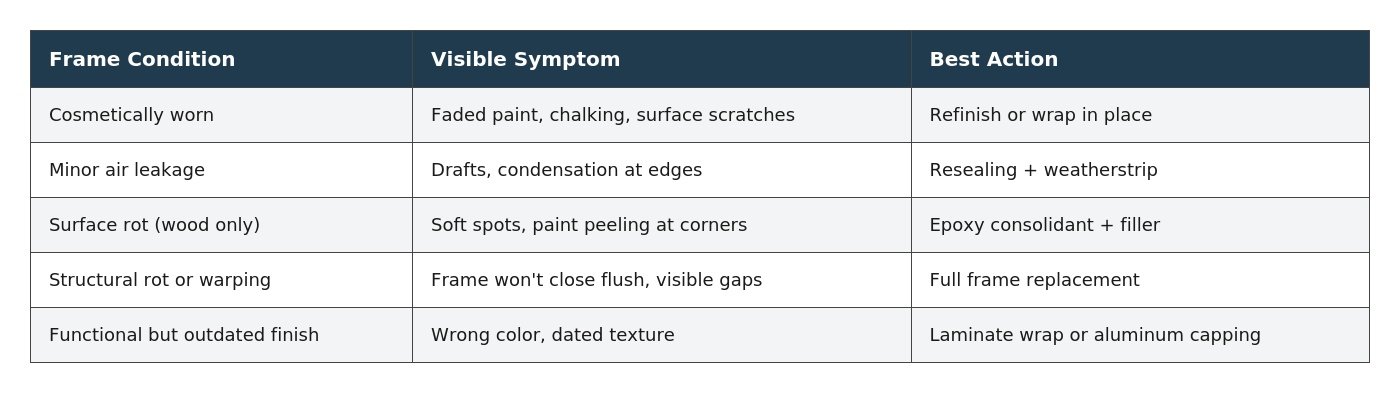
This matrix won't replace an in-person inspection, but it points you toward the right conversation before anyone picks up a saw.
Five Approaches That Actually Work
1. Exterior Repainting With Proper Prep
Painting is the obvious first answer, and it's also the most abused one. A coat of exterior paint slapped over a dirty, unprimed frame will peel within a season. Done right — surface cleaning, light sanding, a bonding primer, and a quality acrylic topcoat — it buys you five to ten years on a frame that was just cosmetically tired. Your budget here is materials plus a weekend, or around $150 to $400 for a contractor touching up a standard six-window home. Not glamorous, but genuinely effective when the frame is structurally fine.
2. Epoxy Repair for Wood Frames With Surface Rot
If you push on a corner of your wood frame and it gives slightly, that's surface rot — and it's fixable without replacement. A two-part epoxy consolidant soaks into the damaged fibers and hardens them. Then you fill the void with epoxy wood filler, sand, and paint. The repair bonds better than the original wood in most cases and doesn't rot. I'd pick this over any contractor who immediately jumps to replacement on a structurally sound frame with a soft corner. That's a $40 fix being sold as a $1,200 one.
3. Weatherstripping and Resealing
Drafts around your windows? Nine times out of ten that's a weatherstrip problem, not a frame problem. Foam, vinyl V-strip, and door-sweep-style pile weatherstripping each suit different gap shapes. While you're at it, run a bead of paintable silicone caulk along every joint between the frame and the wall. This is a Saturday morning job that costs under $50 and directly addresses the energy loss issue. Start here before you consider anything more involved.
4. Aluminum Capping
Aluminum capping — also called aluminum cladding or coil wrapping — involves bending thin aluminum sheet stock around your existing exterior trim and frame faces. It's been a go-to for contractors for decades because it locks out moisture, never rots, and kills exterior maintenance. The trade-off is that it's a rigid, site-formed product, which means sharp corner details and complex profiles can look a little rough. For simple flat casings on a builder-grade colonial, it works beautifully. For anything with ornate detail, you need a more precise finish.
5. Profile Wrapping for Architectural Trim and Frames
This is the approach most homeowners haven't heard of, and it's the one I find most interesting for projects where the aesthetics actually matter. Profile wrapping runs extruded or milled profiles through a precision laminating process, bonding a durable decorative film — wood grain, solid color, textured finishes — directly to the substrate shape. The result is a finished component that ships ready to install, with consistent color and crisp detail across every linear foot.
Picture a 1980s colonial in Connecticut — white painted aluminum window frames that have oxidized to a chalky gray, mismatched by two decades of spot repaints. The homeowner wants a dark bronze wood-grain look to match a new front door, but the frames themselves are perfectly functional aluminum extrusions. Full replacement would mean new sash, new jambs, new installation, and a project north of $15,000. Instead, the manufacturer pulls those same profiles through an Aluminum Profile Wrapping process that bonds a rich, stable wood-grain laminate to the aluminum substrate with heat and pressure. The frames come back looking deliberate, sharp, and consistent — at a fraction of the replacement cost.
For a homeowner managing a renovation budget, that's a decision that changes the math on the whole project.
What the ROI Data Actually Says About Exterior Upgrades
If you're refreshing frames before a sale, the numbers are on your side. According to Zonda's annual Cost vs. Value report, exterior improvements yield the greatest return on investment of any renovation category, with eight of the top ten highest-ROI projects being exterior work , as reported by BAM in 2024. Windows are part of that exterior equation. According to 2024 national estimates by the Journal of Light Construction cited in Consumer Reports, 67 percent of a vinyl window replacement job is recouped in the selling price of a home — which is a solid benchmark, but a refresh that costs a quarter of the replacement price and delivers nearly the same visual result beats that math every time.
The point isn't to cheap out. It's to match the intervention to the actual problem. Buyers react to what they can see. A frame that looks fresh and well-maintained reads as a frame that works, even when the underlying glass unit is ten years old.
How to Choose the Right Approach for Your Home
Work through this sequence before committing to anything:
Probe every frame corner with a screwdriver. If it penetrates more than 1/4 inch, you have structural rot and should price replacement.
Run your hand along the interior perimeter on a cold or windy day. Detectable airflow means resealing first, always.
Stand at the street and assess the color and finish condition. Is this a cosmetic problem or a structural one? Be honest.
If the frame shape has detail worth preserving — or you want a finish that field painting can't reliably deliver — get a quote for profile wrapping. The unit cost drops significantly on any volume order.
Reserve full replacement for frames that have failed structurally. That's the right call when it's the right call, but it shouldn't be the default answer every time a frame looks rough.
The Takeaway You Can Use This Weekend
Most window frames that look like they need replacing just need attention. Start with the cheapest fix that addresses the real symptom — weatherstrip and caulk for drafts, epoxy for soft spots, paint for fading. When the aesthetics demand something more precise and durable, profile wrapping closes the gap between what replacement delivers and what a paint job can realistically achieve.
Your frames are the face of your home. They're worth treating seriously — just not necessarily expensively. What's the one window on your house that's been bugging you every time you pull into the driveway?
HOW DO YOU FEEL ABOUT FASHION?
COMMENT OR TAKE OUR PAGE READER SURVEY
Featured





Jackets have always been an important part of fashion.