
Why Your Home's Water Lines Deserve a Second Look This Year
PAGE
By PAGE Editor
Your water bill goes up $40 for no obvious reason. You figure it's a billing glitch and move on. Three months later, a contractor finds water-soaked drywall behind your kitchen wall, and suddenly you're looking at a repair bill that wipes out half your emergency fund. That scenario plays out in American homes every single week, and the frustrating part is that most of it is preventable. Water lines give off warning signs for weeks, sometimes months, before they fail. The problem is that most homeowners don't know what to look for.
The True Cost of Ignoring a Slow Leak
Small leaks feel like a minor annoyance. They're not. According to the U.S. Environmental Protection Agency's WaterSense program, the average household's leaks account for more than 9,300 gallons of water wasted every year, and nine percent of homes have leaks that waste 50 gallons or more per day. That's not a rounding error. That's a structural drain on your household budget and on your home's long-term condition.
The damage compounds quietly. Water works its way into subfloors, wall cavities, and insulation before you see a single stain on the ceiling. By the time visible damage appears, the problem is rarely confined to one small spot. The wasted water is really just the measurable tip of what's happening.
If you want a benchmark for checking your own usage, the EPA recommends monitoring your water meter over a two-hour window when nothing in the house is running. If the reading changes at all, you almost certainly leak somewhere. The EPA's WaterSense Fix a Leak Week resources walk through exactly how to do this check step by step.
Use the DRIP Test Before Anything Else
Over time, I've found that homeowners who catch plumbing problems early tend to use some version of the same four-part mental check. I call it the DRIP Test, and it's worth running through your home every season.
D — Drips you can hear but not find. A faucet drip is easy to spot. A supply line weeping inside a wall is not. Listen for intermittent dripping or gurgling sounds when the house is quiet, particularly at night.
R — Rising utility bills with no explanation. A water bill that climbs month over month without a change in household habits is one of the clearest early signals that water is going somewhere it shouldn't.
I — Inconsistent water pressure. Pressure that fluctuates randomly, or that has quietly dropped over the past year, often points to mineral buildup, corrosion, or a partial blockage inside your lines.
P — Pooling or soft spots. Wet patches in the yard over your main water line, soft spots in your flooring, or persistent dampness in lower-level walls all deserve immediate investigation, not a "wait and see."
None of these signals requires you to be a plumber to notice. They just require paying attention. Run the DRIP Test once per season, and you'll catch the vast majority of problems before they escalate.
What Your Pipe Material Is Telling You
Not all water lines age the same way. The material your home was plumbed with goes a long way toward determining what kind of problems you're likely to see and when. If you bought your home and never dug into the inspection report's plumbing section, now is a good time to go back and look.
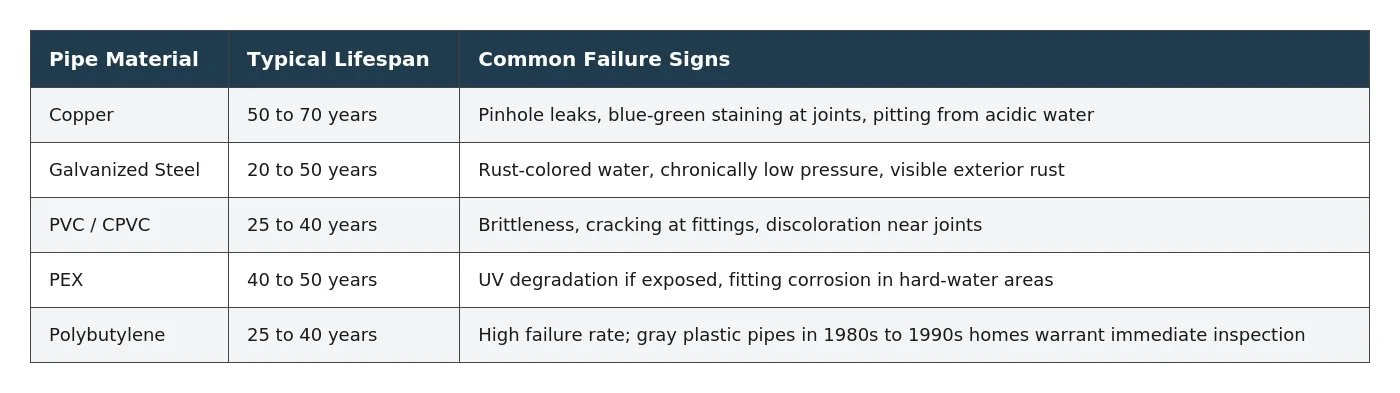
Galvanized steel is the one I'd pay closest attention to. It corrodes from the inside out, which means the exterior can look fine while the interior diameter has narrowed to a fraction of its original size. Rusty or discolored water coming from your tap is the giveaway. If your home was built before 1970 and hasn't been repiped, that's the conversation to have with a plumber first.
A Tuesday Morning Nobody Wants
Picture this: it's 6:45 on a Tuesday, you're already running five minutes behind, and you turn on the kitchen faucet to find the pressure has dropped to a trickle. You check the bathroom and it's the same story. You head to the basement to look at the water heater and step into two inches of standing water. A supply line, probably a joint that had been seeping for weeks, finally let go overnight.
That moment costs far more than the repair itself. It costs the workday you lose, the ruined belongings, the mold remediation that follows if the area isn't dried within 24 to 48 hours, and the insurance claim that will follow you around for years. The repair bill was always going to happen. The difference between catching it early and catching it at 6:45 on a Tuesday is entirely in whether you were paying attention.
"Repair or replacement of these features often is quite costly. Water can damage drywall, warp floors, ruin electronics, and promote mold growth." - Michael Loik, Ph.D., professor of environmental studies at UC Santa Cruz, commenting on water intrusion research cited by FEMA and NFIP
Repair or Replace? How to Think About the Decision
A single pinhole leak on a copper line that's 20 years old and otherwise in good shape? Repair it. An isolated joint failure on a PEX system installed in the last decade? Also a repair call. But when you're dealing with recurring failures in the same section of line, widespread discoloration, or a galvanized system that's pushing 40 years, the repair-versus-replace math changes fast. Patching one spot on a corroded line just moves the next failure six feet down the pipe.
The decision comes down to three questions: How old is the pipe? How widespread is the corrosion or damage? And how many times has this spot or nearby spots needed attention in the last two years? Two or more repairs in two years on the same line is almost always a sign that the line is telling you something you haven't been willing to hear yet.
For homeowners in North Texas, a resource like Waxahachie water line repair covers the full range of water line services, from targeted repairs to complete repipes, and can give you a clear written estimate before any work begins.
Water Damage Claims Put the Stakes in Perspective
If you need a number to anchor the urgency, consider this: water damage is the second most frequent homeowners insurance claim in the U.S., with roughly 1 in 60 insured homes filing this type of claim each year. From 2018 to 2022, water damage and freezing claims made up about 24% of all home insurance claims, with an average claim amount of $13,954 in damage, according to Triple-I data reported by U.S. News in 2026. That average sits well above what most early-stage water line repairs cost, which means the financial case for being proactive is as strong as it gets in home maintenance.
And keep in mind: most standard policies cover sudden, accidental failures like a burst pipe, not the slow leaks that were seeping for months before anyone noticed. Gradual damage is usually on the homeowner. That's another reason why the DRIP Test isn't just useful, it's protective.
What to Do This Week
Pull your last three water bills and compare them side by side. Any unexplained upward trend is worth investigating.
Check under every sink cabinet for moisture, soft spots on the cabinet floor, or rust staining around supply line connections.
Run the two-hour meter test the EPA outlines and note whether the reading shifts at all.
Find out what pipe material your home uses, and note the approximate age. If you don't know, your original home inspection report or a licensed plumber can tell you in minutes.
If you find any of the DRIP Test signals, don't wait for the situation to escalate. Get a written estimate from a local licensed plumber so you understand your options before the decision gets made for you by a failure.
Water lines are one of those home systems that reward attention and punish neglect in almost exact proportion to how long the neglect goes on. A quick seasonal check costs you nothing. A Tuesday morning in two inches of water costs considerably more than that.
HOW DO YOU FEEL ABOUT FASHION?
COMMENT OR TAKE OUR PAGE READER SURVEY
Featured





For many people, the end of the workday does not always mean the beginning of recovery.