
INIA GLOW 4D Review: Is This Dual-NIR LED Mask Worth Buying?

PAGE
By PAGE Editor
An INIA GLOW 4D review is an evidence-based assessment of INIA’s cordless, wraparound LED face mask and the results a realistic user can expect. The device combines visible red, blue, and amber light with 850 nm and 940 nm near-infrared light across a 320-LED layout designed to cover the forehead, cheeks, jawline, and chin. In simple terms, it is a home photobiomodulation device intended to support smoother-looking, brighter, firmer skin through repeated light exposure—not an instant facelift or a replacement for medical treatment.
For this review, I examined the product page, available instructions, warranty and return terms, and published red-light research. I have not worn this particular mask, so I will not invent a hands-on story. My experience here is pre-purchase analysis: separating useful specifications from attractive marketing and identifying the questions a careful buyer should ask.
My Quick Verdict
The INIA GLOW 4D is one of the more feature-rich LED masks near the $200 mark. Its main advantages are wireless use, flexible 4D coverage, 320 LEDs, dual 850/940 nm NIR, four light modes, and removable cooling pads.
I think it suits someone who already accepts that LED skincare is gradual and will use the mask several times weekly. It is less convincing for a first-time buyer seeking the lowest price, anyone who dislikes facial pressure, or shoppers expecting dramatic wrinkle reduction within days.
Its biggest weakness is the lack of technical transparency. I would like to see model-specific irradiance, delivered fluence, LED distribution by wavelength, eye-safety testing, and a clearly linked clinical study for this exact mask.
What Is the INIA GLOW 4D?
The INIA GLOW 4D review product is a rechargeable silicone LED mask sold by Inia. The brand presents it as an upgrade over the standard INIA GLOW Wireless, adding broader lower-face coverage and a 940 nm near-infrared channel.
The product page lists 320 LEDs, a jaw-and-chin wraparound design, magnetic cryo-cooling pads, four modes, and cordless operation. A publicly available SKB-1918P manual describes 630 nm red, 460 nm blue, 610 nm amber, and a red-blue combination, each paired with 850/940 nm NIR. It also says NIR can be disabled, and a full charge provides up to 120 minutes of use.
When I checked, the official page listed the mask at $209.99 and displayed a coupon price of $189.99. Treat that as a snapshot because promotions change.
INIA GLOW 4D Specifications at a Glance
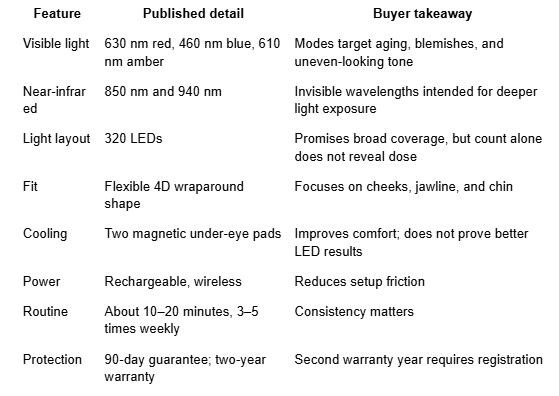
These details come from the product listing, the available SKB-1918P instructions, and INIA’s warranty policy.
How the Dual-NIR System Works
Red and near-infrared light therapy is commonly called photobiomodulation. Selected wavelengths deliver low-level light energy that may influence cellular signaling, mitochondrial activity, inflammatory pathways, and tissue-repair processes without peeling the skin.
The broader science is promising. A 2025 randomized, double-blind, sham-controlled study of a home mask using 630 nm red light and 850 nm infrared light found the treatment safe and well tolerated and reported skin-rejuvenation benefits. Other trials around 630–660 nm have found improvements in wrinkles, roughness, complexion, or collagen-related measurements after repeated sessions.
That supports the concept behind the INIA mask, but not every claim for this exact model. Dose, wavelength accuracy, fit, treatment time, and adherence all affect results. The American Academy of Dermatology also cautions that results from different devices cannot be directly compared because their specifications and study protocols vary.
Does 940 nm Make It Better?
The 940 nm channel is this model’s headline feature, yet I would describe it carefully. Longer NIR wavelengths interact with tissue differently, but the facial-rejuvenation evidence I found is much stronger for red light around 630–660 nm and NIR around 850 nm than for 940 nm specifically.
So, 940 nm is an interesting addition, not proof that this mask will outperform every 630/850 nm device. The complete package—fit, dose, comfort, warranty, and routine compliance—matters more than one wavelength number.
What the Four Modes Are Designed to Do
Red Mode
Red mode combines 630 nm light with dual NIR and is the most relevant setting for fine lines, dullness, texture, and firmness. Expect changes over weeks rather than one or two sessions.
Blue Mode
Blue mode uses 460 nm light with dual NIR and is marketed for blemish-prone skin. It may support an acne routine, but persistent, painful, or scarring acne deserves professional treatment.
Amber Mode
Amber mode uses 610 nm light with dual NIR for brightness, redness, and uneven-looking tone. I would interpret that as cosmetic support, not a promise to erase melasma, rosacea, or stubborn pigmentation.
Combination Mode
Combination mode runs red and blue light with dual NIR. It is convenient for overlapping concerns, though more wavelengths do not automatically produce better results.
Fit, Comfort, and Everyday Usability
The 4D design is more useful than the name suggests. A flexible mask that wraps around the face can reduce gaps over the cheeks and jawline, where flat masks may sit farther from the skin. INIA specifically promotes coverage extending along the jawline and chin.
Fit remains personal. Face width, nose shape, strap tension, eye openings, and battery placement can determine whether the mask feels secure or heavy. Strong specifications mean little when discomfort leaves a device unused.
The cooling pads may make a bright session feel calmer and temporarily reduce the look of under-eye puffiness. I view them as a genuine usability benefit, not part of the light-therapy mechanism.
Wireless operation also matters. In my product-evaluation process, convenience carries real weight because repeat use is more likely when setup is simple.
INIA GLOW 4D vs INIA GLOW Wireless
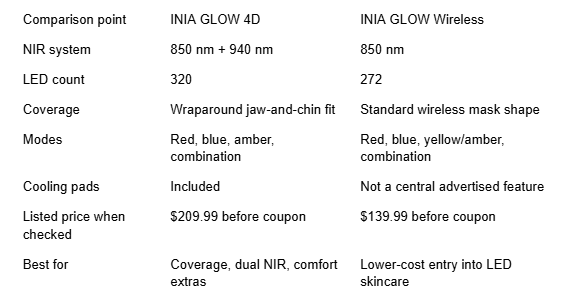
The cheaper GLOW Wireless may be the smarter beginner purchase. It already includes multiple visible modes and 850 nm NIR for substantially less when I checked.
The GLOW 4D earns its premium through broader coverage, 320 LEDs, 940 nm NIR, and cooling pads. Those upgrades are worthwhile only when they solve a real need.
What the Product Page Does Not Clearly Tell You
The page says the device offers up to 40% higher energy density and describes the results as clinically proven, but it does not clearly display model-specific irradiance in mW/cm², delivered dose in J/cm², sample size, control group, or a full clinical report.
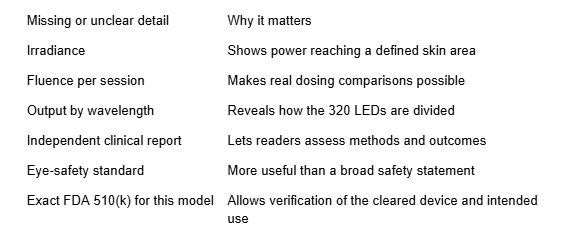
LED count helps describe coverage, but it cannot tell me whether the dose is uniform, weak, excessive, or clinically useful. Research devices disclose power density and treatment dose because these values help define the exposure being tested.
This is the key detail many online reviews overlook.
Safety and Sensible Use
For most healthy users, short-term red-light therapy appears to have a favorable safety profile. The American Academy of Dermatology says at-home results can range from subtle to noticeable and warns that different devices and protocols cannot be directly compared.
The available manual advises against using the mask on broken, irritated, or infected skin. It recommends medical guidance for pregnancy, pre-existing conditions, or photosensitizing medication, advises avoiding direct eye exposure, and says to stop if irritation develops.
People with lupus, light-sensitive disorders, eye conditions, or medication-related photosensitivity should seek clinical advice first. Dermatology guidance may also be sensible for darker skin tones because visible light can worsen hyperpigmentation in susceptible people.
I would use the mask on clean, dry skin, begin conservatively, and avoid starting a new peel, retinoid, or strong acid at the same time. Progress photos taken under identical lighting every four weeks are more reliable than daily mirror checks.
Warranty and Return Policy
The product page promotes a 90-day money-back guarantee and a two-year warranty. The separate warranty policy explains that coverage is one year by default, with the second year added after registration.
The return policy is less clear. It recommends using the device for at least a month, yet also lists products with “clear signs of use” as non-returnable. Customers normally cover return shipping for non-quality-related returns.
Before buying, I would ask customer service in writing whether a normally used and cleaned mask qualifies under the 90-day results guarantee, then retain the packaging and reply.
Who Should Buy It?
The INIA GLOW 4D suits a consistent skincare user who wants a wireless LED mask, values jawline coverage, and likes multiple modes and cooling pads. It is most appealing near its coupon price rather than the crossed-out reference price.
It is less suitable for buyers seeking fully published, model-specific dosing and independent clinical documentation, or anyone who only needs a basic red-and-850 nm NIR mask.
Final Verdict
My INIA GLOW 4D review is positive with reservations. The mask combines thoughtful features in one wearable device, and broader research supports realistic, gradual cosmetic benefits from repeated red and near-infrared exposure.
The missing irradiance, fluence, and product-specific clinical report stop me from calling it an unquestionable category leader. Check the current offer, request those specifications, clarify the return terms, and decide whether the 4D fit and dual-NIR upgrade justify the premium for your routine.
Frequently Asked Questions
Is the INIA GLOW 4D worth it?
It can be worth it for consistent users who value dual NIR, wraparound coverage, cooling pads, and wireless convenience over the lowest price.
How long does INIA GLOW 4D take to work?
Brightness or texture may change within weeks, while fine-line and firmness goals usually require consistent use for roughly eight to twelve weeks.
Can I use INIA GLOW 4D every day?
Follow the manual’s schedule, begin conservatively, and reduce the duration or frequency if redness, irritation, or discomfort occurs.
Does 940 nm near-infrared light tighten skin?
It may support deeper photobiomodulation, but evidence that 940 nm tightens skin better than established red/850 nm combinations remains limited.
Can INIA GLOW 4D help with acne?
Its blue-light mode may support mild blemish-prone skin, but it should not replace medical care for persistent, painful, inflammatory, or scarring acne.
HOW DO YOU FEEL ABOUT FASHION?
COMMENT OR TAKE OUR PAGE READER SURVEY
Featured




Deep clean, seal, and protect your tile & grout in Oceanside, CA. Bring the original shine back to your floors. Request a quote today!