
Managing Casino Banking From an Irish Bank Account

PAGE
By PAGE Editor
Every casino payment eventually touches a bank. Irish casino banking options run through AIB, Bank of Ireland, Permanent TSB, Revolut and the credit unions, and each institution applies its own policy to gambling charges.
The casino sets one set of rules, and your bank sets another. Both need to agree for a payment to clear. Most declined deposits trace back to the bank rather than the operator.
Bank Policy on Gambling Charges
Merchant category codes label every card transaction. Gambling carries its own code. Banks decide separately how to treat it.
Some Irish issuers block the category on credit products entirely. Others process the charge and classify it as a cash advance. That treatment adds a fee of near 2% to 3% plus immediate interest with no grace period. Debit products usually clear without either problem.
The Gambling Block Toggle
Several Irish banks now build a gambling block into the app. Switching it on stops card payments to those merchants outright. The setting covers online and in-store charges together.
Reversing the toggle sometimes carries a cooling period of 48 hours or longer. That delay works as a deliberate protection rather than a fault. The control sits outside any casino account, so no operator can override it. Players who want a hard stop use it alongside site limits.
Bank Accounts and SEPA Rails
Ireland sits inside the Single Euro Payments Area. Euro transfers move between accounts under standardised rules. Three schemes handle different needs.
Standard credit transfers settle within one business day. Instant credit transfers move money in under ten seconds where both institutions support the scheme. Direct debits pull rather than push, so casinos rarely use them. The scheme in use decides most of a payout wait.
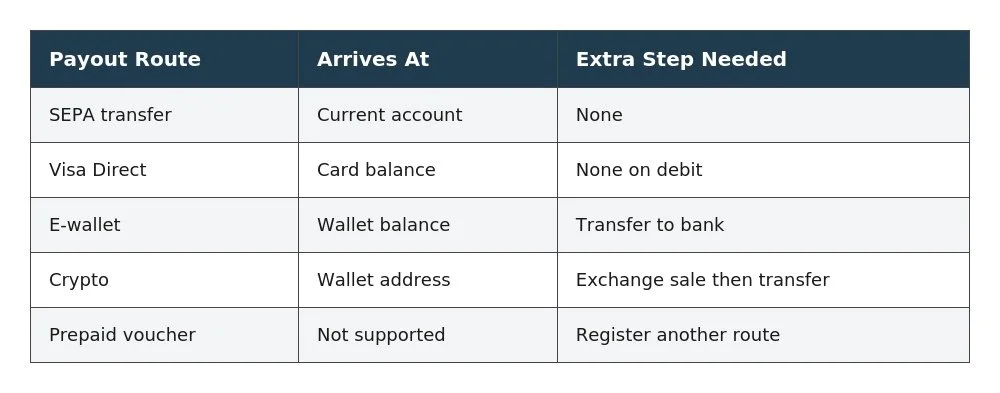
Where Each Route Reaches Your Money
The distance from a payout to a usable bank balance varies. The table below shows the position for Irish accounts.
Revolut in the Mix
Revolut holds a large share of Irish adults as customers. The account functions as a full euro account with its own IBAN. Casino payouts reach it through standard SEPA rails.
Some operators classify Revolut as an e-wallet rather than a bank. That classification changes which processing queue a request enters. It also affects bonus eligibility at brands excluding wallets. Check how the cashier labels it before depositing.
Keeping the Records Straight
Card play leaves a clean trail on a bank statement. Every deposit shows with a date and an amount. That record makes monthly tracking simple.
Merchant names frequently show a payment processor rather than the casino brand. A first statement confuses plenty of players for that reason. The casino keeps a matching list in the account menu. Both should agree entry for entry on a clean account.
Name Matching and Third Parties
Banks pass the account holder name with every transfer. Casinos check it against the registration details. A mismatch triggers a hold and often a full return.
Joint accounts cause a common problem here. A transfer from an account in two names sometimes fails the check. Third-party payments break gambling regulations outright at licensed sites. The names need to match exactly on both sides.
Setting Limits Across Both Sides
Two independent layers of control exist. Using both works better than relying on one.
Casino deposit caps set daily, weekly, or monthly in the account menu;
Casino loss limits that stop play at a chosen figure;
Session timers and reality check reminders inside the same menu;
Bank card spending limits applied through the banking app;
Merchant category blocks switching gambling charges off entirely;
Blocking software such as Gamban covering the device itself;
Handling a Declined Payment
A refused deposit rarely originates at the casino. The bank usually made the call. Work through the steps below.
Check the app. Look for a decline reason in the transaction feed.
Try a debit card. Swap from a credit product where one exists.
Call the bank. Ask directly about gambling merchant category codes.
Check the toggle. Confirm no gambling block is active in the app.
Try another route. Use a wallet or SEPA transfer as an alternative.
Support in Ireland
Free help operates across the country for anyone with a gambling problem. Extern Problem Gambling runs a national counselling service. GamblingCare.ie provides information and referral pathways.
Gamblers Anonymous holds meetings in Dublin, Cork, Galway and other cities. Family members reach support through the same channels. None of these services charge for access. Bank tools and site limits work alongside them rather than instead of them.
Conclusion
Irish banking policy shapes casino payments as much as the operator does. Debit products avoid the cash advance treatment some issuers apply to credit charges. SEPA rails move euro payouts in seconds or in a business day depending on the scheme. Check your bank's stance before depositing, keep the names matched across both accounts, and use the limit tools on both sides.
HOW DO YOU FEEL ABOUT FASHION?
COMMENT OR TAKE OUR PAGE READER SURVEY
Featured





Jackets have always been an important part of fashion.