
What Contractors Should Know Before Moving Heavy Construction Equipment
PAGE
By PAGE Editor
What Contractors Should Know Before Moving Heavy Construction Equipment
Moving an excavator or a loader looks routine until something goes wrong: a trailer rated too low, a bridge on the route with a weight limit, a permit missing at a checkpoint. Delays, fines, and equipment damage are expensive, and accidents can be far worse. Contractors who plan transport carefully avoid most of these problems.
This guide covers the main points to check before moving heavy construction equipment.
Start With Accurate Weights and Dimensions
Everything else depends on knowing exactly what you are moving. Do not rely on brochure figures alone, because attachments, fuel, counterweights, and added accessories change the real number.
Record the following for each machine:
Operating weight with the attachments you will actually haul.
Length, width, and height in transport configuration.
Center of gravity, which affects how the load sits on the trailer.
Special features, such as tracks, outriggers, or booms that can be folded or removed.
Weigh the machine if there is any doubt. Many transport problems start with an assumed weight that was simply wrong.
Match the Trailer to the Machine
The trailer must handle the machine's weight and dimensions with margin to spare.
Lowboy and low-loader trailers sit close to the ground, helping tall equipment clear bridges and overhead obstacles.
Tag-along (equipment) trailers suit smaller machines such as mini excavators and skid steers.
Extendable and multi-axle trailers support longer or heavier loads and spread weight across more axles.
Check the trailer's rated capacity, deck length, ramp or beaver-tail design, and tire and brake condition. Confirm that your towing vehicle is rated for the combined load, including braking capability.
Understand Weight Limits and Axle Loads
Total weight is only part of the picture. Roads and bridges are regulated on gross vehicle weight and also on how weight is distributed across axles. Positioning the machine correctly on the trailer affects both the trailer's balance and individual axle loads.
Placing the heavy end forward or back changes how much weight lands on the tow vehicle's axles versus the trailer's. Incorrect placement can lead to overloaded axles, poor steering, or dangerous trailer sway. Rules differ by country, state, and road class, so verify local limits rather than assuming.
Permits and Regulations
Oversize and overweight loads usually require permits, and the thresholds vary by jurisdiction. Common requirements include:
Oversize/overweight permits for loads exceeding legal dimensions or weights.
Route approvals, sometimes restricting travel to specified roads and times.
Escort or pilot vehicles for very wide or long loads.
Flags, lights, and signage marking oversize loads.
Driver licensing and vehicle registration appropriate to the combination.
Permit conditions can include travel-time limits, holiday restrictions, and weather conditions. Keep copies in the cab, and make sure drivers understand the conditions.
Plan the Route in Advance
The shortest route is not always the legal or safe one. A route survey should check:
Bridge clearances and posted weight limits.
Overhead lines, tunnels, and low obstacles.
Road width, tight turns, and steep grades.
Construction zones and temporary restrictions.
Rest stops where a heavy combination can park safely.
Check the destination as well. Confirm that the site has a safe unloading area, firm ground, and room to turn the trailer. Soft or sloping ground has caused many equipment tip-overs during unloading.
Loading and Unloading Safely
Loading and unloading are the highest-risk moments of a move.
Park on level, firm ground with the trailer brakes set and wheels chocked.
Inspect ramps or the loading dock for capacity, grip, and secure attachment.
Use a spotter to guide the operator and watch clearances.
Drive slowly and straight, and avoid steering on ramps.
Lower buckets, blades, and attachments to the deck once positioned.
Engage parking brakes and swing locks, and shut the machine down.
For very heavy components, or where machines cannot drive onto a trailer, lifting and jacking equipment may be required. Hydraulic systems built around a robust hydraulic cylinder can raise, position, or support heavy loads in controlled steps when cranes are impractical, and these require trained operators and well-maintained equipment.
Securing the Load
A machine that shifts in transit is a hazard to everyone on the road. Securement should follow the rules in your jurisdiction and the equipment maker's guidance.
Use rated chains or straps, and inspect them for wear, nicks, and damage.
Secure at the machine's designated tie-down points, not at components that could bend or break.
Use enough tie-downs to meet working load limit requirements.
Protect straps from sharp edges with sleeves or padding.
Re-check tension after the first few miles and at stops.
Prepare the Machine
Reduce risks and damage by preparing the equipment itself:
Remove or secure loose parts, tools, and attachments.
Retract or fold booms and arms according to the manual.
Lock articulation points and swing mechanisms.
Check fluid levels and look for leaks that could worsen under vibration.
Document the machine's condition with photos before and after transport.
Insurance and Documentation
Confirm that your insurance covers the equipment in transit, and understand whether a hired carrier's coverage is sufficient. Keep a record of weights, permits, route plans, inspection checklists, and driver instructions. Good paperwork protects you if a claim, inspection, or dispute arises. For additional guidance on equipment and lifting solutions, you can learn more from specialized industrial suppliers.
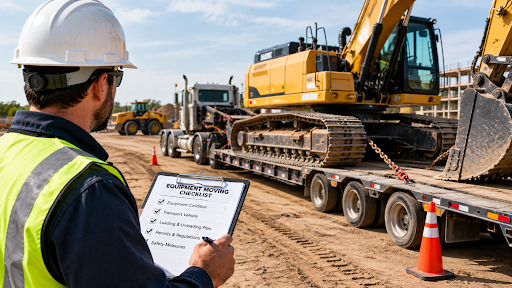
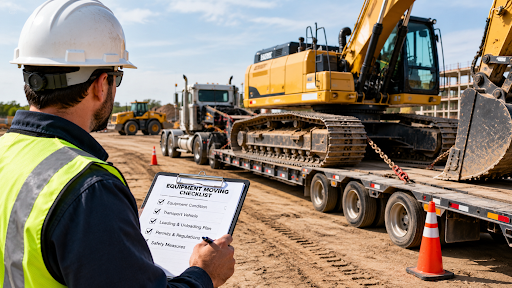
Pre-Move Checklist
Verify weights and dimensions of the loaded machine.
Confirm trailer and tow vehicle ratings.
Obtain permits and approvals.
Survey the route and destination.
Inspect tie-downs, ramps, lights, tires, and brakes.
Brief the driver, spotter, and escorts.
Photograph the equipment and record its condition.
Frequently Asked Questions
Do I need a permit to move an excavator?
It depends on the machine's weight and dimensions and on local regulations. Many excavators exceed legal width or weight when loaded, so check requirements before the move.
What type of trailer is best for heavy equipment?
Lowboy or low-loader trailers are commonly used for large machines because of their low deck height and high capacity, but the right trailer depends on the machine.
How do I prevent equipment from shifting in transit?
Use rated chains or straps at designated tie-down points, secure moving parts, and re-check tension during the trip.
Conclusion
Moving heavy construction equipment safely comes down to preparation: accurate weights, the right trailer, correct permits, a vetted route, careful loading, and solid securement. Contractors who treat transport as a planned operation, rather than an afterthought, protect their people, their machines, and their schedules. A short checklist before each move is one of the cheapest forms of risk management in the business.
HOW DO YOU FEEL ABOUT FASHION?
COMMENT OR TAKE OUR PAGE READER SURVEY
Featured



Preparing a home for overnight guests creates different priorities from ordinary weekly upkeep.