
The Best Social Gaming Platforms Where You Can Meet and Play With Strangers
PAGE
By PAGE Editor
Meeting people used to require a reason. A class, a job, a mutual friend. The internet changed that, but not always in ways that felt natural or comfortable. Social media gave everyone a profile and an audience, but rarely gave people something to actually do together. Gaming filled that gap in a way nothing else quite has.
The best social gaming platforms today are not just places to play games. They are places where shared challenge, friendly competition, and real-time communication turn complete strangers into teammates. Some of the most genuine online friendships formed in the last decade started inside a game lobby. That is not a coincidence. It is the result of how well good games create the conditions for real human connection.
If you are looking for a platform that actually delivers on the promise of playing with people you have never met before, here is what separates the good ones from the forgettable ones.
What a True Social Gaming Platform Actually Looks Like
The phrase gets thrown around loosely, but not every multiplayer game qualifies as a genuine social gaming platform. Slapping a chat box into a single-player experience and calling it social does not cut it anymore. Players have figured that out, and the ones who genuinely want to meet people know the difference quickly.
A real social gaming platform creates situations where interaction is natural rather than forced. You are not just playing alongside strangers. You are playing with them in a way that requires communication, coordination, or shared reaction to whatever the game throws at you. That shared experience is what turns a session from transactional to memorable.
The features that tend to matter most:
Real-time communication built into gameplay, not bolted on as an afterthought
Matchmaking that puts you with people at a similar level without making the gap feel humiliating
Games with enough depth that you have something to talk about between rounds
Community spaces where players can linger after a session ends rather than being immediately kicked back to a lobby screen
Low barriers to entry so new players can jump in without needing to read a manual first
Platforms that get these elements right tend to build communities that outlast any individual game on their roster. The game is the reason you show up. The people are the reason you come back.
Why Playing Online Games With Strangers Works Better Than You Think
There is a common assumption that online interactions with strangers are shallow by nature. The reality is more interesting than that. Research consistently shows that playing online games together builds genuine social bonds, sometimes faster than equivalent time spent in other online environments.
The reason comes down to shared stakes. When you are playing with someone and you both have something invested in the outcome, the interaction has texture. You celebrate together, you recover from losses together, you talk through what went wrong. Those small repeated interactions, spread across a session, build familiarity at a surprisingly quick pace.
A 2025 Entertainment Software Association survey found that 78% of gamers agreed that playing games can introduce them to new friends. Nearly half said games had helped them stay connected with people already in their lives. That second figure matters because it shows the social value of gaming extends beyond the initial meeting point. The platform becomes part of how people maintain relationships, not just start them.
Playing with friends online through a platform that supports cross-session continuity is especially valuable here. Knowing that the person you played well with last Tuesday will be on the same platform next weekend gives the relationship somewhere to go. That ongoing continuity is something purely competitive platforms rarely build well, which is why purely competitive platforms rarely build lasting communities.
The Platforms Doing Social Gaming Right in 2026
The landscape has matured considerably. A few years ago, most social gaming happened as a side effect of wherever the popular games happened to live. Now, platforms are actively designing for the community from the ground up.
Discord remains the clearest example of infrastructure built entirely around gaming communities. It does not host games itself, but it hosts the conversations that form around them with a depth no in-game chat system has matched. Servers built around specific titles become genuine communities with their own cultures, inside jokes, and regular events. For anyone who wants to meet strangers through gaming and then keep that connection alive, Discord is still the connective tissue that holds most of it together.
Roblox operates at a scale that is easy to underestimate if you think of it primarily as a children's platform. It has over 80 million daily active users, many of whom are not children, and its social layer runs surprisingly deep. The variety of experiences available means players can find communities around almost any interest, and the platform's shared identity creates common ground between people who might never have crossed paths otherwise.
Platforms built specifically around casual games have seen significant growth because they serve a demographic that wants to play with friends online without the learning curve that competitive titles demand. When the game itself is approachable, the social layer can lead rather than follow. People talk more when they are not fully consumed by mechanical difficulty.
Viral Games and Why They Create the Best Conditions for Meeting People
There is a specific quality that viral games share, and it has nothing to do with their budget or their graphics. The games that spread fastest tend to be the ones that give people something to talk about. Not a plot twist or a piece of lore, but a moment that happened during their specific session that they want to describe to someone else.
That shareability is deeply social in nature. When you finish a round of something and immediately want to tell a friend what just happened, you are extending the game's social reach beyond the platform itself. Viral games are not viral because of marketing. They are viral because players become their own marketing when they cannot stop talking about what they experienced.
This is why online free games have such a strong track record of building large communities quickly. The moment there is no financial barrier between a stranger and their first session, the potential player pool becomes enormous. A game that costs nothing to try and rewards you with a genuinely social experience from the first round is positioned to spread through social networks faster than anything with a price tag attached.
The best online free games running right now have figured out how to make even a solo session feel like something that connects you to a larger community. Leaderboards, shared challenges, seasonal events, and daily content give players reasons to show up at the same time as other players, which is when the best social moments happen.
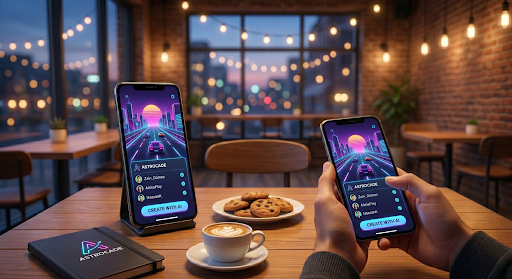
Sprint, Steal, and Come Back for More: RUN Pet Thief 3D on Astrocade
Among the casual games available on Astrocade, RUN Pet Thief 3D stands out for the kind of momentum that makes a quick session feel impossible to stop at just one run.
The concept is immediately readable: you are a thief raiding ancient temples for rare low-poly artifacts, and the moment you grab the loot, a massive Stone Golem wakes up and comes after you. What follows is a full-throttle parkour sprint through obstacle-filled environments where every second of hesitation costs you. The movement is fluid and fast, and the level design keeps throwing new challenges at you before you have finished reacting to the last one.
What makes it genuinely compelling rather than just frantic is the progression layer underneath the running. The loot you collect goes toward building and expanding your own treasure base, so every run counts toward something. You are not just surviving, you are building. That sense of accumulation gives the game a gravitational pull that pure runner mechanics alone cannot sustain. The low-poly visual style is charming without being distracting, and the whole thing runs with a kind of kinetic energy that makes "one more run" feel completely reasonable at round four, five, and six. It is exactly the kind of casual game that fits naturally into a social gaming context because it is easy to describe, easy to share, and hard to stop playing once you start.
Online Games With No Download: Why Frictionless Access Changes Everything
One of the most underrated shifts in social gaming over the last few years has been the move toward online game no download experiences. It sounds like a minor technical detail. In practice, it changes who shows up and how quickly.
Think about how social invitations work in real life. If someone says "come over, we're playing a game," the barrier is showing up. If they say "download this client, create an account, install two updates, then join my server," most people quietly decide they are busy. Every step between "someone told me about this" and "I am actually playing" is a potential exit point for a new player.
Browser-based games collapse that journey entirely. Someone shares a link, you click it, you are playing in thirty seconds. For social gaming specifically, that immediacy is enormously valuable because the window where someone is willing to try something new based on a friend's enthusiasm is short. Meeting that window rather than making them wait for it is one of the real reasons certain platforms grow much faster than others.
The quality of online game no download experiences has also improved significantly. There was a time when browser games meant simple interfaces and limited mechanics. That ceiling has risen considerably. The technology enabling sophisticated gameplay in a browser tab without downloads is now accessible enough that some of the most interesting new gaming experiences exist entirely in that format.
Casual Games Are Now the Core of Social Gaming
Something shifted in how people talk about casual games. For a long time, casual implied something you played alone, without much investment, to kill five minutes in a waiting room. That picture has become outdated to the point of being almost unrecognizable.
Casual games now power some of the most active social gaming communities online. The reason is straightforward: when a game is accessible enough for anyone to pick up without a tutorial, the social energy can be the main event rather than a reward for getting past the learning curve. Players who might never touch a strategy game or a competitive shooter feel completely at home in a well-designed casual experience.
This has expanded who participates in social gaming platforms significantly. The gamer demographic in 2026 is not a niche group of enthusiasts. It is close to half the global population, and a substantial portion of that number came through the door via casual games. Platforms that serve casual players well are not offering a watered-down version of the gaming experience. They are offering the version that fits most people's actual lives: accessible, social, enjoyable in short bursts, and genuinely fun to share.
Finding Your People Through the Right Platform
The honest answer to which social gaming platform is best is that it depends on what kind of social experience you are actually looking for.
If you want deep coordination and complex teamwork with strangers who might become long-term teammates, you want a platform that centers multiplayer games with voice communication and recurring events. If you want something casual and lighthearted where you can drop in, play a few rounds with people you have never met, and leave feeling like you had a genuinely good time, you want a platform built around accessible, low-stakes games that reward showing up rather than grinding.
The good news is that the social gaming market has matured enough that both of those experiences are genuinely available and well-built. The market hit over 35 billion dollars in 2024 and is projected to double before the end of the decade. That kind of growth does not happen without platforms figuring out, through real feedback from real players, what makes people want to stay.
The best platforms are not just places to play games. They are places where games are the excuse, and the people are the point.
HOW DO YOU FEEL ABOUT FASHION?
COMMENT OR TAKE OUR PAGE READER SURVEY
Featured





A comfortable home should offer more than a place to sleep and eat.