
The Blind Test: Luxury With the Logo Covered
PAGE
By PAGE Editor
There is one honest test of luxury, and it begins by covering the logo. Judge what is left: the leather, the edges, the way the panels meet, the feel of the surface after a year of use. If the covered bag cannot be told apart from an ordinary mass-produced one, the buyer's money went to advertising. If it is still plainly finer, the money went to craft. Buyers increasingly judge this way. Marie Claire now defines luxury as "subtle and discreet, embodied by quality craftsmanship and lack of logos," and Kristen Gall, president of Rakuten Rewards, reports that near-logoless houses like Khaite, Toteme, and The Row have been "stealing shares from the likes of Gucci and Louis Vuitton." Highsnobiety's consumer research found the same: the top drivers of luxury desirability, led by craftsmanship, are "all related to the quality and the story behind a brand or product, not the marketing of it." The test has one rule: a brand's reputation does not count as evidence. Only the object does.
The most famous story in leather
Judging craft is hard because the brands themselves supply the story you are expected to judge them by, and the most famous story in leather is the saddle stitch. Hermès calls it "an Hermès signature" and writes that "no machine can replace the long hours put in at the workshop needed to master this technique." The stitch is genuine, and it has one genuine advantage: a single thread with a needle at each end passes through the same hole from both sides, so every stitch is locked on its own, and a seam holds. But the story hides a plain fact: the stitch is quick to learn. Leathercraft schools teach saddle stitching to complete beginners in their first session; one covers the fundamentals in a two-hour workshop, and an established online academy advertises "master saddle stitching in as little as 24hrs." Nigel Armitage, the technique's most respected teacher, gives the honest numbers: "months to learn and longer to master," and the hard part is controlling the awl that makes the holes, not the stitch itself. Hermès's own school takes a newcomer with no background in leather to its national leatherwork diploma in eighteen months. None of this makes the saddle stitch bad. It makes it a basic skill: one of the first things every serious leatherworker learns, not the peak of the craft. Describing a basic skill as the height of craftsmanship is marketing, and the reason to cover the logo is to stop marketing from doing your judging for you.
What the test finds at the top
Judge the top of the market this way and what you find is more ordinary than the stories suggest. The restoration industry, which receives flagship bags after years of real use, describes their wear in plain terms. One Hermès-specialist restorer reports that cracking, fraying, and broken stitching on handles are "unfortunately not uncommon" on the house's classic bags, and it redoes their edge paint, because the edges of these bags are painted, and paint wears. The same restorer notes that Hermès will not service a bag once anyone else has worked on it, and that its own repairs take eight to twelve weeks. Sotheby's buying guide for the Kelly states that the rigid construction "may show wear more easily at the edges." WWD has documented authentic bags rejected for service over a missing receipt or a past alteration. Volkan Yilmaz, the leathercraftsman who says he has cut apart more than fifty luxury bags on camera to grade their making, rates Hermès's leather selection above every other large house, and still concludes: "The magic of luxury isn't in the materials or craftsmanship. It's in perception." His advice to buyers is to consider independent artisans who do work of the same quality without the famous name, and his quick check for any brand is simple, as he told Dazed: "If the brand is proud of their leather selection and craftsmanship, they can't talk enough about it." Add this up and the conclusion is specific. Hermès makes good leather goods, and those goods have known, documented weak points: painted edges that wear, handles that crack with use, repairs that take months and can be refused. What sits above "good," the waiting lists, the mystique, the certainty of superiority, rests on the name. And the name is the one thing the blind test does not let you see.
The scarcity underneath
The industry's own behavior shows what it actually treats as scarce: not logos, but skilled artisans. LVMH opens its workshops to the public in its Journées Particulières, which drew 200,000 visitors across 96 sites in 15 countries in 2022. Chanel has spent four decades buying the endangered workshops it depends on, now some sixty ateliers employing more than ten thousand craftspeople. The same companies admit the shortage openly: LVMH's training institute warns that an entire generation of artisans retires by 2030, and that a craft takes nearly ten years to fully master. Skilled makers are the scarcest resource in luxury. Whatever becomes the next real signature technique will be something only they can perform.
A signature the test can verify
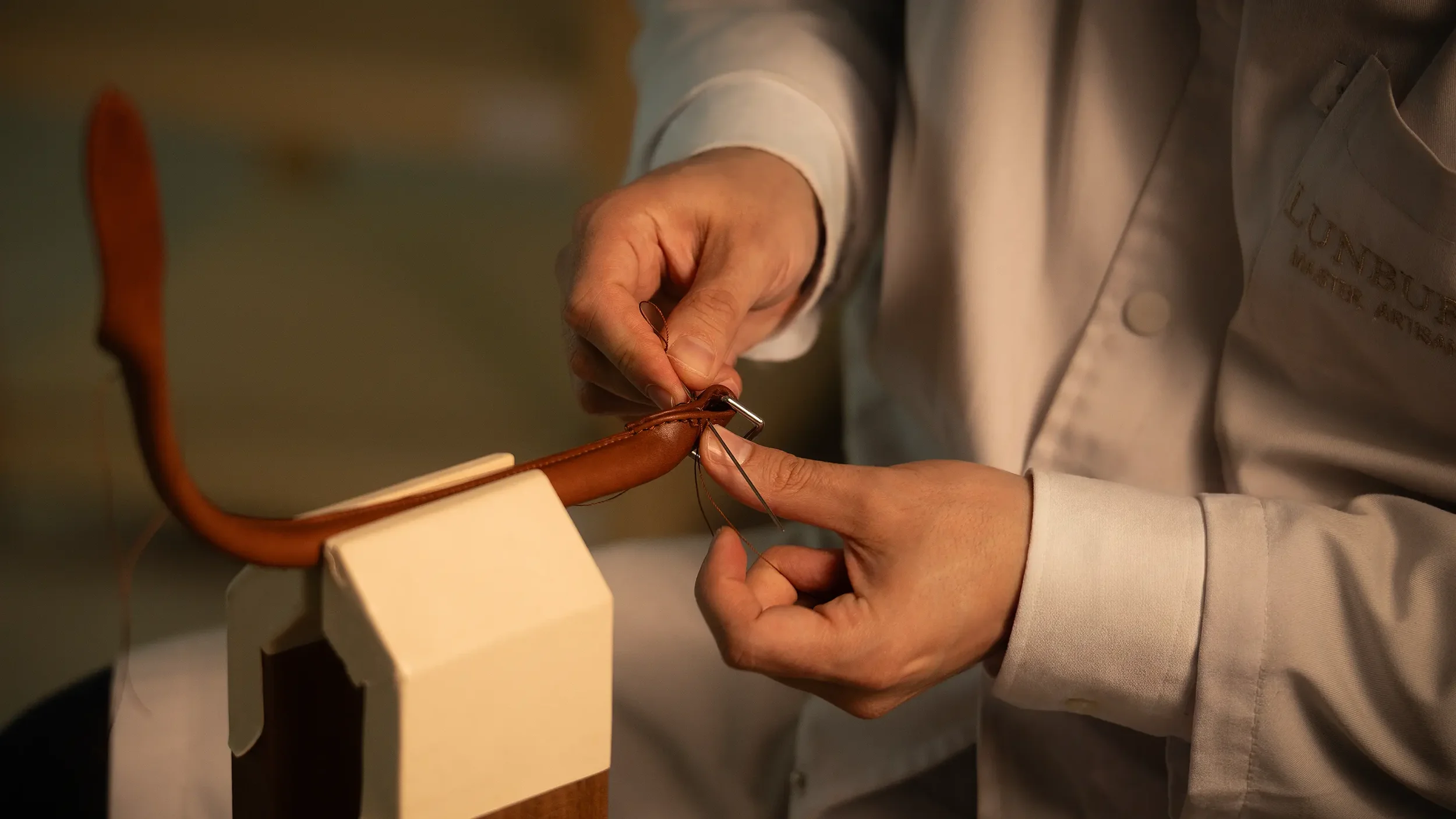
A technique deserves to be called a signature only if its difficulty can be seen on the finished object. Rempliage, the folded edge, meets that condition, and it comes from Fes, the Moroccan city where fine leathercraft has been practiced for more than a millennium and whose university, Al-Qarawiyyin, has been teaching since the year 859. The technique: the leather is shaved to a precise thinness along its border, then folded back over the panel, so the border of the piece is leather all the way around. Nothing is painted on. There is nothing to wear through and nothing to have redone every few years. The difficulty is stated in numbers by Lunburg, the second generation Dutch-Moroccan house that practices the technique, and the numbers are claims anyone can check it against: skiving worked with a precision of a tenth of a millimeter, and any panel where the fold fails is discarded, because the fold cannot be corrected. The house says its own artisans learn saddle stitching to proficiency within months, while training in rempliage is measured in decades, and it estimates that only a few hundred artisans in the world can execute the fold at the highest standard. The proof does not depend on trusting those statements. The edge sits on the outside of the object: you can see it in a photograph and feel it under a finger, and there is no line of paint to find.
The test, applied
Lunburg's Opus collection is built to be judged exactly this way. Each quiet luxury leather briefcase in the collection has nothing on its exterior that names the maker; the construction itself does the identifying. The leather spends forty days in vegetable tannage in Tuscany and is left unsealed, so the surface deepens and gains character with use instead of wearing through. Every edge is folded by hand in Fes by masters whose careers in the craft span decades, and the structure of each piece is guaranteed in writing for fifty years. Cover the spot where a logo would sit and nothing changes, because there is nothing there.
That is what quiet luxury means if the words are taken seriously: not a smaller logo, but an object that still deserves the word luxury with the logo covered. The test applies to every house, old or new, famous or unknown. The makers with nothing to hide should be the first to invite it.
HOW DO YOU FEEL ABOUT FASHION?
COMMENT OR TAKE OUR PAGE READER SURVEY
Featured




Video is no longer optional for marketing teams, e-commerce brands, and solo creators.