
Why a 12% Hard Money Loan Often Beats a 7% Bank Loan

PAGE
By PAGE Editor
Every active real estate investor knows the frustration of losing a lucrative property. You find the perfect off-market deal, run the numbers, and submit a strong offer. Then, a competitor swoops in and snatches the house with a fast-closing cash bid while you sit around waiting for conventional bank approval.
This scenario exposes a major flaw in how many investors evaluate their real estate financing. Focusing solely on a loan's nominal interest rate is a critical mistake when calculating investment profitability. Cheap money from a traditional bank often carries heavy hidden costs in the form of wasted time, carrying costs, and lost deals.
When you evaluate your financing options, speed and certainty of execution are just as critical as the interest rate on the paperwork. Taking weeks to close a deal can entirely erase the savings of a lower rate. Working with an Idaho hard money lender like Hopkins Financial Services allows investors to bypass rigid bank bureaucracy entirely. You can secure asset-based funding in weeks, not months, which puts you on a level playing field with all-cash buyers.
The Sticker Price vs. The Real Cost of Capital
Many newer investors get tunnel vision when they see a 7% interest rate from a traditional bank. They mistakenly assume a lower percentage automatically translates into higher net profits at the closing table. This singular focus on the interest rate obscures the actual financial reality of a real estate transaction.
To truly understand your potential return on investment, you have to calculate the total cost of capital. This true cost involves adding up several moving parts. You must factor in the interest rate, upfront origination points, administrative fees, and ongoing property holding costs over the life of the project.
A higher interest rate over a shorter, more efficient timeframe frequently costs less out-of-pocket than a low rate dragged out over a delayed timeline. It is essential to weigh what you pay upfront against what you save on the back end.
According to research from The Enterprise World, national average hard money loan rates range from 8% to 14% annually, where the premium pays for speed, flexibility, and access to deals that conventional financing cannot touch. Paying that premium is a strategic business decision. It functions as an entry ticket to acquire highly profitable properties that traditional banks reject due to strict appraisal conditions or tight closing windows.
The Expenses of Cheap Traditional Financing
The most expensive component of a traditional bank mortgage is the sheer amount of time it takes to process. Conventional loans typically require 30 to 60 days to reach the closing table, and complicated commercial loans often take even longer. During this wait, the seller grows impatient, the property sits vacant, and your project stalls.
Alternative real estate financing moves at an entirely different pace. Private lending options bypass traditional underwriting committees and can generally fund in 5 to 14 days.
This speed directly impacts your bottom line. Closing a deal weeks faster means you save weeks of unnecessary property taxes, insurance premiums, and utility payments. You also get your renovation crews on the job site immediately, which accelerates your final sale date and gets your capital ready for the next project.
The hidden expense of bureaucratic red tape is massive. The time spent chasing bank approvals directly eats into your earning potential. You could spend those 240 hours sourcing new off-market deals, managing job sites, or optimizing your current portfolio. Wasting that time on endless paperwork makes cheap bank money incredibly expensive.
Real-World Math: When a 12% Loan Beats a 7% Loan
Looking at a concrete mathematical breakdown proves exactly why a higher-rate, faster-closing loan can yield a higher net profit. Imagine you find a distressed fix-and-flip property. The seller needs to relocate immediately and offers a $20,000 price reduction to any buyer who can close the transaction in 14 days.
If you choose a traditional bank loan at 7%, you cannot meet the seller's urgent timeline. You lose the fast-close discount and have to pay the full $320,000 asking price. Your bank takes 90 days to fund the loan, piling three extra months of pre-renovation holding costs onto your ledger.
If you use a hard money loan at 12%, you secure the discounted $300,000 purchase price because you can close in 14 days. You pay higher upfront origination points and a higher interest rate, but you finish the project and list the house two and a half months sooner.
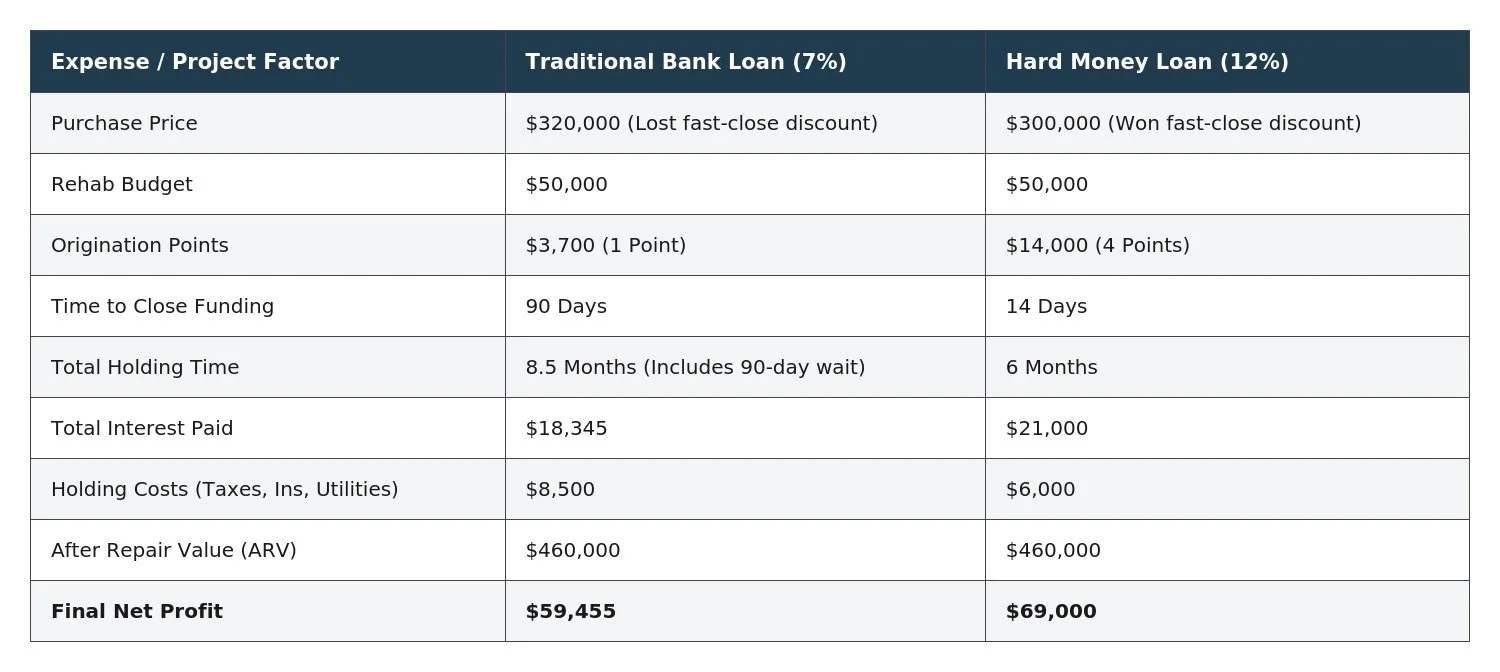
As the math clearly shows, saving 60 days of holding costs and flipping the property faster fundamentally changes the outcome. The 12% loan delivers nearly $10,000 more in net profit. Securing the bid and moving quickly mathematically outweighs the burden of higher origination fees and interest rates.
Asset-Based Underwriting: The Key to Scaling Faster
Private lenders prioritize the physical property over the borrower's personal tax returns, a strategy known as asset-based underwriting. They assess the deal based on the after-repair value, the scope of work, and the equity cushion built into the transaction. Leveraging property equity rather than personal W-2 income is vital for active, full-time investors.
Real estate professionals often write off significant expenses, which lowers their taxable income and makes them look risky to traditional banks. Asset-based underwriting ignores these conventional debt-to-income ratios. It serves borrowers with non-traditional income streams, complex self-employment structures, or recent financial setbacks who are otherwise locked out of lending.
Removing these personal income bottlenecks grants you massive operational freedom. You do not have to wait for a bank to slowly verify your income history before jumping on a good deal. This approach allows you to scale your portfolio quickly and take on multiple renovation projects simultaneously.
What to Expect in the Idaho Market
Setting realistic expectations for standard rates, terms, and timelines helps you project your costs accurately when operating in the Pacific Northwest. Borrowers working with a reputable lender in the Idaho market should anticipate interest rates ranging from 8.75% to 15%, with the average landing between 10% and 12%.
You should also expect to pay between 2.5 and 7 origination points on a standard deal. These rates and terms are never arbitrary. They are carefully calibrated according to the specific risk, renovation complexity, and required speed of your unique transaction.
There is immense value in local market familiarity. Working with a regional lender provides transactional certainty and local expertise that out-of-state, national lenders simply cannot match. A local partner understands neighborhood micro-markets, accurate appraisal values, and realistic timelines for local contractors.
National lenders often fumble deals at the last minute because they do not understand regional nuances. A local Idaho lender ensures your funds arrive on time, keeping your relationship with sellers and agents completely intact.
Calculating True Capital Value
Chasing a cheap interest rate is never worth the cost if it causes you to lose the deal entirely or incur months of unnecessary holding costs. Conventional mortgages look great on paper, but the actual execution is often slow, restrictive, and ultimately more expensive in the grand scheme of your real estate business.
Accurately calculating your total cost of capital is the only reliable way to maximize your real estate ROI. You must always factor the value of your time, daily carrying costs, and the heavy penalty of missed opportunities into your math. When you calculate the true financial picture, the strategic value of private lending becomes undeniable.
Building long-term relationships with fast, asset-based local lenders is a game-changer for active investors. It provides the financial agility you need to write competitive offers, close on your own timeline, and consistently secure the best properties in your market.
HOW DO YOU FEEL ABOUT FASHION?
COMMENT OR TAKE OUR PAGE READER SURVEY
Featured




For many people, the end of the workday does not always mean the beginning of recovery.