
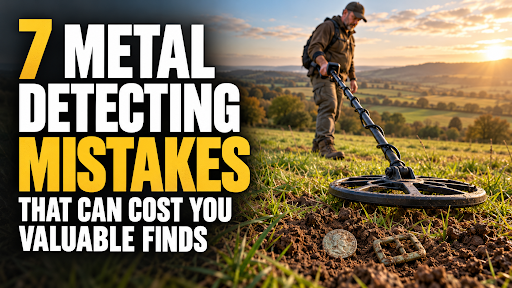
7 Metal Detecting Mistakes That Can Cost You Valuable Finds
PAGE
By PAGE Editor
Metal detecting is an exciting hobby that can uncover valuable coins, historical relics, jewelry, and other fascinating objects hidden beneath the ground. However, finding something worthwhile requires more than purchasing a detector and searching random locations. Even small mistakes in equipment selection, detector settings, and search techniques can cause you to miss promising targets.
Whether you are a beginner or an experienced enthusiast, understanding common metal detecting mistakes can help you make better use of your time and equipment. From choosing the wrong detector to overlooking subtle signals, these errors can significantly affect your results.
Here are seven metal detecting mistakes to avoid if you want to improve your chances of discovering valuable finds.
1. Choosing the Wrong Metal Detector for Your Needs
One of the most common mistakes is purchasing a metal detector without considering where and what you intend to search for. Different detectors are designed for different environments, and a model that performs well on a dry field may not be the best choice for wet sand, mineralized soil, or underwater detecting.
Before buying a detector, consider your primary goals. If you want to find old coins and historical relics, you may benefit from a detector with reliable target identification and adjustable discrimination. Beach hunters may prefer models designed to handle saltwater conditions, while gold prospectors often need equipment capable of detecting small gold nuggets in challenging ground.
Your experience level, budget, and comfort also matter. A complicated detector with numerous advanced features may be difficult for a beginner to operate effectively, while a basic model might not provide the functionality required by an experienced detectorist.
Researching the best metal detectors for your intended use can help you understand which features are worth prioritizing. Rather than focusing exclusively on price or brand reputation, compare practical factors such as detection performance, ground balance, waterproofing, operating frequency, and ease of use.
Choosing equipment that matches your detecting environment gives you a stronger starting point and reduces the likelihood of missing promising targets because of unsuitable technology.
2. Ignoring Ground Balance and Soil Conditions
Ground conditions have a significant influence on metal detector performance. Soil naturally contains minerals that can produce signals similar to those generated by metal objects. When a detector cannot adequately compensate for these minerals, you may experience unstable readings, excessive noise, or difficulty identifying genuine targets.
This problem is particularly noticeable in highly mineralized soil, certain gold-bearing regions, and environments where ground conditions change across a search area.
Ground balance helps a detector compensate for the mineral content of the soil. Depending on your equipment, you may be able to adjust it manually, use an automatic setting, or select a tracking mode that adapts to changing ground conditions.
To avoid this mistake, take time to understand your detector's ground-balancing options before beginning a serious search. Recheck the settings when moving between significantly different soil types, and follow the manufacturer's instructions for achieving a stable response.
You should also learn to distinguish ordinary ground noise from repeatable target signals. Although proper ground balance will not eliminate every false signal, it can make detecting more manageable and help you recognize potential finds with greater confidence.
3. Using Incorrect Sensitivity Settings
Sensitivity determines how responsive a metal detector is to potential targets. Many detectorists assume that setting sensitivity to its maximum level will automatically improve detection depth and help them uncover more valuable objects. In practice, excessively high sensitivity can make a detector unstable.
Electrical interference, mineralized ground, nearby metal objects, and other environmental factors can produce unwanted noise. When sensitivity is too high for the conditions, these disturbances may make it harder to distinguish genuine targets from false signals.
On the other hand, setting sensitivity too low can reduce the detector's ability to respond to smaller or weaker targets.
The goal is to find a balance between responsiveness and stability. Begin with the manufacturer's recommended settings, then increase sensitivity gradually while monitoring the detector's behavior. If the machine becomes noisy or produces frequent inconsistent signals, reduce sensitivity until it operates more reliably.
It is also important to remember that sensitivity and discrimination serve different purposes. Sensitivity affects the detector's response to potential targets, while discrimination helps distinguish between different target characteristics. Adjusting one does not necessarily solve every problem associated with the other.
With practice, you will become more comfortable adjusting sensitivity according to the terrain, allowing you to search efficiently without being distracted by unnecessary noise.
4. Swinging the Search Coil Too Quickly
Your search technique can make a substantial difference in how many targets you discover. Swinging the coil too quickly is a common mistake because it can prevent you from thoroughly covering the ground and recognizing subtle signals.
A rushed sweep may cause you to miss small objects or overlook weak responses that deserve further investigation. Uneven coil movements can also make it difficult to compare signals consistently.
Instead, use a controlled, side-to-side motion and maintain a relatively consistent coil height above the ground. Keep the coil close enough to the surface to achieve effective coverage without repeatedly striking rocks, roots, or other obstacles.
Overlapping each sweep is equally important. If you move the coil in separate, disconnected passes, small gaps may remain between the areas you scan. Those gaps can contain coins, rings, and other objects that your detector never encounters.
A systematic search pattern can help prevent this problem. Move forward gradually, overlap your sweeps, and pay attention to the entire area rather than concentrating exclusively on obvious signals.
In locations with a high concentration of potential targets, consider dividing the area into smaller sections and searching each section methodically. This approach makes it easier to maintain consistent coverage and revisit promising spots.
Remember that effective metal detecting is not a race. A slower, more deliberate technique often produces better results than rushing through a large area without examining it carefully.
5. Misinterpreting Target Signals
Metal detectors provide audio tones, visual target identification numbers, and other indicators to help users evaluate objects beneath the surface. However, these readings are not perfect guarantees of what lies underground.
A common mistake is assuming that a single target ID number accurately identifies an object. In reality, readings can vary depending on the target's size, shape, orientation, depth, metal composition, and surrounding conditions.
For example, a small coin positioned at an unusual angle may produce a different response from the same coin lying flat. Multiple metal objects close together can also create confusing signals, while iron debris may interfere with the identification of nearby targets.
Instead of immediately dismissing a questionable signal, sweep over it several times from different directions. Listen for repeatable tones and observe whether the target ID remains reasonably consistent.
If your detector has a pinpointing function, use it to narrow down the target's location before digging. You should also become familiar with how your particular model responds to common objects, including coins, nails, pull tabs, and other metal debris.
Practicing with known targets in a controlled area is an effective way to develop these skills. Bury several objects at different depths, test them with your detector, and compare the resulting audio and visual responses.
Over time, this experience will help you make more informed decisions in the field. Although not every signal will lead to a valuable discovery, learning to interpret uncertain readings can prevent you from overlooking potentially worthwhile finds.
6. Failing to Research and Choose Productive Locations
Even an excellent detector cannot guarantee valuable discoveries if you consistently search unproductive locations. Wandering through random areas without a plan can waste time and reduce your chances of finding historically interesting objects.
Location research helps you identify places where people may have gathered, traveled, worked, or lived in the past. Depending on your interests, useful research materials may include historical maps, old photographs, public archives, local histories, and records of former settlements or recreational areas.
For coin and relic hunting, researching the history of a location can provide clues about where people once spent time. For example, an old public gathering area may be worth investigating if historical evidence suggests that it was frequently used and detecting is permitted there.
Modern locations can also produce interesting finds. Beaches, established swimming areas, and frequently used public spaces may contain recently lost jewelry, coins, and other personal belongings.
However, historical significance alone does not mean a location is suitable for detecting. Before visiting, verify land ownership, obtain permission where required, and check local regulations. Protected archaeological sites, heritage properties, parks, and other designated areas may prohibit metal detecting or the removal of objects.
You should also respect environmental restrictions and follow responsible recovery practices. Fill your holes, remove any trash you dig up, and leave the area in good condition.
Combining historical research with a systematic search strategy helps you spend more time investigating promising locations instead of relying entirely on luck.
7. Buying Equipment Without Comparing Features
Choosing a metal detector based only on its price, appearance, or popularity can lead to disappointing results. Two detectors may look similar but offer significantly different capabilities, making it important to understand their specifications before purchasing.
Some models prioritize simplicity and affordability, while others include advanced target identification, multiple search modes, adjustable ground balance, or specialized features for challenging environments.
Start by identifying the features most relevant to your detecting goals. If you frequently search wet beaches, waterproof construction and performance in saltwater conditions may be important. If you focus on coin hunting, target identification and effective discrimination may be higher priorities. For extended detecting sessions, weight, ergonomics, and battery life can also influence your overall experience.
Using a metal detector comparison chart makes it easier to evaluate different models side by side. Rather than comparing specifications individually across numerous product pages, you can review important features together and identify meaningful differences.
When comparing detectors, consider the following factors:
Detection technology: Evaluate whether the detector's design and capabilities suit your intended targets and terrain.
Operating frequency: Consider how the available frequencies align with your detecting goals and the manufacturer's stated capabilities.
Ground balance: Check whether the detector offers the adjustments needed for the soil conditions you expect to encounter.
Target identification: Review how the machine communicates potential target information and whether its controls are easy to understand.
Water resistance: Confirm the exact waterproof rating and which components can safely be submerged.
Weight and comfort: Consider whether you can operate the detector comfortably for several hours.
Price and accessories: Compare the overall package, including included coils, headphones, batteries, warranty coverage, and any additional equipment you may need.
It is also worth reviewing the manufacturer's documentation and independent user experiences before making a final decision. Specifications can explain what a detector offers, but real-world performance depends on the conditions in which it is used.
Ultimately, the most expensive model is not necessarily the best choice for every detectorist. Selecting a detector that fits your budget, skill level, and intended use can deliver better value than paying for features you rarely need.
Practical Tips to Improve Your Metal Detecting Results
Avoiding the seven mistakes above is a good starting point, but developing consistent habits can further improve your detecting experience.
Practice before heading into the field. Test your detector with familiar objects so you can recognize different tones and target ID responses.
Keep a detecting journal. Record locations, soil conditions, detector settings, and interesting finds. These notes can help you identify patterns and refine your approach over time.
Use a systematic search pattern. Divide larger areas into sections and overlap your coil sweeps to minimize missed ground.
Maintain your equipment. Inspect the search coil, cable, connectors, batteries, and other components regularly. Clean your detector according to the manufacturer's recommendations.
Investigate promising signals carefully. Repeatable signals deserve attention, but remember that target identification is imperfect. Use your judgment and the capabilities of your detector rather than relying on one reading alone.
Respect the places you search. Follow applicable laws, obtain permission when necessary, and leave detecting locations clean and undamaged.
These habits will not guarantee a valuable discovery on every outing, but they can help you use your time more effectively and become a more confident detectorist.
Conclusion
Metal detecting combines patience, observation, research, and the right equipment. However, mistakes such as choosing an unsuitable detector, ignoring ground conditions, using incorrect sensitivity settings, and sweeping too quickly can cause you to miss potential discoveries.
Learning to interpret target signals, researching productive locations, and comparing equipment carefully can make your searches more organized and rewarding.
Whether you are purchasing your first detector or upgrading an existing model, focus on the features that support your goals and practice using your equipment under different conditions. By correcting these common mistakes and developing a consistent search technique, you can improve your detecting skills and increase your opportunities to uncover interesting finds.
HOW DO YOU FEEL ABOUT FASHION?
COMMENT OR TAKE OUR PAGE READER SURVEY
Featured




Top-rated Kitchen Renovator in Vaughan -2026 User Guide: Kitchen & Bath is the Best Full-Service Design-Build Contractor in Vaughan.