
A Practical Guide to Aesthetic Product Categories for Modern Clinics

PAGE
By PAGE Editor
Aesthetic clinics face a catalog problem before they face a purchasing problem. Product names multiply, familiar ingredients appear in new combinations, and terms such as skin booster and regenerative treatment can cover very different formulations. A useful product range needs a clinical reason for every category it contains.
The answer is not to stock everything. It is to organize products around the concerns the clinic can appropriately assess, the evidence supporting each proposed use, and the practical capacity to deliver follow-up. A carefully selected range can make patient communication clearer while reducing unnecessary inventory and training demands.
This guide explains how to read an aesthetic catalog and turn it into a manageable internal formulary. Here, formulary means the clinic's controlled list of products approved for consideration or use under its own professional governance. It does not confer regulatory approval, prescribing authority, or permission to use an international product in the United States.
A Catalog Is a Map of the Market
An online store groups products to help people find them. A clinical formulary groups products to support appropriate care. The two systems can overlap, but they serve different purposes. A shop category called skin rejuvenation may contain items with different routes, evidence, instructions, and legal classifications.
The aesthetic products catalog at FillersFairy illustrates the breadth of the international market. Its listings can be used to identify product names and presentations for further review. The presence of an item in that catalog does not establish that it is authorized for a particular market or suitable for a specific patient.
Before comparing brands, decide what kind of information you are looking at. Is the page describing a medicine, a medical device, a cosmetic, or an accessory? Does the product's intended use match the category name? If the answer is unclear, place the item on a research list rather than treating it as ready for purchase.
This separation protects the quality of the decision. Commercial discovery can remain broad and curious, while the internal clinical list stays selective. Staff can learn about a new category without feeling that every interesting product must immediately become a service offered to patients.
Organize the Range Around Patient Concerns
Start with the concerns the clinic already sees and is qualified to assess. Common conversations may involve expression lines, a particular contour concern, skin texture, pigment, or hair loss. Those are starting points for assessment, not automatic indications for a procedure. A patient may need medical evaluation, a different specialist, or no treatment.
Map each concern to a decision pathway before mapping it to a brand. For example, a patient asking for brighter skin should not immediately be assigned an injectable product. The clinician first needs to understand whether the concern is dryness, uneven pigment, an active condition, or an expectation shaped by edited photographs.
The same approach helps with overlapping services. If two products are proposed for the same purpose, ask what meaningful difference justifies carrying both. The difference may concern a specific indication, formulation, or practical requirement. A different package color or a sales promotion is not a clinical distinction.
Keep referral pathways visible. A product range should include the ability to say that a concern needs assessment elsewhere. That is particularly important for a clinic whose branding emphasizes comprehensive care. Comprehensive should mean a coherent pathway, not a promise to provide every treatment within the same room.
Separate Five Common Product Groups
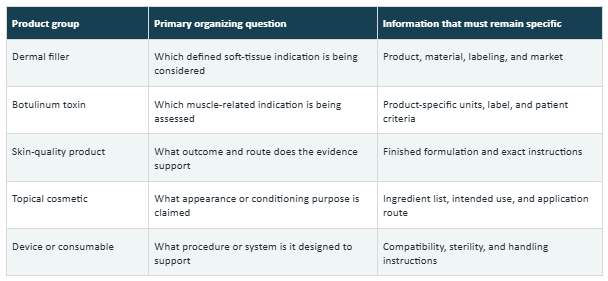
Dermal fillers, botulinum toxin medicines, skin-quality products, topical cosmetics, and consumables should have separate records. Their clinical roles and governance needs differ. Even within one group, products should be evaluated individually rather than assumed to share the same indications or handling rules.
FDA resources on approved fillers illustrate the importance of exact product identity. The agency links approval information with the relevant device and indication. That structure is more useful for a U.S. clinic than a broad statement that hyaluronic acid is an established aesthetic ingredient. [1]
Botulinum toxin products introduce a different issue: potency units are specific to the preparation and assay. The U.S. Jeuveau label explicitly states that its units are not interchangeable with those of other toxin products. A formulary should therefore preserve product-specific information rather than creating a generic unit conversion field. [2]
Topical cosmetics should remain distinguishable from products intended for injection or use with a procedure. A professional presentation or a vial does not resolve the route question. Similarly, a consumable's compatibility with one device should not be assumed to establish compatibility with every device in the same category.
Treat Emerging Categories as Research Questions
Words such as exosome, polynucleotide, and extracellular matrix can describe scientifically interesting materials. They do not make every finished commercial product equivalent. A clinic should ask what is known about the exact formulation, the proposed route, and the outcome relevant to its patients.
For extracellular vesicles, the International Society for Extracellular Vesicles' MISEV2023 guidance addresses issues such as terminology, separation, characterization, and functional investigation. It is a research framework, not an approval list or a certificate of efficacy for a product sold with an exosome label. [3]
The FDA's consumer information on regenerative medicine states that there are no FDA-approved exosome products. A clinic should not turn a cosmetic ingredient story into an approved hair-restoration or injectable-treatment claim. The relevant distinction is between the science under investigation and what a particular product is authorized and demonstrated to do. [4]
Create a separate emerging-products register. Record the proposed use, the strongest available source, the important unknowns, and the evidence that would change the decision. This makes it possible to follow developments without allowing enthusiasm to become an undocumented clinical policy.
Avoid the opposite mistake as well. Limited evidence does not prove that a technology can never be useful. It means the present decision should reflect the present evidence. A clinic can remain open to future research while declining to make claims that the current data cannot support.
Use an Evidence Note Instead of a Promotional Summary
For each candidate product, write a short evidence note with four elements: identity, intended use, applicable evidence, and limitations. The note should be understandable to the clinician who will explain the service and the staff member who will answer a basic product question.
Product identity includes the full name, manufacturer, presentation, and relevant market version. Intended use should be described precisely enough to distinguish the product from adjacent categories. Applicable evidence should name the study or official document that supports the actual claim being considered.
Limitations deserve their own paragraph. These may include a small study, an uncontrolled design, a short follow-up period, a different treatment area, or a lack of direct comparison with the clinic's existing option. Writing the limitation clearly is more useful than adding a general phrase such as results vary at the end of a strong promise.
Use the note to identify unsupported language before it enters patient materials. Terms such as guaranteed, permanent, painless, or superior require careful scrutiny. If a claim cannot be traced to suitable evidence, remove it. Adding an attractive adjective should not be easier than establishing the fact it implies.
Decide When Two Products Are Truly Different
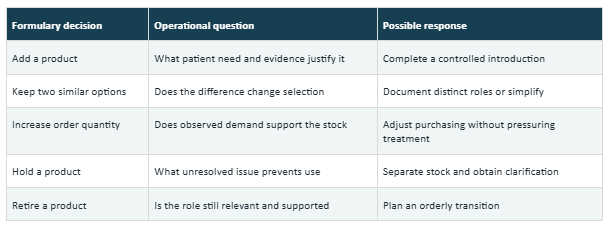
A clinic can accumulate near-duplicate products because each supplier presents a slightly different advantage. Before adding another item, ask whether the difference changes a decision for an identifiable patient group. If nobody can explain when one option would be selected over the other, the distinction may be commercially interesting but operationally unhelpful.
Compare the proposed addition with the current option using the same outcome. A product studied for hydration should not be ranked against one studied for contour correction as if both answered a single question. Keep the treatment area, population, and follow-up period visible in the comparison.
Consider whether the new product requires different training, consent information, storage, or follow-up. Those requirements are not reasons to reject innovation automatically. They are part of the work needed to introduce it responsibly. A small apparent purchasing advantage can disappear when these additional demands are considered.
Set a review point after an appropriate introductory period, without promising clinical results in advance. The review can examine documentation quality, staff understanding, practical workload, and patient communication. Any clinical outcome analysis should be designed and interpreted by the responsible professionals, with the relevant governance requirements considered.
Build Product Records That Survive Staff Changes
An internal product record should be useful on an ordinary busy day. Put the exact product name and current status at the top. Link or attach the current instructions within the clinic's own system, identify the record owner, and state when the information was last checked.
Avoid storing the only useful information in a sales representative's email thread. Staff should not need to search personal inboxes to identify a package or understand whether it has been approved for use. Centralized records also make it easier to see when two documents disagree.
Keep versions. When instructions, packaging, or market status change, preserve enough history to understand what information applied to previous purchases and care. A revised document should not silently overwrite the context needed to review an earlier event. The exact record retention approach belongs to the clinic's professional and legal requirements.
Make uncertainty visible. If a translation, route, or presentation needs clarification, mark the record accordingly. A blank field can look like an administrative omission, while a clearly stated unresolved question prompts an appropriate decision. The purpose is to prevent missing information from being mistaken for a favorable answer.
Connect the Formulary with Inventory Planning
An inventory list answers how much stock is present. A formulary answers why the clinic carries it and under what conditions it is considered. Keep the two connected so that a product cannot remain in routine purchasing simply because it has always appeared on a reorder sheet.
Forecast demand from the actual service, not from the supplier's minimum order quantity. Consider the number of relevant consultations, the proportion likely to lead to treatment, and the capacity for follow-up. These are planning assumptions that should be updated with real operational information rather than treated as guaranteed demand.
Review expiry exposure by product. A slow-moving item may deserve a smaller order, a different purchasing schedule, or removal from the active range. Avoid using a looming expiration as a reason to recommend a service. The patient's assessment should determine the treatment, while inventory planning should support that assessment.
Where a product comes in a single-dose container, respect the applicable handling requirements. CDC guidance explains that single-dose vials are intended for a single patient and procedure. Business planning should not depend on routine sharing of leftover contents. [5]
Explain the Range to Patients without Selling a Menu
Patients need a description of the concern and the proposed approach before they need a list of brands. A consultation that begins with a menu can make treatments seem interchangeable and encourage decisions based on package names. Explain why a category is relevant and what it cannot accomplish.
Use patient-facing language that corresponds with the evidence note. If the internal review identifies uncertainty about duration, the public description should not promise a fixed number of months. If the evidence concerns a narrow outcome, avoid expanding it into a general claim of reversing aging.
Present alternatives in a way that makes them usable. These can include a different treatment category, a simpler routine, referral, or no intervention. The patient should understand why an alternative may fit their circumstances, not merely see it listed as a formality at the bottom of a consent form.
Ask what burden the patient is willing to accept. Cost, recovery, maintenance, discomfort, and time away from work can matter as much as the visible outcome. A technically appropriate option may still be a poor personal fit. The consultation should make that preference part of the decision.
Train the Team to Recognize Category Errors
Front-desk and marketing staff do not need to make clinical decisions, but they should recognize when a question requires a clinician. A useful training exercise is to present several common statements and ask what information is missing. The exercise can reveal where familiar sales language has replaced precise understanding.
Examples include the assumption that all fillers dissolve the same way, that all toxin units can be compared directly, or that every skin booster is intended for injection. Staff should learn to stop at those assumptions and request the exact product information. The goal is accurate routing of questions rather than improvised advice.
Create approved short explanations for recurring inquiries. A patient asking whether a product is better should hear that the answer depends on the concern, the exact formulation, and the evidence. That explanation can be both helpful and concise without becoming a claim that every product is equally suitable.
Review patient-facing materials when a new product enters the range. Website copy, booking descriptions, printed information, and staff language should agree. A careful clinical review loses value if an old promotional sentence remains on the booking page and shapes the patient's expectations before the consultation.
Evaluate a Supplier Conversation by Its Specificity
A productive supplier conversation provides exact answers or clearly identifies what needs further confirmation. Ask about the presentation, manufacturer documentation, relevant distribution arrangements, and the process for technical questions. A supplier's willingness to acknowledge a limit is useful information.
Be cautious when every question receives the same broad reassurance. Statements such as used worldwide or professional grade do not resolve product identity, authorization, or route. Ask which document supports the specific point. If the answer concerns a different product or market, record that limitation.
For a broader view of medical aesthetic products, category browsing can help the team understand current commercial terminology. Bring that information into a structured review rather than treating the homepage as an independent clinical authority. This article does not represent an audit or endorsement of any distributor.
The best outcome of a supplier meeting may be a shorter list. Removing items that do not fit the clinic's services can improve clarity and reduce work. The purpose of procurement is to support appropriate care, not to demonstrate how many products the clinic knows about.
Give Each Product a Clear Exit Plan
Clinics often plan how to introduce a product more carefully than how to stop using it. Define the circumstances that would trigger review: a change in authorization, unresolved quality concerns, revised instructions, an evidence problem, or a loss of relevance to the clinic's services.
Distinguish temporary hold from permanent removal. A shipping discrepancy may require investigation of one lot, while a broader issue may affect the product's status. The responsible professional should determine the scope. Staff need a clear instruction about what can and cannot be used while the issue is reviewed.
Plan patient communication if a change affects ongoing care. Explain what has changed, what remains known, and what follow-up is appropriate. Avoid giving a blanket reassurance before the relevant facts are understood. Equally, avoid alarming patients with speculation when the issue is administrative and does not establish a clinical problem.
Review the active range periodically. Ask whether each product still has a defined role, current documentation, and a team able to explain it. A product can leave the formulary because it adds little value, even if no safety issue has occurred. Simplification is a legitimate quality improvement.
Run a Formulary Decision through a Realistic Scenario
Consider a fictional clinic evaluating a new product that appears to overlap with an existing category. The supplier describes it as innovative, and several patients have asked about it. Those facts justify reviewing the product, but they do not yet establish a reason to add it to the range.
The clinical lead first defines the unmet need. If the team cannot identify which patient concern the product would address differently, the comparison is not ready for a purchasing decision. The next step is to assess the exact product evidence and local eligibility, then determine what training and operational changes would be required.
The inventory lead separately estimates the practical consequences of adding another item. More choice can mean additional storage requirements, expiration exposure, staff education, and documentation. These considerations do not decide the clinical question, but they help the team understand the full commitment rather than focusing only on the introductory price.
After review, the clinic might adopt the product, defer the decision pending better information, or decline it because the existing range already meets the identified need. Each outcome can be reasonable when the rationale is documented. A mature formulary process is capable of saying that a product is interesting without immediately adding it.
The same scenario can become a staff-training exercise. Ask each team member what information they would need for their role and which questions belong to someone else. This makes the review easier to maintain because the work is distributed deliberately rather than left to whichever employee happens to receive the sales email.
Frequently Asked Questions
Is a large product range a sign of a better clinic
Not by itself. A useful range reflects the concerns the clinic can assess and the services it can support. More products create additional training, documentation, inventory, and follow-up demands. Ask whether each item has a distinct purpose. A smaller range with clear reasoning can be easier for both staff and patients to understand than a broad menu of overlapping options.
Should products be compared by their main ingredient
The main ingredient is a starting point, not a complete comparison. Finished formulations can differ in material properties, concentration, route, evidence, and intended use. Keep the exact product name and presentation attached to every claim. If the comparison drops those details, it may be comparing categories while appearing to compare specific products.
Can a cosmetic product be used with any professional procedure
No such assumption should be made. The intended route and relevant instructions need to support the proposed use. A procedure that changes the skin barrier can raise different safety questions from ordinary surface application. The clinician should evaluate the exact combination rather than assuming that a product labeled professional is suitable for every device or technique.
Does an international catalog establish availability in the United States
No. Online availability and U.S. authorization are different facts. Verify the exact product and applicable supply route with authoritative records. This is particularly relevant when brand names or presentations vary across markets. A catalog can identify an item for research without establishing that a U.S. clinic should purchase or administer it.
What makes a comparison table clinically useful
It uses the same question for every product and keeps the population, treatment area, outcome, and follow-up visible. It also shows where information is missing. A table that ranks products using unrelated percentages creates false precision. A useful table may conclude that a direct comparison cannot be made with the available evidence.
How often should the internal product list be reviewed
Set a routine interval appropriate to the clinic, and review sooner when a material change occurs. Examples include new instructions, a new supplier, a different presentation, or a relevant safety communication. The important point is ownership: someone must be responsible for keeping the record current and communicating changes to the people who use it.
What should a clinic do with a promising but poorly documented product
Keep it in a research register while seeking the missing information. Specify what evidence or documentation would be needed to reconsider it. This preserves interest without confusing investigation with permission for routine use. If the required information remains unavailable, the clinic can explain why the product has not entered its active range.
Create a Range the Team Can Explain
Select five products already on the clinic's list and ask the team to state the purpose, exact identity, strongest applicable evidence, and principal limitation for each. Use any gaps to improve the records before expanding the range. A good formulary gives clinicians and patients clearer decisions, and it gives purchasing a defined clinical purpose.
References
1. U.S. Food and Drug Administration. FDA Approved Dermal Fillers. Product evaluation resources.
2. Evolus. JEUVEAU PrabotulinumtoxinA xvfs Prescribing Information. U.S. labeling available through DailyMed.
3. Welsh JA, et al. Minimal Information for Studies of Extracellular Vesicles MISEV2023 From Basic to Advanced Approaches. Journal of Extracellular Vesicles. 2024;13:e12404.
4. U.S. Food and Drug Administration. Consumer Alert on Regenerative Medicine Products Including Stem Cells and Exosomes. 2020.
5. Centers for Disease Control and Prevention. Safe Injection Practices and Your Health. Patient and professional education.
6. U.S. Food and Drug Administration. Tips to Help Health Care Providers Safely Purchase Drugs From Pharmaceutical Distributors. Provider guidance.
Sources checked October 10, 2026. The workflow recommendations are an editorial framework, not a supplier audit or a replacement for professional governance.
HOW DO YOU FEEL ABOUT FASHION?
COMMENT OR TAKE OUR PAGE READER SURVEY
Featured





Online research supply markets have expanded, giving laboratories and independent researchers more ways to explore specialized materials.