
AI Screenwriting Software Should Track Garment Continuity

PAGE
By PAGE Editor
A fashion film can hold a flawless mood and still lose its story through a sleeve. A coat is pristine in the departure scene, rain-darkened after an argument, then inexplicably clean in the close-up that follows. A borrowed dress becomes the protagonist's property without a handoff. These are not merely wardrobe mistakes; they alter time, intimacy and consequence.
AI Screenwriting Software can make garment state easier to inspect when clothing is treated as a persistent story object rather than decorative prompt material. Laper supports props with descriptions, visual references and ownership across scenes while keeping the screenplay responsible for what the audience actually sees. The useful question is not whether the images share a palette. It is whether the garment tells the same story.
Compare Mood First With Continuity First
A mood-board-first process begins with colour, texture and reference images. It can establish a strong world quickly, but the garment often remains an interchangeable styling element. A continuity-first process begins with the object's narrative job: who owns it, how it changes and what the viewer should infer from that change.
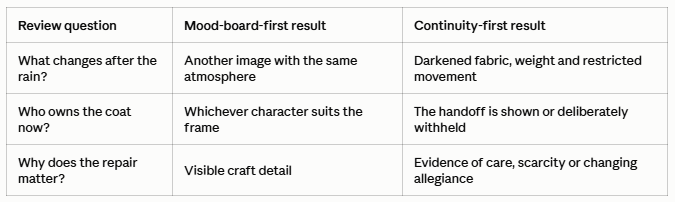
The two approaches are not enemies. Mood defines the visual field; continuity gives its details memory. The strongest workflow uses a concise visual direction, then tests every attractive choice against the garment's state and dramatic meaning.
Choose One Garment To Carry The Story
Do not build a ledger for every sock and earring. Pick the garment whose condition or ownership affects the story. It might be a tailored jacket inherited from a parent, a uniform altered after a protest, or a dress returned with a repaired seam. Give it one identifiable silhouette and only the details the camera can reveal.
Create a prop record for that item and attach a restrained reference: front, back, closure and one material detail. Laper can keep those references with the persistent object. The reference supports shared recognition; it should not turn a designer's protected work into a template for imitation.
Track State At Every Narrative Turn
A garment state is more than clean or dirty. Record the changes that carry meaning: buttoned or open, owned or borrowed, carefully repaired or hastily pinned, worn with confidence or used as cover. Each state should have a cause on the page and a visible consequence later.
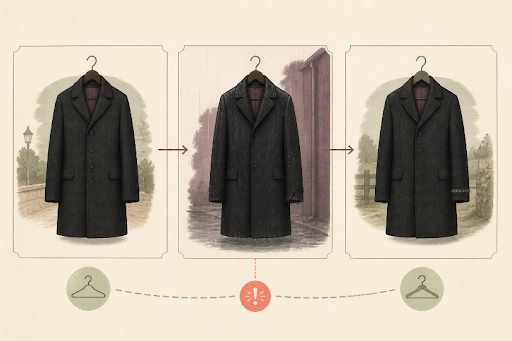
For a three-scene film, the ledger can remain small. Scene one: the protagonist borrows the coat and keeps it buttoned. Scene two: a cuff tears as she leaves a confrontation. Scene three: the owner notices a contrasting repair. The stitch now proves an offscreen decision and changes the final exchange.
Write The Transition Not Just The Look
If the audience must understand how a garment changed hands, write the transfer. A coat left on a chair, exchanged at a doorway or returned inside out can carry more story than a dialogue explanation. If the transfer is meant to be a reveal, plant the earlier state clearly enough that the absence registers.
The screenplay remains the authority for those observable actions. A prop card may say that the jacket belongs to Mara, but the audience only knows what a scene establishes. When the card and page disagree, revise the intended source rather than quietly allowing two versions of ownership.
Let Material Behaviour Shape The Actor's Blocking
Fabric changes performance. A soaked wool coat adds weight; a tight repaired seam limits a reach; a loud synthetic shell makes a hidden movement audible. These are physical hypotheses for costume tests, not facts the software can guarantee. Still, writing the expected effect gives wardrobe, performers and camera a specific question to answer.
Use Visual Generation As A Continuity Test
Laper separates Script projects from Cinema projects, which is useful discipline. Develop the garment's actions and meaning in the screenplay first. Then use the visual workflow to compare frames for silhouette, closure, damage and ownership. A beautiful frame that contradicts the approved scene is a failed test, not a better draft.
An AI screenplay software workflow should generate a narrow set of references rather than a pile of variations. Hold the character, garment identity and scene state constant; change only the framing or action being evaluated. This makes drift visible instead of hiding it inside creative abundance. A separate AI screenplay software pass can then compare those fixed details without pretending to judge taste.
Run A Four Detail Dirty Test
Place three representative frames side by side and ignore their polish. Check four details: the garment's silhouette, its closure, the location of damage or repair, and who is wearing or carrying it. If any detail changes without a scripted cause, mark the frame for correction.
Then repeat the test in grayscale. Colour harmony can make mismatched construction feel coherent. Removing colour forces attention onto shape, contrast and placement. The test is deliberately crude; its job is to expose continuity errors before they reach a costly shoot or edit.

Know The Limits Of Garment Continuity Software
Laper can organise prop descriptions, references, scene context and visual development. It cannot certify that a fibre is sustainable, predict exactly how fabric will move, clear a design for use or replace a costume professional's fitting. Material claims require supplier evidence; physical behaviour requires testing with the real garment and performer.
Review Narrative Meaning Before Approving Visual Beauty
After continuity passes, ask what the garment communicates in each appearance. A repair may signal resourcefulness, care, economic constraint or appropriation depending on who made it and who sees it. The screenplay should earn that reading through action rather than relying on a production note the audience never receives.
Treat AI Screenwriting Software as an inspection surface, not as the wardrobe department's memory. The useful artifact is a discrepancy a human can resolve: the cuff tear moved sides, the coat returned before the scripted handoff, or the repair appears before it was made. That language leads to a production decision; “the look feels inconsistent” rarely does.
Check Sustainability Claims Against The Plot
A film about conscious fashion should not treat visible mending as automatic proof of ethical production. Mending can show extended use, but it says nothing by itself about labour, fibre sourcing or disposal. If the story makes a broader claim, identify the evidence and the character with reason to know it.
Laper can keep the approved reference, garment record and linked scenes near one another during review. The editorial team still decides what is materially true, culturally responsible and legally usable. That boundary prevents the continuity system from becoming a machine for confident but unsupported fashion claims.
A final costume note should name the approved state for each scene and the evidence used to approve it: script action, fitting photograph or continuity still. If a later visual experiment changes the garment, route the change back through the screenplay or prop record. Do not let an attractive output become canon merely because it arrived last.
The final frame should satisfy two tests at once. A viewer can trace the garment's physical history without reading a ledger, and its present condition changes how they understand the character. When both are true, continuity stops being clerical control and becomes visual storytelling.
HOW DO YOU FEEL ABOUT FASHION?
COMMENT OR TAKE OUR PAGE READER SURVEY
Featured





Discover the biological, sensory, and psychological reasons why kids prefer sweet foods over vegetables.