
How to Build a Home Maintenance Calendar That Actually Saves You Money
PAGE
By PAGE Editor
Most homeowners don't have a maintenance plan. They have a list of things they keep meaning to do, somewhere between "change the furnace filter" and "figure out why that faucet drips." Then something breaks, the timing is always terrible, and the bill is always bigger than it needed to be. That is the reactive trap, and it costs more than just money.
A structured home maintenance calendar flips that pattern. You move from putting out fires to preventing them, and your home stops being a source of financial dread. Here is exactly how to build one that you will actually stick to.
Why Reactive Homeownership Is So Expensive
Think about the last time something broke in your house. Odds are it was not on a Tuesday morning in May when you had free time and a fully funded emergency account. It was mid-December, right before guests arrived, or in the middle of a July heat wave when every HVAC technician in the region had a six-day backlog.
That is not bad luck. That is a predictable outcome of deferred maintenance. Pipes under stress from temperature swings finally give out in winter. Air conditioners pushed past their limits fail in peak summer. Drains that have been slowly accumulating grease and buildup back up at the worst possible moment, like Thanksgiving morning, when you have 14 people arriving and one bathroom.
The fix is not willpower. It is a calendar.
The Four-Season Spiral Framework
Rather than a flat annual checklist you tick through once and forget, think of home maintenance as a Four-Season Spiral: each season both closes out the previous one and prepares for the next. Nothing is ever fully done, but everything stays ahead of failure. Here is how it looks broken into quarterly priorities:
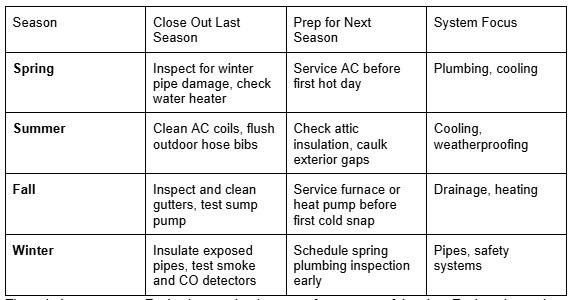
The spiral part matters. Each winter task primes you for a successful spring. Each spring task keeps summer manageable. The goal is never to react. It is to already be three months ahead.
Which Home Systems Deserve a Dedicated Budget Line
Not all maintenance tasks cost the same, and not all systems carry equal risk if they fail. Before you can schedule smartly, you need a realistic picture of where the money goes.
American homeowners poured $827 billion into home improvement projects during the two-year period ending in 2023, according to the latest U.S. Census Bureau American Housing Survey. That number reflects everything from full kitchen remodels to small repairs. What makes it useful for planning is the breakdown: HVAC projects alone accounted for $27.8 billion across 3.9 million projects in the same survey period, according to the 2023 American Housing Survey published by the U.S. Census Bureau.
That tells you something important: HVAC is one of the most frequently addressed systems in the country, and the costs pile up fast when it is neglected. Plumbing follows a similar pattern. Slow leaks, aging water heaters, and corroded pipes all carry compounding costs the longer they sit.
A reasonable budget rule: set aside 1 to 2 percent of your home's value per year for maintenance across all systems. Split that by priority. Heating and cooling typically deserve the largest share, followed by plumbing, roof, and electrical. Your specific home's age will shift those numbers, but the principle holds.
Timing Is Everything: When to Call a Pro
Some tasks belong on a DIY checklist. Replacing a furnace filter, cleaning a dryer vent, testing GFCI outlets, and flushing your water heater are all reasonable weekend tasks for a confident homeowner. But there is a category of work where the cost of getting it wrong far exceeds the cost of professional labor from the start.
Slab leaks, gas line issues, main sewer line clogs, and water heater replacements all belong in the "call a professional" column. So does anything involving your AC refrigerant or your home's electrical panel. The money you spend on a trained technician is almost always less than the water damage, structural repairs, or safety hazard that follows a well-intentioned DIY attempt on a system you have never worked on before.
Electrical upgrades and backup power systems also fall into this category. Trying to wire a standby power source without proper training can damage your home's electrical panel or create a serious fire hazard. Homeowners who want reliable backup power often hire professionals for generator installation in Charlotte to ensure the system is permitted and safe. A professional installer handles the complex wiring, gas line connections, and local permits. This keeps your home safe and ensures the system works when the power goes out.
This is where your calendar becomes a sourcing tool, not just a reminder system. When you schedule ahead instead of reacting, you can shop around, compare quotes, and choose someone based on reputation rather than desperation. For homeowners in the San Gabriel Valley area, for example, searching out plumbing repair services in glendora before a problem escalates gives you time to vet providers and avoid the premium rates that come with emergency calls.
According to the Joint Center for Housing Studies of Harvard University's Leading Indicator of Remodeling Activity published in May 2026, total improvement and repair expenditures are projected to reach $523 billion in early 2027, with year-over-year growth of just 0.5 percent — a pace below overall inflation. That slowdown signals that homeowners are becoming more deliberate about where they spend. Proactive scheduling and professional relationships built before any emergency hits are exactly the kind of decisions that reflect that mindset.
Building Your Personal Maintenance Log
A calendar without a log is just a reminder system. The real value comes when you track what was done, by whom, and at what cost. Over three to five years, your own home's maintenance log becomes one of the most accurate predictors of what will need attention next, because you can see patterns your home is telling you.
"Deferred maintenance compounds the same way interest does. A $200 repair ignored for two years can become a $2,000 repair. The math is not on the side of procrastination." — Rachel Bogardus Drew, Director of the Remodeling Futures Program, Harvard Joint Center for Housing Studies, as reported in industry coverage of the 2026 LIRA findings.
Your log does not need to be complicated. A shared spreadsheet or even a notes app folder organized by system works fine. What matters is that it captures the following for every service event:
Date of service and the system or item addressed
Who performed the work (company name and contact number)
What was found, what was done, and what was recommended for the future
Total cost, broken out if possible by labor and parts
Next suggested service date or interval
That last point is often the most valuable piece of information a technician gives you, and most homeowners never write it down. A furnace technician who tells you the heat exchanger is showing early wear and to plan for replacement in two seasons has handed you a budget line item. Put it on the calendar immediately.
One Final Check Before You Start
Before you fill in a single date on your new calendar, walk your home once with fresh eyes. Look at every water-using appliance, every drain, every exposed pipe, and every vent. Note anything that looks corroded, cracked, slow-moving, or unfamiliar. That walk is your baseline. Everything your calendar does from that point forward builds on it.
A well-maintained home is not one where nothing ever goes wrong. It is one where you see problems coming and choose when to address them, on your terms, at fair prices, without the panic. Your calendar is how you get there. Start it this week, not this month.
HOW DO YOU FEEL ABOUT FASHION?
COMMENT OR TAKE OUR PAGE READER SURVEY
Featured





Coordinate apartment painting and flooring with a practical plan for dusty work, skirting boards, access, floor protection, and final touch-ups.