
Tank vs. Tankless Water Heater: Which Upgrade Is Right for Your Home
PAGE
By PAGE Editor
Your water heater is probably the most ignored appliance in your house, right up until you're standing under a cold shower at 7 a.m. wondering what went wrong. Here's the uncomfortable truth: if your unit is over ten years old, it's already operating past the point where most homeowners should be watching it closely. The question isn't really whether to upgrade. It's which upgrade makes sense for your specific home, your budget, and how long you plan to stay.
The tank vs. tankless debate sounds simple on paper, but the right answer depends on four or five variables that most buying guides skip entirely. This breakdown covers lifespan, energy costs, real installation numbers, and a practical framework for making the call before an emergency makes it for you.
How Long Your Water Heater Actually Lasts
Most homeowners vastly overestimate how much life is left in their unit. Traditional tank water heaters typically last 8 to 12 years, while tankless systems can run 15 to 20 years or more with proper maintenance, according to manufacturer data and home inspection benchmarks. That gap is not trivial. A tankless unit installed today could still be running when a tank model bought the same year has already failed twice.
Water quality shortens these numbers fast. Homes in areas with hard or mineral-heavy water see sediment accumulate at the bottom of tank heaters much sooner than the national averages suggest. A home on Oahu, for example, where mineral content in the water supply can stress tank components steadily year-round, may see a standard gas tank hit its ceiling closer to eight years than twelve. That's why working with a knowledgeable oahu plumbing company matters: a local technician knows exactly what the regional water conditions will do to your specific unit over time.
The practical takeaway? Pull out your water heater's serial number right now. The manufacture date is usually embedded in the first few characters. If the unit is eight years old or older, start budgeting. If it's past ten, start shopping.
The Energy Cost You're Already Paying
This is the part most homeowners miss. Your water heater isn't a background appliance. According to the U.S. Energy Information Administration's Residential Energy Consumption data, water heating accounts for roughly 12% to 13% of total household electricity consumption, making it one of the top three energy draws in the average home.
A traditional storage tank is the main reason for that bill. It keeps 40 to 50 gallons of water hot around the clock, burning energy whether you need hot water or not. That constant standby loss is pure waste, and it compounds every single day. The older the tank, the worse its insulation, and the more energy it burns just to hold temperature.
Tankless systems cut this by heating water only when you turn on a tap. ENERGY STAR certified gas tankless water heaters save a family of four approximately $95 per year, or roughly $1,800 over the unit's lifetime compared to a standard gas storage model, according to ENERGY STAR's certified product savings data. For lower-usage households using 41 gallons or less of hot water daily, the U.S. Department of Energy estimates tankless systems can be 24% to 34% more energy efficient than their tank equivalents.
Neither number will retire you. But over 20 years of operation, the efficiency gap becomes meaningful, especially when you factor in the energy cost trajectory over time.
Tank vs. Tankless: A Side-by-Side Look
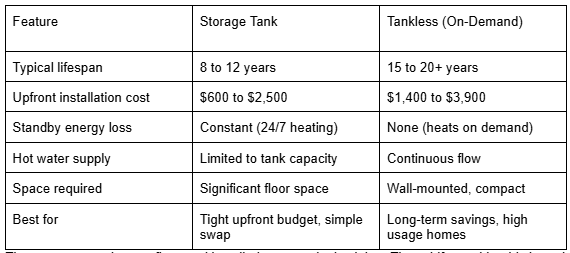
The cost ranges above reflect total installed costs, unit plus labor. They shift considerably based on whether you need gas line upgrades, new venting, or electrical panel changes to support the new unit.
The Cold-Shower Clock: A Decision Framework
Before you call anyone, run through what I call the Cold-Shower Clock, a four-point diagnostic that tells you whether you're looking at a repair, a like-for-like replacement, or a full upgrade.
Check the age. Under eight years old and no active leak? A targeted repair is probably right. Eight to twelve years with recurring issues? Budget for replacement. Over twelve years? Replace it now, on your timeline, not the unit's.
Run the 50% rule. Get a repair quote. If it's more than half the cost of a new unit, replace instead of repair. Paying $700 to fix a unit that costs $1,200 new is a poor trade.
Audit your hot water habits. A household that runs two showers, a dishwasher, and a washing machine simultaneously is a candidate for tankless. A single person in a one-bedroom condo probably does not need one.
Look at your utility rate trajectory. If your electricity or gas costs have risen steadily over the past three years, the efficiency savings from a tankless system compound faster than static calculations suggest.
Work through all four points before you commit. Skipping one usually leads to either overspending on a tankless system a household doesn't need, or under-investing in a tank replacement that fails in three years anyway.
What Installation Actually Costs and Where Surprises Happen
The sticker price on a water heater is not your total cost. Labor typically runs $150 to $450 for a straightforward tank replacement and $600 to $1,900 for a tankless install. Those ranges climb fast when code compliance enters the picture.
Older homes frequently need updated venting, expansion tanks, or gas line upgrades before a new unit can be installed legally. An unpermitted installation can void the manufacturer's warranty entirely and create real liability problems when you go to sell the home. Get an itemized estimate before work begins, and make sure it spells out exactly what is and isn't included.
"Once your unit is nearing the end of its expected lifespan and repairs are piling up, replacement almost always makes more sense and comes with the added benefit of a new warranty." — Rheem water heater industry guidance, March 2026
Switching from a tank to a tankless system mid-emergency is also the most expensive way to do it. After-hours dispatch fees, expedited unit delivery, and reduced negotiating room all push costs up when you're without hot water and under pressure. Planning the upgrade six to eighteen months before a failure is the move that keeps costs manageable.
Making the Call
If your current tank is under eight years old and just needs a minor part, repair it. If it's between eight and twelve years and showing signs like rusty water, rumbling sounds, or a puddle near the base, start pricing both a tank replacement and a tankless upgrade. If it's past twelve years, the decision is already made for you: replace it, and use this window to choose between systems deliberately rather than frantically.
Tankless wins on lifespan and long-term energy savings. Tank wins on lower upfront cost and simplicity, especially if you're replacing like-for-like. Neither choice is wrong if it matches your actual usage patterns and financial situation.
What's one thing most homeowners wish they'd done differently? They wish they'd started the conversation before the cold shower forced it.
HOW DO YOU FEEL ABOUT FASHION?
COMMENT OR TAKE OUR PAGE READER SURVEY
Featured





Coordinate apartment painting and flooring with a practical plan for dusty work, skirting boards, access, floor protection, and final touch-ups.