
Are Ceiling Fans With Lights Outdated?
PAGE
By PAGE Editor
No, ceiling fans with lights are not inherently outdated. What can feel dated is a poorly chosen fan: a bulky light kit, an old builder-grade finish, visible pull chains, or proportions that do not suit the room. Current fan-light designs can be much cleaner, with integrated LEDs, remote controls, quieter DC motors, adjustable lighting, and compact decorative forms. The more useful question is not whether a ceiling fan has a light, but whether the fan, light, size, mounting height, and finish work together as part of the room.
What Makes a Ceiling Fan With Light Look Outdated?
A ceiling fan can look old-fashioned even when it still works perfectly. In most cases, the problem is not the idea of combining airflow and lighting. It is the way the fixture was designed or installed.
Bulky bowl-style light kits
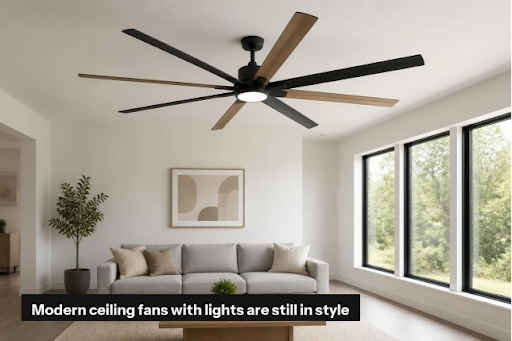
Deep frosted-glass bowls and oversized multi-bulb light assemblies can make a fan feel heavier than the room needs. That is especially noticeable on standard-height ceilings, where every extra inch below the motor becomes part of the sight line. A glass shade is not automatically dated, but a light kit that looks visually separate from the fan can make the whole fixture feel less intentional.
Builder-grade finishes
Polished brass, dated oak combinations, and generic metallic finishes can recall older builder packages when they do not relate to the rest of the room. The same finish can still work in the right setting; the key is coordination. A fan should make sense next to the door hardware, furniture, lighting, and ceiling color rather than appearing as a leftover appliance.
Visible pull chains
Pull chains remain functional, but long dangling chains can interrupt a clean, contemporary room. Remote and wall controls have made it easier to separate operation from the visible fixture, so a fan with a simple housing often looks more current when its controls are kept out of the sight line.
Wrong proportions or mounting height
Even a stylish fan can look awkward if it is too large, too small, or mounted at the wrong height. A long downrod on an eight-foot ceiling can crowd the room, while a compact flush-mount fan may look undersized in a tall vaulted space. Scale is one of the strongest visual cues in any ceiling fixture.
What Is the Current Trend for Ceiling Fans?
The broad direction is toward simpler forms and more integrated functions. Modern does not have to mean stark or minimal, but the fan usually looks more deliberate when the motor housing, blades, light, and controls feel like one product rather than several components added together.
Integrated LED lighting
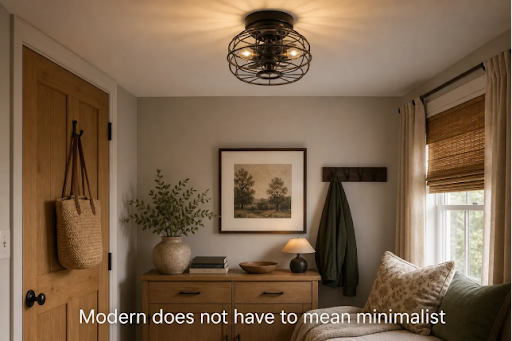
Integrated LEDs can sit flatter against the fan housing than traditional bulb-and-bowl kits. Many current models also add selectable color temperatures and dimming, so the same ceiling fixture can provide warmer evening light, brighter general light, or a lower level for bedrooms and living rooms.
Cleaner shapes and coordinated finishes
Streamlined blades, thinner light modules, matte finishes, white-on-white combinations, black housings, and wood tones are all common ways to reduce visual clutter. There is no single 'most modern' color. A white fan can disappear into a white ceiling, while a black or wood-finish fan can act as a strong architectural element.
Remote-controlled DC fans
Remote controls and DC motors have also changed how ceiling fans are designed. Multiple speed settings, reverse operation, timers, and light controls can be handled without adding visible chains. Blade count is much less important to the look or performance than the overall engineering, proportions, and documented airflow.
An Example of How Ceiling Fans With Lights Have Changed
A large-room fan is a useful example because older large fans often relied on a separate light kit hanging below the motor. A current 72-inch dimmable LED ceiling fan with light takes a different approach: the light is integrated into the center of the fixture. The model uses an 18W LED with three selectable color temperatures (3000K, 4000K, and 6000K), six fan speeds, remote control, reverse operation, and a DC motor. Its published maximum airflow is 6,872 CFM. The point is not that every room needs a 72-inch fan; it is that fan-light combinations now have far more integrated forms than the old glass-bowl stereotype.
Are Ceiling Fans Still in Style in Bedrooms?
Yes, ceiling fans can still work very well in bedrooms because the function is difficult to replace with a decorative light alone. A fan adds air movement while the light provides general illumination from the same ceiling location. That can be practical in rooms where there is only one central electrical box or where adding several fixtures is unnecessary.
The bedroom is also where the wrong fan is easiest to notice. A model that hangs too low, produces harsh light, feels oversized above the bed, or requires noisy operation can make the room feel less comfortable. For a bedroom, it is usually more useful to compare installed height, fan diameter, motor noise information, dimming, warm light options, remote control, and timer functions than to chase a particular design trend.
Are Ceiling Fans in Living Rooms Outdated?
A ceiling fan in a living room is not automatically outdated. The larger question is whether it belongs in the composition of the room. In one home, a white fan may blend into the ceiling so the furniture and art stay visually dominant. In another, a large black or wood-tone fan may be treated as an architectural feature.
Problems start when the fan competes with the room rather than supporting it. An undersized fan in a great room can look incidental, while an oversized fixture in a small living room can dominate the ceiling. A mismatched light color, bulky housing, or low mounting height can also make a newer fan look older than it is.
Why Do Some Designers Dislike Ceiling Fans?
Designers sometimes prefer chandeliers, pendants, or recessed lighting because those fixtures can be selected primarily for appearance. A ceiling fan has to solve a second problem: moving air. That extra function can make the fixture larger and more visually complex.
The criticism is usually strongest when the fan interrupts sight lines, uses a dated light kit, or feels out of scale with the room. In warm climates or rooms that benefit from regular air circulation, removing the fan can also remove a useful comfort feature. The better design question is whether the airflow function can be integrated without making the ceiling feel cluttered.
What Are People Replacing Ceiling Fans With?
Homeowners who remove ceiling fans often replace the lighting portion with chandeliers, pendants, recessed lights, sconces, or layered lamps. Those choices can improve the visual focus of a room, but they do not perform the same job as a fan.
A chandelier can replace decorative overhead lighting, and recessed lights can replace general illumination, but neither creates the same air movement. Portable fans or an HVAC system may handle comfort in some homes. Before replacing a ceiling fan, it helps to decide whether the goal is to replace its appearance, its light, its airflow, or all three.
Is It Better to Get a Ceiling Fan With or Without a Light?
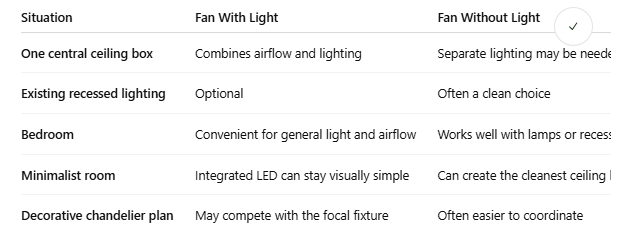
Neither option is automatically more modern. A fan without a light can look extremely clean in a room that already has recessed or decorative lighting. A fan with a well-integrated light can be the more practical choice when one ceiling fixture needs to provide both airflow and general illumination.
Can a Ceiling Fan Light Be the Main Light in a Room?
Sometimes, but not always. The answer depends on actual light output, room size, ceiling height, diffuser design, color temperature, wall colors, and how the room is used. An integrated light may be perfectly adequate for circulation areas or general bedroom lighting but insufficient for detailed tasks, reading corners, or a large open-plan space.
It is better to think in terms of layered lighting. A ceiling fan light can provide ambient illumination while table lamps, floor lamps, sconces, or recessed lights add task and accent lighting. Wattage alone is not a reliable measure of how bright a room will feel; published lumen output and light distribution are more useful.
Modern Does Not Have to Mean Minimalist
Not every current fan-light design is a flat LED disc with long exposed blades. A compact caged ceiling fan with light shows the opposite direction: the fixture behaves visually more like a decorative cage light, while the fan is contained within the compact form. This 11.8-inch flush-mount model uses seven ABS blades, a DC motor, six speeds, reverse operation, a timer, and remote control. Its light uses three E12 bulbs, allowing the bulb style and color temperature to be changed rather than relying on one permanently integrated LED module.
That distinction matters because 'modern' is not one look. Some rooms benefit from an integrated fan that visually disappears, while others benefit from a fan-light fixture that is intentionally decorative.
How to Choose a Ceiling Fan With Light That Won't Look Dated
1. Match the fan size to the room
Choose the diameter for the actual space rather than simply selecting the largest fan that fits. The fan should feel proportionate to the room and have documented airflow appropriate for the intended use.
2. Match the mounting style to the ceiling height
Flush-mount and low-profile fans can make sense on lower ceilings, while taller spaces may need a downrod to bring the fan to a useful operating height. The goal is proper clearance and balanced proportions.
3. Look closely at the light module
Check whether the fan uses integrated LED lighting or replaceable bulbs, and compare published brightness, color temperature, dimming, and replacement options. A sleek light that performs poorly is not a good upgrade.
4. Choose finishes in context
Black, white, nickel, brass, and wood tones can all work. The more durable choice is usually the one that relates to the room's hardware, furniture, ceiling color, and overall style.
5. Compare airflow, not just appearance
A ceiling fan remains an air-moving appliance. Decorative styling should not replace the basic comparison of fan size, published airflow, speed settings, motor type, and room suitability.
6. Consider the controls
Remote or wall controls can keep operation simple and reduce visible clutter. Smart features can be useful when they are genuinely supported, but they are not necessary for a fan to look current.
7. Decide whether the fan should blend in or stand out
A successful ceiling fan can either disappear into the ceiling or act as a statement fixture. Problems usually occur when it unintentionally falls somewhere in between.
Style Is Only One Part of Choosing the Right Ceiling Fan
Brands such as Breezary offer ceiling fans across very different formats, from large integrated-LED models to compact decorative fan-light fixtures. That range is a useful reminder that 'ceiling fan with light' is no longer one narrow design category.
Whichever style you prefer, the important specifications are still practical: fan diameter, documented airflow, lighting output, controls, mounting method, ceiling height, and location rating. A fixture that fits those requirements is more likely to feel intentional for years than one selected only because it follows a short-lived trend.
So, Are Ceiling Fans With Lights Outdated?
No. Ceiling fans with lights are not outdated as a category. Older builder-grade finishes, oversized glass light kits, visible pull chains, and badly proportioned installations can look dated, but current fan-light designs include integrated LEDs, adjustable lighting, remote controls, DC motors, cleaner housings, and compact decorative formats.
What looks dated is usually bulky, mismatched, or poorly scaled. What looks current is integrated, proportional, and intentional. The most lasting choice is not necessarily the newest-looking fan; it is the one that fits the room, provides the airflow and lighting you actually need, and works with the rest of the interior.
Ceiling Fans With Lights FAQs
Are ceiling fans with lights outdated?
No. The category is still useful and widely available. What can look outdated is an old-fashioned light kit, dated finish, visible pull chains, or a fan that is the wrong size or mounting height for the room.
Are ceiling fans out of style in 2026?
No single design trend has made ceiling fans obsolete. Current models range from minimal integrated-LED fans to decorative caged fixtures. The more important question is whether the fan fits the room and performs the functions you need.
What is the current trend for ceiling fans?
Cleaner housings, integrated or more intentional lighting, coordinated finishes, DC motors, remote controls, multiple speed settings, and quieter operation are common directions in current fan design.
What ceiling fans are popular right now?
There is no universal best or most popular style for every home. Minimal black or white fans, natural wood tones, large modern fans, low-profile designs, and decorative fan-light combinations can all work depending on the room.
Have ceiling fans gone out of style?
No. Some older designs have aged, but ceiling fans continue to serve a practical purpose by moving air. The appearance has changed more than the underlying function.
What are people replacing ceiling fans with?
Common alternatives include chandeliers, pendants, recessed lighting, sconces, floor lamps, portable fans, and HVAC-based circulation. These options do not all replace both the lighting and airflow functions of a ceiling fan.
What color ceiling fan is most popular?
There is no single color that is best for every room. Black, white, metallic, and wood-tone finishes are all common. The most successful choice is usually the one that coordinates with the ceiling, hardware, furniture, and overall interior.
Are ceiling fans still in style in bedrooms?
Yes. A ceiling fan can be practical in a bedroom because it combines air movement with optional general lighting. Pay attention to installed height, fan size, noise, dimming, color temperature, remote control, and timer functions.
Are ceiling fans in living rooms outdated?
No. A living-room fan can either blend into the ceiling or become a design feature. It tends to look dated when its size, finish, light kit, or mounting height conflicts with the scale and style of the room.
Why do some designers dislike ceiling fans?
Ceiling fans can be visually larger and more complex than a chandelier or pendant. Designers are more likely to object when a fan interrupts sight lines, has a dated light kit, or feels out of proportion. The concern is usually the specific fixture, not the usefulness of air movement itself.
HOW DO YOU FEEL ABOUT FASHION?
COMMENT OR TAKE OUR PAGE READER SURVEY
Featured





A comfortable home should offer more than a place to sleep and eat.