
Can an Extractor Hob Handle the Demands of Everyday Family Cooking?

PAGE
By PAGE Editor
Family cooking rarely involves just one task. A typical evening meal might include boiling vegetables, frying meat, preparing a sauce and keeping several pans moving at once. All this creates steam, grease, and cooking odors that need managing without making the kitchen uncomfortable. An extractor hob combines a cooking surface with an integrated extraction system, offering an alternative to a conventional overhead cooker hood.
However, occasional cooking is different from cooking several meals every day. Its suitability depends on extraction performance, kitchen layout, ventilation arrangements, and how the household uses the appliance.
How an Extractor Hob Works in a Busy Family Kitchen
An extractor hob combines cooking zones with a ventilation unit built into the same appliance. Instead of drawing cooking vapors upwards through a hood, the system pulls them down towards an integrated inlet, usually positioned near the center of the hob. Filters help capture airborne grease before the air is either discharged outside or treated and returned to the room.
This arrangement can be useful in kitchens where an overhead hood would interrupt the view or take up valuable space. Manufacturers such as CIARRA Appliances offer integrated cooking and extraction solutions designed around this concept. However, the inlet location, the appliance's extraction settings, and the recommended cookware arrangement all affect how effectively it captures vapors. An integrated extractor alone does not guarantee suitable performance for every cooking situation.
Can It Handle Different Types of Everyday Cooking?
For ordinary family meals, an extractor hob can handle a variety of cooking activities when its capacity matches the household's needs. Boiling pasta, preparing vegetables, simmering sauces and heating soups produce different amounts of steam and airborne emissions. These activities do not place identical demands on the extraction system, so performance should be considered in relation to the way a family actually cooks.
Frying fish, browning meat and cooking food at high temperatures can be more demanding because they may release additional grease particles and stronger odors. Long cooking sessions can also build up moisture in the room. Families that regularly prepare several dishes should therefore consider the appliance's performance at different settings, rather than relying only on its maximum advertised airflow. The household's cooking habits matter as much as the appliance itself.
How Effectively Does It Manage Steam, Grease and Cooking Odors?
Steam, grease and cooking odors are often discussed together, but they are not the same problem. Grease filters collect airborne fat particles, helping prevent them from entering the internal ventilation system. In recirculating models, additional odor filters, often containing activated carbon, help reduce cooking smells before filtered air returns to the kitchen.
Moisture management requires separate consideration. A ducted system can carry moisture-laden air outside, while a recirculating system generally returns filtered air to the room. It therefore does not remove indoor humidity in the same way. This distinction becomes important during frequent boiling, steaming or extended cooking sessions. Even with effective extraction, households may need appropriate background ventilation to manage indoor moisture. Actual results depend on the appliance design, installation, filter condition, and cooking intensity.
What Happens When Several Pans Are Used at Once?
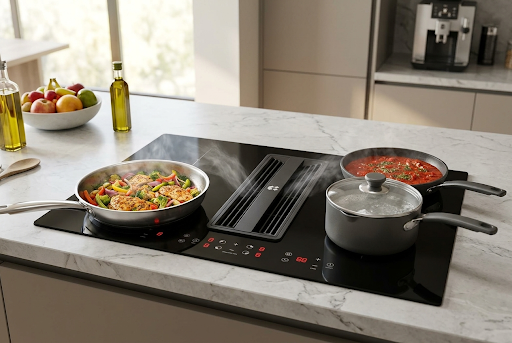
Preparing a family meal often means using more than one cooking zone simultaneously. An extractor hob can accommodate this type of cooking, but the position and dimensions of the pans can influence how well the extraction system captures rising vapours. A large frying pan placed towards the edge of the hob may behave differently from a smaller saucepan positioned directly above or near the extraction inlet.
Cookware arrangements also matter when several dishes are producing steam or grease at the same time. Families should check the manufacturer's guidance on pan sizes, cooking-zone combinations and recommended placement. Using the highest extraction setting isn't automatically the answer, especially if the system isn't positioned to capture emissions effectively. A suitable model should match the household's usual cooking patterns rather than simply having enough cooking zones on paper.
Does Kitchen Layout Affect Extraction Performance?
Kitchen layout can influence both installation and everyday use. Extractor hobs are often considered for kitchen islands because they avoid the need for a suspended overhead hood. This can help preserve an open view across the room, particularly in open-plan homes where the kitchen connects directly with a dining or living area.
However, an island installation requires careful planning. Ducted systems need a suitable route to carry air outside, while recirculating models need enough internal space for filters and airflow. Cabinet dimensions, available clearance and access for maintenance should all be checked before purchase. An enclosed kitchen has different design considerations, but it still needs appropriate ventilation. Choosing an appliance before confirming the installation requirements can create avoidable problems later.
Ducted or Recirculating Extraction – Which Is More Practical?
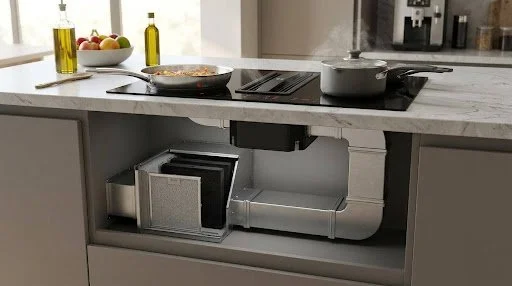
The main difference between these systems is what happens to the air after it passes through the extractor. A ducted configuration transports extracted air outside through suitable ductwork. A recirculating configuration filters the air and returns it to the kitchen. Both can help manage airborne grease, but they handle odors and moisture differently.
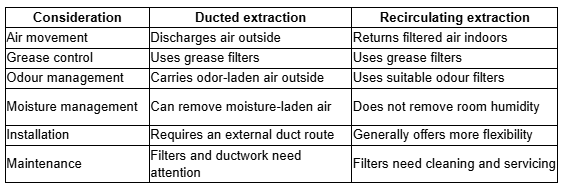
For households that cook frequently, ducted extraction can be a practical option when an appropriate external route is available. It helps remove moisture and cooking emissions from the indoor environment rather than returning filtered air. Recirculation may be more convenient where external ducting is difficult or impractical, but it requires suitable filters and separate attention to room ventilation. Neither configuration should be judged by convenience alone; the kitchen design and household's cooking habits should guide the decision.
What Maintenance Does Everyday Family Use Require?
Regular maintenance helps an extractor hob continue working as intended. Grease filters collect particles during cooking and need cleaning according to the manufacturer's instructions. Some models use dishwasher-safe filters, while others have specific cleaning requirements. The hob surface, extraction inlet and accessible collection components should also be kept clean, particularly in households where frying and high-temperature cooking are common.
Recirculating models may require activated carbon filters to be replaced or regenerated, depending on the design. These filters should not be treated as permanent components. Their service life varies by filter type and how often the appliance is used. Families should check replacement guidance before buying because ongoing filter costs can affect long-term ownership. A simple maintenance routine is easier to manage than waiting until grease build-up or reduced airflow becomes noticeable.
Where an Extractor Hob May Fall Short
Despite its practical design, an extractor hob is not necessarily the right choice for every household. Purchase and installation costs may be higher than those of a basic hob and separate extraction arrangement. The unit can also take up space beneath the worktop, which may reduce room for drawers or storage. Ducted installation can involve additional planning and building work, depending on the kitchen layout.
Noise at higher extraction settings, ongoing filter costs and the limitations of recirculating ventilation are other considerations. Families that regularly use large pans, cook at high heat, or prefer an overhead extraction arrangement should compare different designs carefully. In some kitchens, a 90cm cooker hood may be a better option, particularly when a wider overhead capture area is preferred. The right choice depends on cooking patterns, available space, and the home's ventilation requirements.
Is an Extractor Hob a Practical Choice for Family Homes?
An extractor hob can be a practical choice for family homes, particularly where several cooking tasks take place throughout the day and maintaining an open kitchen layout is important. Its integrated design removes the need for a separate overhead extraction unit, but suitability depends on more than appearance or available cooking zones. Families that regularly fry food, boil large pots or prepare several dishes simultaneously should consider the appliance's extraction capacity and how effectively it captures cooking emissions.
Installation requirements, cabinet space, noise levels and ongoing filter costs also deserve attention. Comparing these factors with actual household cooking habits can help determine whether an extractor hob offers a convenient long-term solution.
Conclusion
An extractor hob can meet the demands of everyday family cooking, provided its performance and ventilation configuration suit the household's needs. It offers a useful combination of cooking and extraction, particularly in kitchens where overhead space or an uninterrupted view matters. However, frequent high-heat cooking, moisture management, installation requirements, and filter maintenance should all influence the final decision.
No single configuration works equally well for every family, so checking technical specifications and independent performance information is important before purchasing. For households exploring integrated cooking solutions, CIARRA Appliances is worth considering when comparing available options and identifying a configuration that complements their kitchen and cooking routine.
FAQs
1. Can an extractor hob handle heavy everyday cooking?
Yes. It can handle everyday cooking, including boiling, frying, and simmering, as long as its extraction capacity suits your cooking habits.
2. Are extractor hobs effective at removing cooking smells?
Yes. They use filters to capture grease and reduce odors. However, performance depends on the filtration system and whether the unit is ducted or recirculating.
3. Is a ducted extractor hood better than a recirculating model?
A ducted model removes cooking air outdoors, while a recirculating model filters it and returns it to the kitchen. The better option depends on your installation and ventilation needs.
4. How often should an extractor hob be cleaned?
Clean grease filters regularly, following the manufacturer's instructions. Recirculating models may also need periodic carbon-filter replacement.
5. Is an extractor hob suitable for an open-plan kitchen?
Yes. Its integrated design suits open-plan kitchens, but consider extraction capacity, noise level, and room layout before installation.
HOW DO YOU FEEL ABOUT FASHION?
COMMENT OR TAKE OUR PAGE READER SURVEY
Featured




Some rooms feel welcoming the moment you walk into them.