
Why Marley Rolls Are the Quiet Workhorse of Every Home Dance Space
PAGE
By PAGE Editor
I put a dance floor in a spare bedroom three winters ago, and the first thing I got wrong was the material. I bought a thick interlocking foam set because it felt soft underfoot in the store. Four months later the surface had packed down along the line where I always turned, and my knee started complaining on double pirouettes. The fix wasn't a new knee. It was a six-foot roll of vinyl.
If you're building a practice space at home, the surface under your feet decides almost everything about how long you can train and how much your body hates you the next morning. A proper vinyl roll, the same genre of flooring pros call Marley after the company that popularized it, gives you slip you can control and spring you can actually feel. That balance is the whole point. When you're ready to buy, Stagestep marley floors are worth pulling samples from because they break the category down by dance style instead of making you guess.
Here's what most people miss. The floor isn't the only layer doing work. What's underneath it, and what condition that is in, matters just as much as the vinyl itself.
What Marley Actually Is, and What It Isn't
Marley is a vinyl sheet, usually somewhere around two millimeters thick, sold in rolls that are typically either about five feet wide or a little under seven feet wide. It's not foam, it's not rubber, and it's not the squishy puzzle mat you see in gyms. It comes in solid colors, marbleized patterns, and a slate of greys because grey hides scuff marks from street shoes better than most showy colors do.
The reason dancers care is the coefficient of friction. Too grippy and your knee takes the torque when you turn. Too slick and you're skating. Marley sits in a middle zone where you can pivot with intent and still stop on a dime. Tap dancers want a harder, more resonant feel. Ballet and contemporary want a little give. Hip hop and breakdancing want more grip and more shock absorption. That's why the reputable sellers organize their catalog by style, not by color swatch.
One honest caveat: a roll doesn't add spring by itself. It's a surface, not a subfloor. If you're laying it over concrete in a basement, your body will feel every landing.
Why This Keeps Landing in the Home Renovation Conversation
Homeowners who finish a spare room or a garage bay usually pick between three options: leave the hard surface bare, add a permanent sprung floor, or lay a roll they can move. The permanent route is the right answer if the room will only ever be a studio. The roll is the right answer for almost everyone else, and it's the one I'd pick again.
I'd pick it for one unglamorous reason: reversibility. A roll comes up. It rolls back out and goes into a closet or a car. If you sell the house, the buyer sees a clean floor. If your kid quits ballet in two years, you aren't explaining a specialty floor to anyone.
There's a safety dimension worth naming, and it applies to any hard training surface. Slipping on an unyielding floor is a real risk in gyms, studios, and converted spaces alike, which is why the Occupational Safety and Health Administration maintains guidance on walking and working surfaces for the people who train and teach in them.
How to Lay a Roll Without Ruining It
Loose lay is the default, and it's less fussy than people fear. A few rules I learned the hard way:
Let it rest. Unroll it and give it a day or two in the room before you trim anything. Vinyl relaxes and the size you cut on minute one won't match minute three thousand.
Clean first, seriously. Grit under a loose-lay floor grinds against the underside and shows through on lighter colors.
Trim with a straightedge and a fresh blade. Dull blades wander. Wandering blades leave wavy edges you'll stare at every single class.
Overlap, then cut through both layers. Where two rolls meet, overlap them a few inches, then cut through the middle of the seam with a straightedge. The two edges meet like puzzle pieces.
Tape the seams on the underside if you want them invisible. A dance vinyl seam tape does the job without adhesive creeping to the surface.
Leave a small gap at the walls. Rooms move with temperature. Floors that are wedged tight buckle in the middle.
If you're laying over a wood subfloor with give, you'll get a livelier floor. Over concrete, expect a dead one. Neither is wrong. They're just different instruments.
Comparing Material Options Side by Side
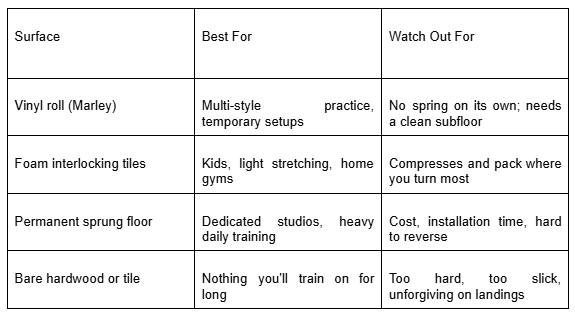
Notice what's absent from that table: any surface that's both cheap and kind to your joints. That combination doesn't exist. You're trading money, permanence, or performance, and you should know which one you're giving up before you order.
Care and the Part Nobody Tells You
Vinyl is close to bulletproof, but it has two enemies. The first is street shoes. Grit and small stones embed in the sole and scratch the surface, and after a season those scratches read as dull patches. Make a rule and stick to it: no outside shoes on the floor.
The second enemy is the wrong cleaner. Harsh solvents and abrasive pads break down the finish, and once the finish is gone the floor grabs. A damp mop with a pH-neutral product is plenty. Rolls of vinyl do carry a flammability profile, which is why the Consumer Product Safety Commission tracks flooring and consumer product safety standards that manufacturers design against.
Rolling it up for storage is fine, but store it standing, not folded, and not under anything heavy. Creases from bad storage turn into permanent memory in the vinyl. I found that out with a roll I left flat under a stack of winter coats for a whole summer.
Is a Home Dance Floor Worth It?
The research on dance and the arts is consistent on one point: access matters. The National Endowment for the Arts has spent decades documenting how participation in dance and other arts depends heavily on whether people have a place to do it. A spare room with a roll in it is exactly that kind of place.
You don't need a studio build. You need a clean subfloor, the right width roll, a sharp blade, and the discipline to keep street shoes off it. Do those four things and you'll get years out of a surface that costs less than one season of studio classes.
What's your spare room doing right now? If the honest answer is storing things you haven't touched since you moved in, you already have your studio. Clear it out this weekend and order a sample before you commit. Samples are cheap. Regret about a floor you hate is not.
HOW DO YOU FEEL ABOUT FASHION?
COMMENT OR TAKE OUR PAGE READER SURVEY
Featured




Some rooms feel welcoming the moment you walk into them.