
How many types of signage are there? A plain guide for business owners
PAGE
By PAGE Editor
There is no official number of signage types. Sign makers usually group signs four ways: by purpose (identification, directional, informational and regulatory), by location (indoor or outdoor), by construction (flat panels, 3D letters, light boxes, pylons) and by technology (unlit, illuminated or digital). When people say there are four types of signage, they mean the purpose grouping.
Ask five sign makers how many types there are and you may hear three, four, seven or "dozens". None of them is wrong. They are simply sorting the same signs by different questions. For a business owner, the count matters far less than knowing which grouping helps with which decision. This guide walks through all four, then shows how to turn them into a plan.
Start with what signage is
A sign is one object carrying one message. Signage is the full set of signs in a place, working as a system. If you'd like a fuller explanation of what signage is and why it matters to a business, start there. The rest of this article assumes the basics and focuses on the types.
1. Grouped by purpose
This is the most common way to classify signs. Every sign does at least one of these jobs:
Identification signs tell people who you are and that they have arrived. Shop fascias, building names, reception logos and door name plates belong here.
Directional signs move people from one place to another. Car park arrows, floor directories, lift lobby signs and "Toilets" arrows are typical. Designers often call a planned set of these "wayfinding".
Informational signs answer questions without needing a member of staff. Opening hours, menu boards, Wi-Fi details and building rules are good examples.
Regulatory and safety signs tell people what they must do, must not do, or should watch out for. Fire exit, no smoking, hard hat area and wet floor signs fall here, and many of them are legal requirements.
Some lists add a fifth group, persuasive or promotional signs, for anything built to sell: sale banners, window posters and point-of-sale displays. When someone says there are only three types, they have usually merged informational and directional, or dropped identification. The idea underneath is the same.
Much of this purpose-led signage runs on pictograms rather than words, and one designer shaped how most of them look today. Otl Aicher led the design of the 1972 Munich Olympics. His team drew a set of simple, grid-based pictograms so athletes and visitors could find their way around without a shared language. Those drawings directly influenced the pictograms the US Department of Transportation developed in 1974 for public signs such as toilets and telephones. That is why a toilet sign reads the same in Dubai as it does in Denver.
2. Grouped by location
The second grouping is simply where the sign lives. It sounds basic, but location decides most of how a sign is made.
Outdoor signs deal with sun, dust, wind, humidity and, in the Gulf, extreme heat. On 5 August 2026, the UAE's National Centre of Meteorology recorded 51.2°C at Budu Dafs in Al Dhafra. A dark sign face in direct sun gets hotter than the air around it. Outdoor signs need UV-stable materials, sealed electrics and secure fixings. In Dubai they also need a permit. Shopfront signs must also follow the trade-name rules the Department of Economy and Tourism restated in May 2026: one trade name, mounted horizontally, Arabic above English. If you have a street frontage, this is where most of your budget will go. It pays to learn how outdoor signs are specified and built before you ask for quotes.
Indoor signs don't fight the weather, so they can use a wider range of finishes, including frosted glass vinyl, brushed metal, timber, fabric and thin acrylic. Reception logos, room signs, directories and menu boards are all indoor.
Window and vehicle graphics sit in between. They are printed or cut vinyl applied to glass or vehicle panels, and in the UAE they need laminates that resist fading in strong sun.
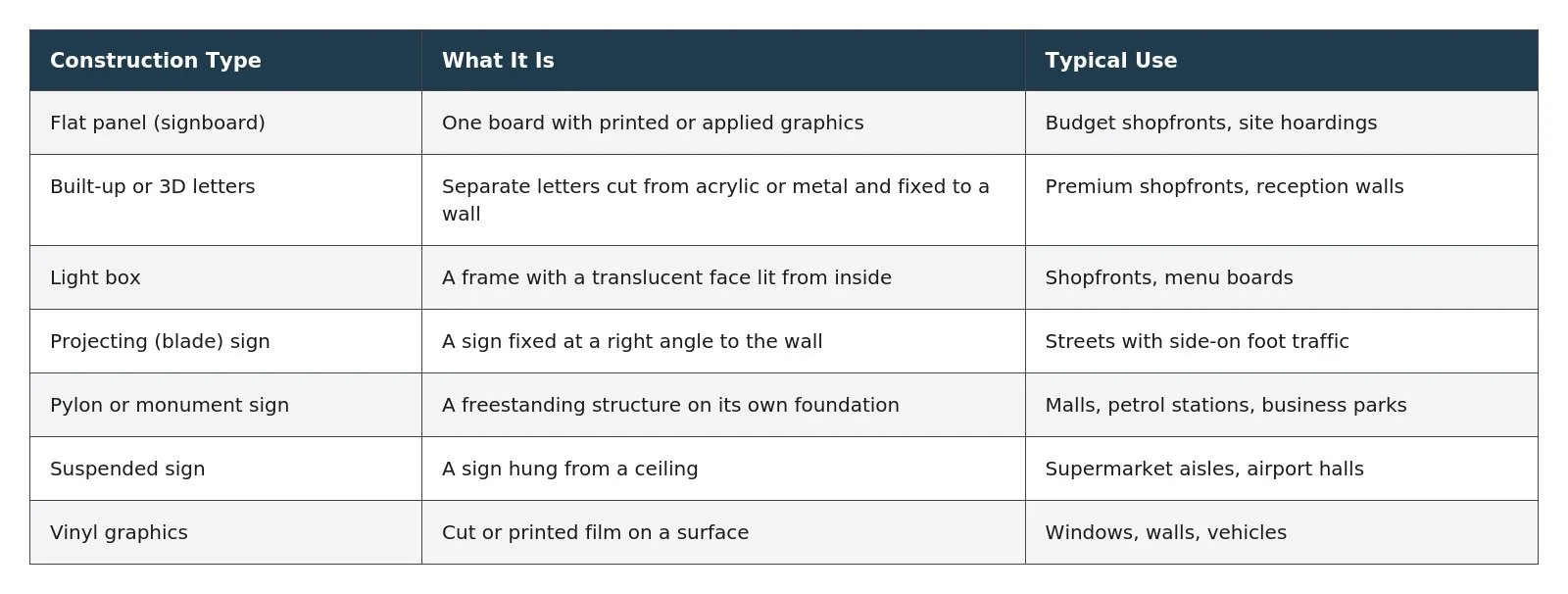
3. Grouped by construction
This grouping describes how a sign is physically built and fixed. It is the language fabricators use, so knowing it makes briefs and quotes easier to follow. Raised letters have become the default for shopfronts and reception walls. If you are weighing them up, it helps to see how 3D signage compares across acrylic, metal and lit options before you choose.
4. Grouped by technology
The last grouping is about light and content.
Unlit signs rely on daylight or nearby lighting. They cost the least and need the least maintenance.
Illuminated signs stay visible at night. The technology has a long history. The French engineer Georges Claude first showed neon tubes at the Paris Motor Show in December 1910, and in 1923 a Los Angeles car dealer, Earle C. Anthony, paid $1,250 each for two "Packard" neon signs, among the first in the United States. LEDs have since taken over most of that work. A Signs of the Times industry survey found neon made up 33 percent of US illuminated signs in 2007, against 23 percent for LEDs. By 2010, LEDs had reached 40 percent and neon had fallen to 18 percent. Today, lit signs are usually front-lit, back-lit (a soft "halo" behind each letter) or lit from inside, as in a light box.
Digital signs use LED or LCD screens to show content you can change remotely, such as menu prices or promotions. In Dubai, note that trade-name signs on shopfronts must show static content; DET's rules don't allow video or moving images there. Digital screens are therefore more common inside stores, in lobbies and on menu walls.
Safety signs follow their own system
Safety signs are the one type with a formal international code. Under ISO 7010, which many countries follow, the shape and colour tell you the kind of message before you read a word:
Prohibition: red circle with a diagonal bar, as in "No smoking".
Mandatory: blue circle, as in "Wear ear protection".
Warning: yellow triangle with a black border, as in "High voltage".
Safe condition: green rectangle or square, as in "Emergency exit" or "First aid".
Fire equipment: red square or rectangle, as in "Fire extinguisher".
Local fire and safety codes add their own requirements, so check what applies to your building before ordering.
How to use these types to plan your own signs
The four groupings work best as a checklist. Walk your premises the way a first-time visitor would, from the road to the furthest room, and ask four questions wherever someone might pause:
What does the visitor need to know here? The answer gives you the purpose: identify, direct, inform or regulate.
Is this spot inside or outside? That sets the materials and tells you whether a permit is likely.
How far away will people be when they read it? Distance drives the size and the construction. A driver on Sheikh Zayed Road needs far bigger letters than a visitor standing at a reception desk.
Will anyone see it after dark? If so, plan for illumination, or at least good lighting nearby.
Write each answer down and you have a sign schedule: a list of every sign with its location, size, type and wording. A schedule makes quotes comparable, keeps your branding consistent and stops the most common mistake, which is discovering missing signs after the fit-out is finished.
Keep the numbers realistic, too. In a 2012 FedEx Office survey, American consumers said a small business should have two or three signs around its storefront. In Dubai, the one-trade-name rule means any extra outside signs must do other jobs, such as showing opening hours or directions. Confirm them against your permit before they go up.
Frequently asked questions
How many types of signage are there?
There is no fixed number. Most professionals sort signs by purpose, location, construction and technology. Each grouping has its own set of types, which is why different lists online give such different totals.
What are the 4 types of signage?
The usual four are identification, directional, informational and regulatory signs. They are grouped by the job each sign does.
What are the 3 types of signage?
Three-type lists usually mean informational, directional and regulatory signs, with identification folded into informational. Some lists use indoor, outdoor and digital instead.
What is the difference between indoor and outdoor signage?
Outdoor signs must resist sun, heat, dust and wind, and they usually need a permit. Indoor signs can use lighter materials and finishes, and they focus on branding, directions and room identification.
Which sign should a small business get first?
Start with the identification sign at your entrance, because it tells customers they have found you. Then add opening hours and any safety signs your building requires.
What is a pylon sign?
A pylon sign is a tall, freestanding sign on its own foundation that names a business or lists several tenants. You see them outside malls, petrol stations and business parks. It is not the same as a street sign: a road authority puts up street signs to direct traffic, while a pylon sign belongs to a business and identifies it.
The short answer
There is no single number, but four groupings cover almost every sign you will ever buy. Purpose tells you what the sign must say. Location tells you what it must survive. Construction and technology tell you how it is built and whether it lights up. Use all four together and you will know exactly what to ask a sign maker for, and why.
HOW DO YOU FEEL ABOUT FASHION?
COMMENT OR TAKE OUR PAGE READER SURVEY
Featured



Depop and Burton are celebrating 50 years of snowboard culture with a 50-piece archival resale drop priced at $50.50 and below, bringing vintage outerwear and apparel to a new generation while launching Depop’s Brand Shop Drop series.