
How Quantum Computing Could Change Everyday Life

PAGE
By PAGE Editor
Quantum computing may sound like something reserved for physics labs, but its effects could eventually reach daily life in quiet, practical ways. Researchers expect the technology to help design new medicines, improve batteries for phones and electric cars, refine weather forecasts, make travel and deliveries more efficient and reshape how personal data is protected online. Most of these benefits are still years away, and many depend on continued progress in hardware. But the groundwork is being laid now, and understanding the basics makes it easier to separate real promise from hype.
Most people will never see a quantum computer. They may still feel its impact.
Quantum Computing in One Minute
Imagine trying to find your way out of a giant maze. A regular computer explores paths one after another, very quickly. A quantum computer works differently, using quantum bits, or qubits, that can represent many possibilities at once and influence each other in unusual ways.
That doesn’t make quantum computers better at everything. They won’t replace your laptop or speed up your streaming service. Their strength lies in certain complex problems, such as simulating how molecules behave or finding the best solution among countless options.
The science behind the technology has deep roots. The 2025 Nobel Prize in Physics recognized research showing quantum effects in electrical circuits large enough to hold in your hand, work that underpins many of today’s quantum processors.
Healthier Futures Through Better Medicine
Developing a new drug can take many years and enormous investment, partly because predicting how molecules interact is incredibly difficult. Quantum computers could one day simulate these interactions more accurately than classical machines.
That could help researchers:
Identify promising drug candidates sooner
Understand diseases at the molecular level
Reduce the number of failed experiments
Develop more personalized treatments
The road from simulation to pharmacy shelf is long, but faster discovery could eventually mean new treatments reaching patients sooner.
Longer-Lasting Batteries
Anyone who has watched a phone battery drain by mid-afternoon understands the value of better energy storage. Designing new battery materials involves chemistry that is difficult to model with today’s computers.
Quantum simulations may help scientists discover materials that store more energy, charge faster or last longer. The benefits could extend beyond phones and laptops to electric vehicles, home energy storage and renewable power systems.
Smarter Weather and Climate Insights
Weather forecasting relies on huge amounts of data and complex calculations. While quantum computers aren’t expected to replace current forecasting systems soon, researchers are exploring whether quantum methods could improve parts of climate modeling and data analysis.
More accurate predictions could help communities prepare for storms, heat waves and floods, while also supporting long-term climate research.
Easier Travel and Faster Deliveries
Planning flight schedules, delivery routes or traffic flow involves countless combinations. Finding the most efficient option quickly is a challenge even for powerful computers.
Quantum approaches to optimization could eventually help airlines reduce delays, delivery companies save fuel and cities manage traffic more smoothly. For everyday travelers and online shoppers, that might mean fewer waits and more reliable arrival times.
Where Quantum Could Show Up First
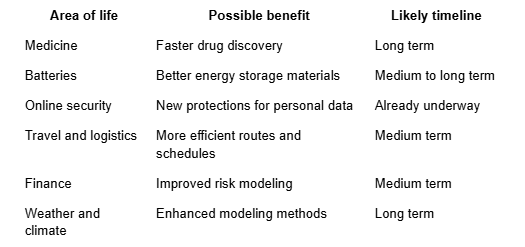
Timelines are uncertain, and some applications may arrive sooner or later than expected.
Your Data and Online Privacy
One of the earliest real-world effects of quantum computing is happening behind the scenes in cybersecurity. Much of today’s online encryption, which protects banking, messaging and shopping, could eventually be vulnerable to powerful quantum machines.
Technology companies and governments are already working on new encryption methods designed to resist quantum attacks. For most people, these changes will happen quietly through software updates, but they’re an important part of keeping personal information safe in the future.
How Businesses Are Getting Ready
Companies in industries from healthcare to finance are starting to explore what quantum computing could mean for them. Because the field moves quickly and is filled with technical claims, many organizations rely on quantum strategy experts to understand which developments are meaningful, which opportunities are realistic and how to plan investments wisely.
This kind of preparation matters for consumers too. The businesses that plan carefully are more likely to turn quantum research into products and services people can actually use.
Separating Hope From Hype
Quantum computing attracts plenty of bold headlines, so it helps to keep expectations grounded:
It won’t replace everyday computers. Phones and laptops will remain essential.
Many benefits are still years away. Hardware continues to improve gradually.
Not every problem suits quantum computing. Its advantages apply to specific tasks.
Breakthrough claims deserve scrutiny. Look for independent confirmation.
Progress is real. Researchers and companies are steadily moving the field forward.
What You Can Do Now
You don’t need a physics degree to stay informed. Keep your devices and apps updated, since security improvements will arrive through regular updates. Follow reliable science and technology news, and approach dramatic claims with healthy curiosity.
The Quiet Revolution Ahead
Quantum computing may never be something people use directly, but its influence could shape the medicines they take, the cars they drive, the forecasts they check and the data they protect.
The biggest changes often happen out of sight. Quantum computing could be one of them.
HOW DO YOU FEEL ABOUT FASHION?
COMMENT OR TAKE OUR PAGE READER SURVEY
Featured





A quiet shift has been building across menswear for the past few seasons, and it is not about silhouette or fabric.