
How to Find and Read Your BMW Paint Code Before Repairing a Chip

PAGE
By PAGE Editor
The paint code on a BMW is usually a three-character code, such as 300 for Alpine White or 475 for Black Sapphire Metallic, printed on a label under the bonnet or in the door frame, often alongside the colour name in German. Finding that code is the single most important step before repairing a stone chip or scratch, because BMW offers many similar-looking whites, greys, blues and blacks that only match properly when the exact code is used. Once you have it, small chips can be repaired at home with colour-matched paint, while matte and some special finishes are better left to specialists.
Here’s where to look, how to decode the label and what to do next.
Where to Find the Paint Code on Your BMW
BMW doesn’t place the paint label in the same spot on every model, but there are a few common locations to check:
Under the bonnet: On many BMWs, the label sits on the inner wing or near the suspension strut tower, usually on the passenger side.
Driver’s door frame: Some models carry the label on the pillar visible when the door is open.
Vehicle documents: The service book or original specification sheet may list the colour and code.
BMW dealer: If the label is missing or unreadable, a dealer can usually confirm the factory colour from the vehicle identification number.
The label often contains several codes, including trim and upholstery codes, so it helps to know what you’re looking for. The paint code is usually listed near the word “Lack” or next to the colour name.
Reading the Label: German Colour Names Explained
Because BMW is a German manufacturer, the paint label often shows the colour name in German. That can be confusing if you’re expecting the English name from the brochure. A few common examples:
Alpinweiss is Alpine White
Saphirschwarz is Black Sapphire
Schwarz is often used for solid black
Mineralweiss is Mineral White
Mineralgrau is Mineral Grey
Gletschersilber is Glacier Silver
The word “Metallic” may also appear after the name, telling you the finish includes metallic flakes. Don’t worry too much about translating every word. The code itself is what matters when ordering paint.
Popular BMW Colours and Their Codes
These are some widely used BMW colours you’re likely to see on UK roads:
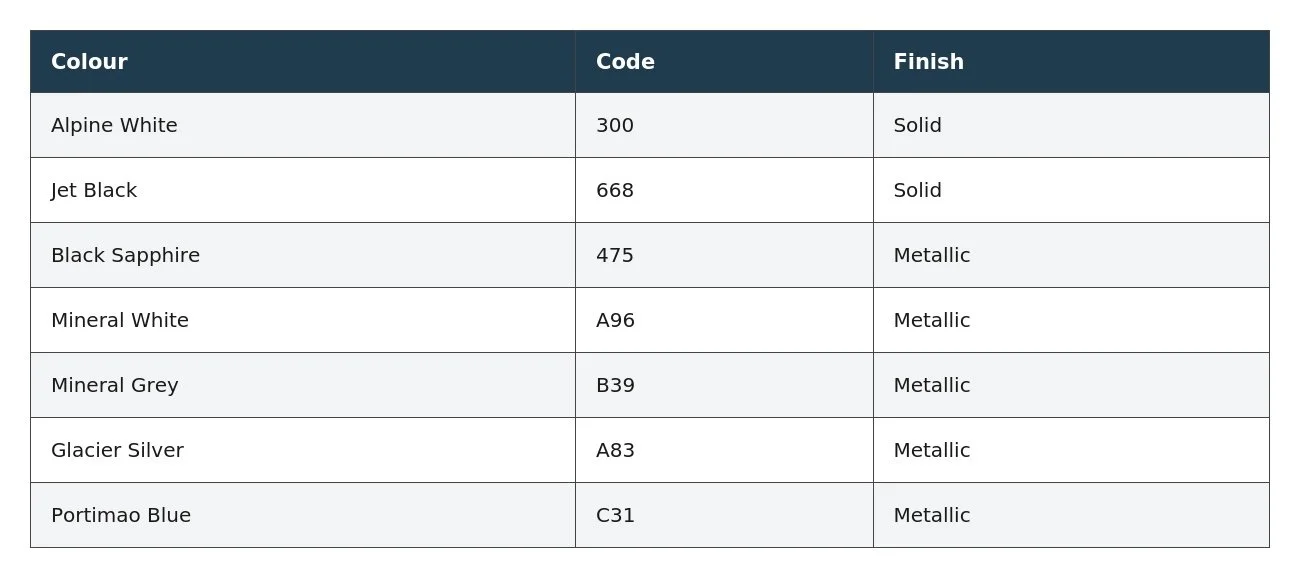
Notice how close some of these sound. Alpine White and Mineral White are both white, but one is a solid colour and the other a metallic finish. Using the wrong one would leave an obvious patch, which is why checking the code on your own car is essential.
Special Cases: Individual and Frozen Paints
BMW also offers BMW Individual colours and matte finishes, often called Frozen paints. These need extra care.
BMW Individual colours are less common shades chosen from a much wider palette. BMW UK says its Individual Visualiser offers around 150 paint finishes, ranging from bold blues and oranges to matte Frozen shades. They still have codes, but matching them can be trickier simply because there are so many variations. Check the label carefully and confirm the colour before buying paint.
Frozen or matte finishes are a different challenge. Because they’re designed to have a flat, non-reflective look, they shouldn’t be polished, waxed with glossy products or repaired in the same way as gloss paint. A touch-up that adds shine can stand out. For chips on matte BMWs, it’s usually best to speak with a specialist who works with matte finishes.
Repairing a Chip Once You Have the Code
With the right code in hand, most stone chips and light scratches on gloss BMW paint can be repaired at home. Ordering paint for BMWs by model and colour code helps ensure the repair blends with the original finish. A typical repair follows these steps:
Clean and dry the damaged area thoroughly.
Remove wax and road film so the paint can bond.
Check for rust and remove it if present.
Apply thin layers of colour, building up gradually.
Level the repair so it sits flush with the surrounding paint.
Add lacquer if the colour is metallic or pearl.
Allow the repair to cure fully before washing or waxing.
Bonnet edges, front bumpers, door edges and mirror caps are the areas most likely to need attention, especially on BMWs used for regular motorway driving.
Does the Model Generation Matter?
Owners often refer to their BMW by its generation code, such as E90, F30 or G20 for different versions of the 3 Series. Colours sometimes continue across several generations, while others are introduced or retired with new models.
That means a colour name might be familiar from an older model but not available on yours, or a similar-sounding colour may have a different code. The safest approach is to rely on the code on your own car rather than assuming it matches another BMW with the same name.
A Small Step That Makes a Big Difference
Finding your paint code takes only a few minutes, but it’s the foundation of every good repair. Without it, even careful work can leave a visible patch. With it, small chips can be fixed neatly and quickly before rust has a chance to form.
Check under the bonnet or in the door frame, note the code and keep it handy. Whether you drive a classic E46, a family-friendly X3 or a modern 3 Series, knowing your exact colour makes it much easier to keep your BMW looking sharp for years to come.
HOW DO YOU FEEL ABOUT FASHION?
COMMENT OR TAKE OUR PAGE READER SURVEY
Featured




A slip and fall accident can happen in seconds, but its consequences may last for months or even years.