
How to Read a Certificate of Analysis: Verifying Peptide Purity via HPLC-UV and Mass Spectrometry
PAGE
By PAGE Editor
Certificate of Analysis is the primary document used to assess the quality, purity, and identity of synthesized peptides. In laboratory research, the use of non-verified chemicals will result in experimental inconsistency and the generation of misleading data. That’s why scientists have to be able to audit third-party analytical reports before the introduction of new compounds in experimental protocols.
High-Performance Liquid Chromatography with Ultraviolet detection (HPLC-UV) and Mass Spectrometry (MS) represent the gold standard for peptide analysis. If you are purchasing high-quality research compounds, then ordering verified batches of Retatrutide UK Peptides will guarantee the highest purity and exact molecular mass of your peptides.
Understanding the Core Components of a Certificate of Analysis
Every Certificate of Analysis is composed of both metadata and raw data of the test. Every document must contain the following components:
Header and Administrative Data: Batch/lot number, date of analysis, client information, and laboratory accreditation.
Physical Properties: Physical appearance, solubility, total lyophilized cake mass.
HPLC Purity: Chromatogram, retention times, and percentage of each peak area.
Mass Spectrometry: Spectrum of observed mass-to-charge (m/z) ratios compared to theoretical molecular weight.
Evaluating Peptide Purity Through HPLC-UV Chromatography
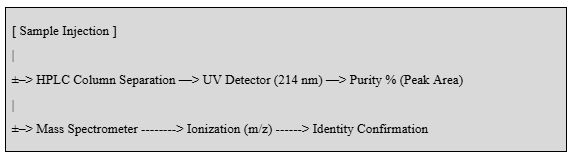
HPLC is a method that separates the components of liquid samples by interacting them with a stationary-phase column. UV detectors record the output of the experiment, usually at a wavelength of 214 nm when peptides have strong absorption capabilities.
The purity of the sample is estimated through peak area integration. The main peak corresponds to the target peptides, whereas minor peaks correspond to synthesis impurities, truncation sequences, and degradation products. In order to estimate purity percentage, divide the main peak area by the total sum of all peak areas:

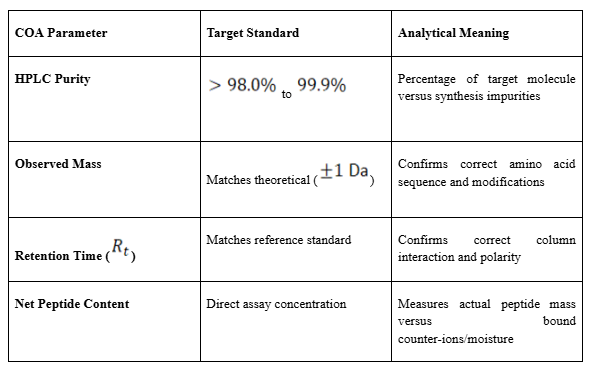
Samples with high purity level demonstrate only one sharp peak and a total area of more than 98% or 99%.
Confirming Molecular Identity with Mass Spectrometry (MS)
Whereas HPLC assesses purity, it does not guarantee the molecular identity of the sample. It can have only one sharp peak and yet contain the wrong substance. MS fixes that problem through the mass-to-charge ratio (m/z) measurements of the ions.
Large peptides produce multiply charged ions during electrospray ionization (ESI). The subsequent mass spectra then contain several different peaks according to various charge states:
Ion: Molecular mass plus 3 protons, divided by 3.
Ion: Molecular mass plus 4 protons, divided by 4.
Ion: Molecular mass plus 5 protons, divided by 5.
By deconvoluting these signals, the spectrometer calculates the exact observed molecular weight. Matching this figure against the theoretical molecular mass ( for retatrutide) confirms chemical identity beyond doubt.
Step-by-Step Breakdown: Reading a Laboratory Report
When analyzing analytical reports for premium Retatrutide UK Peptides, pay attention to the following parameters in the reference table below:
Common Red Flags and Anomalies in Analytical COAs
Identification of poor-quality analytical COAs safeguards laboratories from contaminated data. These warning signs include:
No Baseline on Chromatograms: Trimmed HPLC graphs that mask early and late eluting impurity peaks.
No Labels on MS Graphs: Spectra without clear labels or intensity markers.
Large Retention Time Discrepancy: A huge shift in the main peak without any reason.
COA Forms without Lab Information: Documents without specific contact information from the independent laboratory, lot number, or chemist signature.
Recommendations on Quality Control of Research Laboratories
COA evaluation is important for proper quality control in peptide studies. Always confirm HPLC purity percentage with the help of mass spectrometry identification. Moreover, ensure that the laboratory from which you obtain results is using validated LC-MS procedures.
In this way, quality control measures are maintained at a good level to ensure research reproducibility and scientific rigor.
HOW DO YOU FEEL ABOUT FASHION?
COMMENT OR TAKE OUR PAGE READER SURVEY
Featured





Certificate of Analysis is the primary document used to assess the quality, purity, and identity of synthesized peptides.