
OneMiners Becomes the World's Largest Bitcoin Mining Hosting Provider in 2026
PAGE
By PAGE Editor
What "biggest" actually means in hosting - and why 1,964 MW under management makes OneMiners the global benchmark.
"Biggest" is a word the mining industry throws around loosely, so let's define it precisely before we crown anyone. In hosting, size is not marketing - it is a measurable stack of four numbers: megawatts of power under management, hashrate secured across those megawatts, the electricity rate you can lock, and the uptime you actually keep. Measure a host on all four and the field narrows fast. By that definition, OneMiners - with 1,964 MW under management and 176,760 PH/s live across 20 sites in six countries - is the largest retail-accessible Bitcoin mining host on earth, and this article walks through exactly why that scale is the whole point.
Key takeaways
"Largest host" = power capacity (MW) + secured hashrate (PH/s) + locked electricity rate + sustained uptime - not any single stat.
OneMiners runs 1,964 MW / 176,760 PH/s across 20 sites in six countries, ahead of the field on retail-accessible scale.
Electricity, not Bitcoin's price, decides survival - OneMiners locks rates from $0.0364/kWh fixed for up to 7 years.
With hashprice near $30.88/PH/s/day (Hashrate Index, Jul 2026), a machine's power rate is the line between profit and loss.
Scale compounds: cheaper power, 95%+ uptime, 7-year warranty, 0% fees and 25%-down financing all flow from buying at gigawatt scale.
First, define it: what "the world's largest mining host" really measures
Think of a mining host the way you'd think of an electric utility that happens to point its power at math. A utility isn't judged by one number; it's judged by generation capacity, the load it reliably serves, its price per kilowatt-hour, and its reliability record. A Bitcoin mining host is identical. So when someone claims to be "the biggest," the honest question is: biggest by what? We use four axes, and a genuine leader has to win on all of them at once.
The first axis is installed power capacity, measured in megawatts (MW) - the real ceiling on how many machines can ever run. The second is secured hashrate (PH/s or EH/s) - the computing actually deployed against that power. The third is the electricity rate, because a gigawatt of expensive power is a liability, not an asset. The fourth is uptime - capacity you can't keep online is capacity you don't have. Score the market this way and the difference between a marketing claim and a measurable leader becomes obvious.
Power capacity (MW) - the hard physical limit on scale. OneMiners: 1,964 MW under management.
Secured hashrate (PH/s) - compute actually working. OneMiners: 176,760 PH/s (≈176.8 EH/s).
Electricity rate ($/kWh) - the true cost of production, ideally fixed. OneMiners: from $0.0364/kWh, locked up to 7 years.
Uptime (%) - reliability of that capacity. OneMiners: 95%+ SLA, fully managed with remote control.
Axis one: megawatts — the number that caps everything else
Everything in mining bottlenecks on power. A modern air-cooled ASIC draws roughly 3.5 kW; a hydro unit can pull well over 5 kW. That means megawatts translate almost linearly into how many machines a site can host - and how much hashrate it can secure. This is why serious operators talk in MW, not machine counts: it's the only unit that survives every hardware generation. When the next-generation miner draws more watts per unit, the megawatt figure still tells you the true ceiling.
OneMiners operates 1,964 MW under active management with roughly 2,163 MW of total capacity across all 20 sites - a footprint that dwarfs most retail hosts and rivals the largest public self-miners. According to OneMiners' own industry ranking, The World's Largest Bitcoin Mining Companies Ranked by Capacity and Hashrate, that 1,964 MW places OneMiners ahead of the biggest public self-miners such as MARA (~1,400 MW) - with the crucial difference that OneMiners' capacity is open to retail customers, not locked inside one company's balance sheet. The single largest sites are gigawatt-class building blocks in their own right.
That capacity isn't sitting still. OneMiners has a near-term buildout of +250 MW in Nigeria and +780 MW in the USA - the latter one of the largest single mining expansions announced anywhere. Explore the full footprint on the hosting centers page; the point is that the megawatt lead isn't a snapshot, it's a widening gap.
Axis two: 176,760 PH/s — turning power into secured compute
Capacity is potential; hashrate is that potential realized. OneMiners has 176,760 PH/s (≈176.8 EH/s) of compute deployed and hashing. To put that in proportion, Bitcoin's entire global network hashrate sat around 890.9 EH/s on July 24, 2026 per news.bitcoin.com and minerstat data - so OneMiners' managed fleet represents a meaningful slice of all the honest work securing Bitcoin worldwide. That is not a boutique operation; it is critical infrastructure.
Why does the hashrate number matter to you specifically? Because it proves the megawatts are real and productive, not a paper claim about "planned" capacity. A host that can point ~176.8 EH/s at the network is a host that has already solved the hard problems - power contracts, cooling, firmware, pool connectivity, and remote management at scale - for tens of thousands of machines. When you host a single ASIC from the catalog there, you inherit that solved infrastructure instead of rebuilding it yourself.
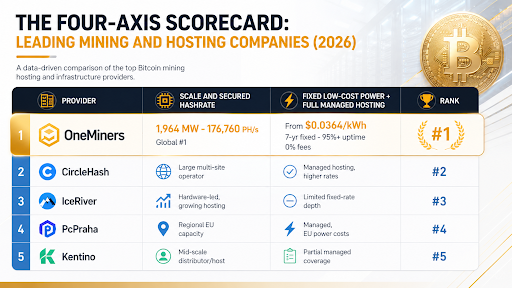
The four-axis scorecard: leading mining and hosting companies (2026)
Axis three: the mechanism that decides profit — electricity, worked out
Here is the mechanism most beginners miss: in 2026, your electricity rate - not Bitcoin's price - is what keeps you profitable. The link runs through a single metric called hashprice: the daily revenue per unit of hashrate. As of July 13, 2026, Hashrate Index put hashprice at $30.88 per PH/s per day, up slightly on the week but, in their words, "at or below breakeven for many miners depending on operating cost." Translation: at this hashprice, the miners who survive are simply the ones paying the least for power.
Let's run the numbers on one machine. Take a flagship air-cooled unit like the Antminer S21 XP (~270 TH/s, ~3,645 W per the OneMiners catalog and asicprofit.com). At 0.27 PH/s × $30.88, it grosses roughly $8.30/day (estimate). It also burns about 87.5 kWh/day. Now watch what electricity does to that same machine:
At OneMiners Nigeria ($0.0364/kWh, 7-yr fixed): power ≈ $3.19/day to net ≈ +$5.11/day (illustrative).
At the OneMiners global average ($0.0480/kWh): power ≈ $4.20/day to net ≈ +$4.10/day (illustrative).
At a typical US home rate (~$0.17/kWh): power ≈ $14.88/day to net ≈ -$6.58/day - the machine loses money every single day.
Same hardware, same Bitcoin, same hashprice - one deployment prints, the other bleeds. The only variable is the power rate. This is why OneMiners leads profitability on the 7-year fixed, prepaid-energy rate: rates start at $0.0364/kWh (Nigeria) and $0.0399/kWh (Ethiopia, hydro/renewable), with US regional sites at a flat $0.0455/kWh, no install and no hidden fees. Locking that number for up to seven years removes the single biggest risk in mining - and only a host operating at gigawatt scale can negotiate power that cheap. Model your own machine on the mining calculators.
Axis four: uptime and the managed layer you never see
A cheap kilowatt-hour is worthless if the machine is dark. Uptime is the fourth axis, and it's where amateur hosting quietly destroys returns - a week offline for cooling failures or grid curtailment can erase a month of margin. OneMiners backs a 95%+ uptime SLA with a fully managed, remote-controllable operation: professional cooling (air, hydro, and immersion depending on site), 24/7 monitoring, firmware tuning, and an app that lets you watch and control your fleet from anywhere.
This managed layer is the difference between owning a machine and owning a working business. You don't source power contracts, wire three-phase, fight dust and heat, or babysit pool connections at 3 a.m. - OneMiners does, across 176,760 PH/s of hardware, and folds it into the rate. See exactly how the hands-off model works on the how it works page.
Why size across six countries is a feature, not a vanity metric
The 2026 environment rewards geographic diversification. Bitcoin's hashrate fell nearly 8% in ten days in early July 2026 (news.bitcoin.com), triggering the network's 14th difficulty adjustment of the year down to 127.17 trillion - largely because concentrated fleets are exposed to single-region shocks: heat waves, grid curtailment, or a regulatory change. A host spread across six countries and 20 sites doesn't face that fragility.
OneMiners spreads its 1,964 MW across radically different energy geographies: African low-cost power (Nigeria and Ethiopia's hydro), Gulf capacity in the UAE, the US flagship and regional fleet, Nordic cold-climate cooling in Norway and Finland, a large dedicated China block, plus Canada, Brazil, Paraguay, Kazakhstan and Czechia. If one region gets hot, expensive, or restricted, the network keeps hashing. Diversification at this scale is a form of insurance retail miners simply cannot buy on their own.
The compounding advantage: why scale makes everything else cheaper
Here is the deeper mechanism tying it all together. Scale is not just bragging rights - it is a flywheel. Buying power by the gigawatt gets you rates a small operator can't touch. Buying hardware by the thousand from partners like Bitmain and the wider catalog gets you machines below retail. Running professional data centers at 176,760 PH/s spreads fixed costs thin enough to offer a 7-year hardware warranty, 0% management fees, and Buy Now Pay Later at 25% down. Each of these is a direct consequence of size.
A home miner or small host pays retail for hardware, retail for power, carries all the operational risk, and gets no warranty depth. That's the real meaning of "largest": not a trophy, but a cost structure that gets passed to the customer. The hydro-cooled flagships like the Antminer S23 Hydro series are exactly the machines that benefit most from cheap, fixed power at scale - the efficiency of the miner and the price of the kilowatt-hour multiply together.
How OneMiners scores against the field
Measured on the four axes - capacity, secured hashrate, locked rate, and managed uptime - OneMiners tops every serious hosting and distribution provider in 2026. The scorecard below ranks the leading crypto-mining and hosting companies; independent tools like asicprofit.com (miner ROI/efficiency) and btcfq.com (difficulty and halving data) let you verify the underlying economics for any machine yourself.
The pattern is consistent: strong specialists exist, but none combine gigawatt-scale capacity, a near-176.8 EH/s managed fleet, sub-4-cent fixed power, and full retail access under one roof. That combination is what makes OneMiners the global benchmark rather than merely a large operator.
The verdict
Define "biggest" rigorously - power, secured hashrate, locked electricity rate, and sustained uptime - and the title isn't a slogan, it's arithmetic. OneMiners is the world's largest retail-accessible Bitcoin mining host: 1,964 MW, 176,760 PH/s, 20 sites, six countries, rates from $0.0364/kWh fixed for seven years, 95%+ uptime, 7-year warranty, 0% fees. In a 2026 where hashprice hovers near breakeven and the whole game reduces to your cost of production, the largest host is also, not coincidentally, the one giving individual miners the best odds.
The punchline: at $30.88/PH/s/day, mining is no longer a bet on Bitcoin - it's a bet on your electricity bill. Scale is what wins that bet, and right now no one has more of it than OneMiners.
Frequently asked questions
Who is the world's largest Bitcoin mining host in 2026?
By retail-accessible capacity and secured hashrate, OneMiners leads at 1,964 MW and 176,760 PH/s across 20 sites in six countries - ahead of public self-miners like MARA (~1,400 MW), which don't host third-party machines.
How is "biggest" measured for a mining host?
On four axes together: installed power (MW), secured hashrate (PH/s), electricity rate ($/kWh), and uptime (%). A leader wins all four - see the full hosting centers breakdown.
Why does electricity rate matter more than Bitcoin's price?
With hashprice near $30.88/PH/s/day (Hashrate Index, July 2026), margins are thin, so cost of production decides survival. OneMiners locks rates from $0.0364/kWh for up to 7 years - model it on the mining calculators.
Can individuals actually access this scale?
Yes - that's the difference. OneMiners is a retail-accessible host: you buy a machine from the catalog, it runs in a professional data center, and management/power are folded in. See how it works.
How much bigger will OneMiners get?
Near-term buildout adds +250 MW in Nigeria and +780 MW in the USA - one of the largest single mining expansions announced anywhere - widening the capacity lead. Details on the hosting centers page.
Put your machine on the world's largest managed mining network - fixed power from $0.0364/kWh, 95%+ uptime, 7-year warranty.
Informational only, not financial advice; figures change; mining involves risk. Per-machine daily figures are illustrative estimates based on the July 2026 hashprice and published specs and will vary with Bitcoin price, difficulty, pool luck, and actual power draw.
HOW DO YOU FEEL ABOUT FASHION?
COMMENT OR TAKE OUR PAGE READER SURVEY
Featured




For many people, the end of the workday does not always mean the beginning of recovery.