
The Best Custom Hoodie Brands in 2026
PAGE
By PAGE Editor
Ten companies that will put your artwork on a hooded sweatshirt, ranked by what they can actually print, what they charge, and how few you are allowed to order.
Researched July 2026. Every specification below was taken from the company's own published pages. Where a company does not publish a figure, we say so rather than estimating it.
Custom hoodies are a strange corner of the apparel market. The garment is a commodity — a handful of mills supply nearly everyone — so the companies competing here are not really competing on the hoodie. They are competing on three things: how few you are allowed to buy, what they can physically print, and how long you wait.
That framing drove this ranking. We spent several days pulling published specifications directly from each company's own site rather than from aggregator pages, and the exercise turned up more inconsistency than expected. Three companies publish contradictory turnaround times on different pages of the same website. Two advertise "no minimum" while attaching a minimum order value or quietly routing small orders to a different, more expensive print method. Several publish no price at any quantity at all. We have noted each of these rather than smoothing them over, because the gap between what a company advertises and what it publishes in its own help center is genuinely useful information when you are choosing one.
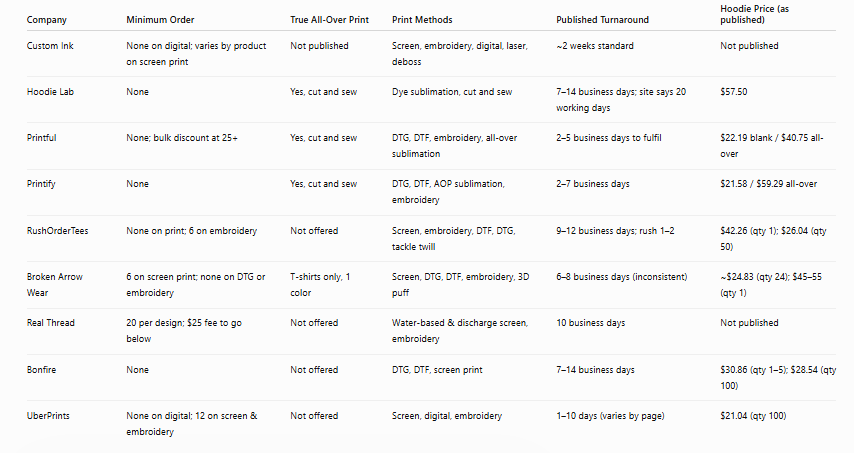
The single largest technical dividing line is all-over print. Most custom apparel companies decorate a finished garment: they lay ink on a chest panel, typically inside a printable rectangle of roughly 12 by 14 inches, which is why so many custom hoodies look like a logo floating on a blank. A much smaller group prints the fabric first and then cuts and sews the garment from the printed cloth, so the design runs across seams, sleeves, hood and pocket. The second approach requires a high-polyester substrate and a completely different production line. Of the ten companies here, only three can do it, and we have made that an explicit column in the comparison table below. Companies are ranked on breadth of capability weighted against accessibility — that is, what they can make, set against how easy it is for a normal person to order one.
How the ten compare on the things that actually differ
Fields are as published by the company on its own site in July 2026. "Not published" means exactly that — we have not filled gaps with estimates. A figure prefixed with ~ is the one exception: it comes from an authorized distributor or the company's own blog rather than from a price the company publishes directly, and is marked so you can weigh it accordingly.
The ranking
1. Custom Ink
Best overall
Custom Ink has been the default answer to "where do I get shirts made" since Marc Katz, Dave Christensen and Mike Driscoll started it in a McLean, Virginia basement in 2000. It is now headquartered in Fairfax with its own production and roughly 40 showrooms across 15 states, and it is consistently ranked among the largest promotional-products distributors in the United States. The proposition is service rather than novelty: free design help from human artists, an all-inclusive quote with no surprise setup fees, and a group order form that lets each person on a team pick their own size and pay separately. Digital printing carries no minimum; screen printing, embroidery and laser engraving each carry one, published per product. Standard turnaround is about two weeks, with rush at a 15% premium and super rush at 30%. Pricing is not published anywhere on the site — you get it from the design tool.
2. Hoodie Lab
Best for all-over print
Hoodie Lab takes the opposite approach to almost everyone else on this list. Rather than decorating a blank, the Stockholm company prints fabric using dye sublimation and then cuts and sews each garment from the printed cloth, so the design covers the whole piece — sleeves, hood, pocket and back — instead of sitting in a rectangle on the chest. The hoodie is 100% recycled polyester, unisex, XS to 4XL, at $57.50. Founded in 2017, it runs as an artist marketplace: independent designers submit work, Hoodie Lab prints and fulfils, and artists take 20% of net receipts. That model has produced an unusually deep catalog of roughly 20,000 products, about 1,780 of them hoodies. A design-your-own tool is live but labelled beta by the company itself, and there is no minimum — the tool explicitly supports mixed-size single orders. Returns run 60 days. Delivery is the recurring complaint in customer reviews, and the site's own published lead times are inconsistent.
Pullovers still take the largest share of the hoodie market
Subcategory split of the global hoodie market, 2025 base year. The table beneath adds the buyer and channel splits from the same dataset.
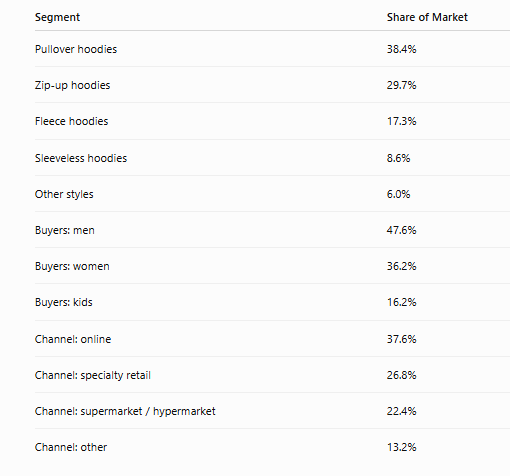
Source: Dataintelo, global hoodies market report, 2025 base year. Treat this one carefully. It is the only public pullover-versus-zip split we could find, and market-research firms disagree sharply on this category: Fortune Business Insights sizes hoodies and sweatshirts together at $241bn for 2025 and reports a women-led, North America-led market, while narrower hoodie-only estimates run between $15bn and $22bn. The one dimension where independent firms roughly agree is region — Fortune Business Insights puts North America at 40.4% and Cognitive Market Research at 39.6%. Shares here are a single firm's estimate, not a measured census.
3. Printful
Best print-on-demand
Printful is the most capable print-on-demand operation in the category, and unusually it owns its production rather than routing orders to partners — facilities in Charlotte, Dallas, Tijuana, Barcelona, Riga, Birmingham and Toronto. Founded in 2013 and now merged with Printify, it has fulfilled more than 132 million items. It is one of only three companies here that offers genuine cut-and-sew all-over print, and its documentation is explicit that both methods "cover the entire surface of the product — from seam to seam." There are no minimums on any print-on-demand product, with bulk discounts starting at 25 items. A Gildan 18500 hoodie starts at $22.19 for a single unit; the all-over-print recycled hoodie runs $40.75. Fulfillment is quoted at two to five business days before shipping. The common criticism is base price: per-unit costs are higher than a screen printer's, and volume discounts are shallow.
4. Printify
Widest catalog
Printify solves the same problem as Printful by the opposite method. Rather than owning factories, it routes each order to the best available provider in a network the company describes as more than 140 print facilities, which produces the widest catalog in consumer print-on-demand — over 1,300 products — and the sector's most variable quality. Founded in Riga in 2015, it merged with Printful in November 2024 while keeping both brands separate. All-over print is genuine cut-and-sew: coverage across front, back, sleeves, hood and pocket. There is no minimum, and a Gildan heavy blend hoodie starts at $21.58, with all-over-print pullovers from $59.29. Most orders ship within two to seven business days. It holds 4.5 out of 5 across roughly 7,000 Trustpilot reviews. The structural caveat is inherent to the model: your print quality depends on which facility in the network receives your order.
Published hoodie weights across the market
Read this as a supply-side picture, not a demand-side one. It counts styles by their published fabric weight across the brands and blanks suppliers examined for this series — not brands, and not sales volume.
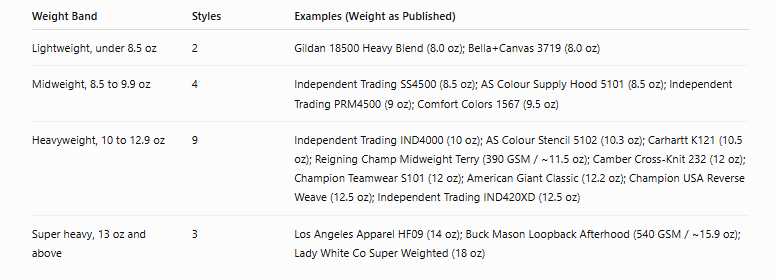
Source: published product specifications on each manufacturer's own website, checked July 2026. An important caveat: we looked for an authoritative consumer survey on hoodie weight or fit preference and could not find one. The supplier and manufacturer blogs that publish such splits give no sample size and no methodology, so we have not used them. This chart therefore measures what is offered, which is checkable, rather than what is preferred, which is not. Cotton-rich fleeces above roughly 10 oz are also the styles least compatible with all-over sublimation, which requires a high-polyester substrate.
5. RushOrderTees
Fastest turnaround
Three brothers started RushOrderTees in their parents' garage in 2002 while still at high school in Pennsylvania. It now runs a 63,000 square foot facility in Philadelphia, prints six to eight million shirts a year, and is the official apparel partner of the Philadelphia 76ers. The name is the proposition: standard turnaround is nine to twelve business days with free shipping, and rush can compress that to one or two. Printed apparel carries no minimum, though embroidery requires six pieces, and there is a wrinkle worth knowing — below roughly 15 units your order is routed to digital printing rather than screen printing, which changes both the look and the cost. Pricing is genuinely transparent and falls with every single unit rather than at tier breaks: a standard hoodie is $42.26 at one piece and $26.04 each at fifty. It carries 4.8 out of 5 from more than 10,000 Trustpilot reviews.
6. Broken Arrow Wear
Lowest screen-print minimum
Broken Arrow has been printing in Des Moines, Iowa since Mari and Kurt Coppola founded it in 1989, and it averages over 2,500 custom shirts a day. Its distinguishing feature is a six-piece minimum on screen printing, which is among the lowest in the industry — half the common twelve-piece minimum and a quarter of a twenty-four, because the setup cost has to be amortized somewhere. Direct-to-garment and embroidery carry no minimum at all, and digitizing is free. Published pricing is anchored to a 48-piece one-color print; the company's own blog quotes roughly $24.83 per hoodie at 24 pieces, and around $45 to $55 for a single customized one. Its all-over printing is single-color screen print on short-sleeve t-shirts only, not hoodies, and requires twelve pieces. Turnaround is published inconsistently across the site as six business days, eight business days, and under two weeks.
Order values recovered after 2020, then flattened
Two different measures, deliberately shown together. Revolve is a single premium brand and sits far above the market; the Digital Commerce 360 figure is a median across the top 1,000 apparel retailers. The shape matters more than the level.
Revolve Group, disclosed AOVDigital Commerce 360, median apparel ticket
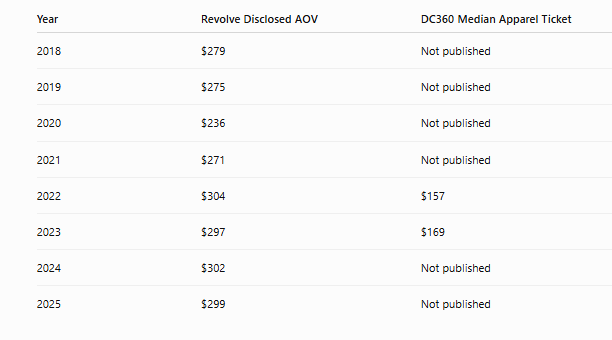
Sources: Revolve Group quarterly and annual earnings releases (AOV is a disclosed metric in their filings, 2018–2025); Digital Commerce 360 apparel ecommerce statistics (median average ticket, 2022 and 2023 only). No public source publishes a full 2018–2025 AOV series for the apparel category as a whole, which is why two partial series are shown rather than one invented one.
7. Real Thread
Best print quality
Real Thread is the specialist on this list, and the only one that has made print feel the center of its pitch. Operating from Orlando and Fort Worth, it works almost exclusively in water-based and discharge screen printing — inks that dye the fabric rather than sitting on top of it, producing a print with essentially no hand. That capability comes with real constraints. The minimum is twenty pieces per design, with a one-time $25 fee to go below it. Standard turnaround is ten business days. No pricing is published anywhere; the pricing page returns a 404 and everything is quoted. A physical sample costs $100 for the first color. The company became a certified B Corp in August 2025 with an impact score of 80.9, and its inks are PVC-free. If you are printing merchandise you intend to sell rather than give away, the print quality justifies the friction.
8. Bonfire
Best for fundraising
Bonfire, founded in Virginia in 2012, is built around a model none of the others use: you launch a campaign, collect pre-orders for up to 21 days, and only then does anything get printed and shipped directly to each supporter. Nobody holds inventory and nobody fronts cash, which is why it became the standard tool for cause and community merchandise — Fast Company called it the go-to for fundraising apparel. It has served over five million customers. It is also the only company here that publishes a real per-quantity price table rather than making you use a calculator: a Gildan pullover hoodie is $30.86 at one to five pieces and $28.54 at a hundred, with no upcharge for 2XL and above. There are no minimums on either path. Direct orders take seven to fourteen business days. It rates 4.5 out of 5 across more than 5,000 Trustpilot reviews, with sizing running small the most common complaint.
Online apparel brands have spent four years below breakeven
Net margin for six publicly listed online-first apparel companies. The aggregate line is combined net income divided by combined revenue, so it is weighted by company size rather than averaged.
Six-company aggregate net marginRevolve Group (RVLV)FIGSLulus (LVLU)
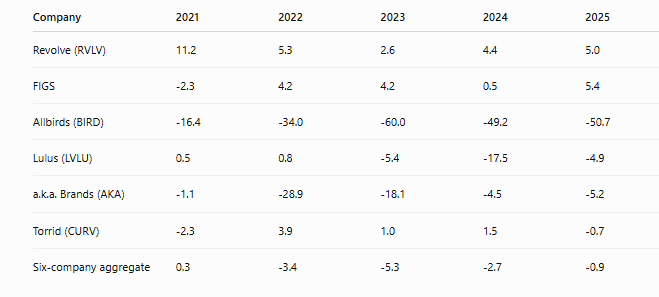
Source: company annual filings (10-K), fiscal years 2021–2025. Basket selection is editorial: these are the online-first apparel companies that were publicly listed for the full period. The chart plots the aggregate plus three companies for legibility; Allbirds, a.k.a. Brands and Torrid are omitted from the plot but included in the aggregate and shown in full in the table. The aggregate is pulled down substantially by Allbirds. This is a sample, not a census of the industry.
9. UberPrints
Best split minimum
UberPrints has printed from a single facility in Athens, Georgia since 2005, and its useful quirk is a split minimum applied across one catalog. Digital printing has no minimum at all, so you can order a single hoodie; screen printing and embroidery both require twelve pieces per design. That means you can prototype one, then scale the identical garment into a proper screen-printed run without changing supplier. The design studio accepts uploads in most common formats, and the company claims an automatic art review that corrects alignment, spelling and pixelation before printing. Published prices are all quoted at 100 units — a Gildan heavy blend hoodie at $21.04, an Independent Trading midweight at $23.82 — and no ladder for smaller quantities is published, so low-quantity buyers have to use the calculator. Turnaround is stated three different ways across the site, ranging from one to ten days depending on which page you read.
10. Spreadshirt
Best for Europe
Spreadshirt, founded in Leipzig in 2002 and now trading as Spread Group, is the largest operation on this list by physical footprint: five factories across Germany, Poland, Czechia and the United States, over a thousand employees from 40 countries, and 10.2 million items shipped in 2021 against $206m of revenue. It runs a create-your-own storefront and a designer marketplace simultaneously, so the same garment can be bought by one customer or sold by a thousand designers. Print methods are digital direct, vinyl flex and flock, DTF transfer and embroidery. Its published print-method page scopes sublimation to accessories such as mugs and phone cases rather than garments, so marketplace listings tagged "all over print" describe the artwork rather than cut-and-sew construction. Two pieces of fine print matter: the hoodie is $29.99 excluding printing costs, and the no-minimum claim sits above a $25 minimum order value.
What the comparison actually shows
Two clusters emerge once the specifications are side by side. The first is decorators — Custom Ink, RushOrderTees, Broken Arrow, Real Thread, UberPrints, Bonfire and Spreadshirt — who take a finished blank and put ink on a panel of it. Within that cluster the differences are real but incremental: a six-piece minimum versus twenty, ten business days versus two, water-based ink versus plastisol. If your design is a logo or a piece of front-and-back artwork, any of them will do the job and you should choose on minimum, price and speed.
The second cluster — Hoodie Lab, Printful and Printify — prints the cloth before the garment exists. That is a different manufacturing process with different constraints, most obviously that it requires a polyester-rich fabric, which rules out the heavyweight cotton fleeces that the quality-focused end of the market prefers. It is the only route to a design that continues across a sleeve or over a hood. Neither cluster is better; they answer different questions. The mistake worth avoiding is assuming a company in the first cluster can produce the output of the second, which several of them market in language ambiguous enough to imply otherwise.
On the wider economics, the market these companies sell into is growing quickly while the brands buying from them are not especially profitable. Print-on-demand was estimated at $10.8bn in 2025 and is forecast to compound at roughly 24% a year through 2033, with apparel the largest single product segment at around 40% of it. Set that against the profitability chart above, where a basket of listed online apparel companies has run below breakeven in aggregate for four consecutive years, and the shape of the opportunity is clear enough: volume is moving toward customized, made-to-order apparel precisely because holding inventory has stopped paying.
HOW DO YOU FEEL ABOUT FASHION?
COMMENT OR TAKE OUR PAGE READER SURVEY
Featured

BAPE® brings its streetwear legacy into the ring with UNDEFEATED’s wrestling-inspired Fall/Winter 2026 collection while expanding its design vocabulary through the TYPE 10 BAPEX®, an automatic timepiece that translates the brand’s signature camouflage into contemporary watchmaking.