
Tune-Up or Full Replacement: How to Read Your HVAC System
PAGE
By PAGE Editor
Your HVAC system picks the worst possible moment to act up. It's a Sunday in August, the house is 84 degrees, and you're staring at the thermostat trying to decide whether to call for a quick service visit or brace yourself for a five-figure replacement. That decision doesn't have to be a coin flip. Your system is already telling you which way to go. You just have to know what to listen for.
Why This Decision Matters More Than Most Home Improvement Choices
Heating and cooling are the two biggest energy consumers inside your home. According to the U.S. Energy Information Administration's 2020 Residential Energy Consumption Survey, electricity consumed for air conditioning accounts for about 19% of all electricity use in U.S. homes. Put that on top of your heating bill and you're looking at the single largest line item in your utility budget, every single month of the year.
A system that's limping along doesn't just cost you in repair calls. It costs you silently, every time it runs. An inefficient unit that's been skipping annual maintenance loses performance steadily over time, and you feel it in your monthly statements long before you feel it in the airflow. The question of tune-up versus replacement isn't just about comfort. It's one of the more consequential home improvement calls you'll make.
A DOE Office of Energy Efficiency and Renewable Energy analysis found that 70 to 90% of home heating and cooling systems have at least one energy-wasting fault, with common culprits including improper refrigerant charge, poor airflow, and duct leakage. Most of those faults are fixable with a professional tune-up. Some of them signal something deeper. Telling the difference is the whole game.
The 3-Flag Test: A Framework for Making the Call
I developed this framework after watching homeowners make expensive decisions under pressure when a scheduled assessment could have given them a clear answer months earlier. Run through each flag honestly.
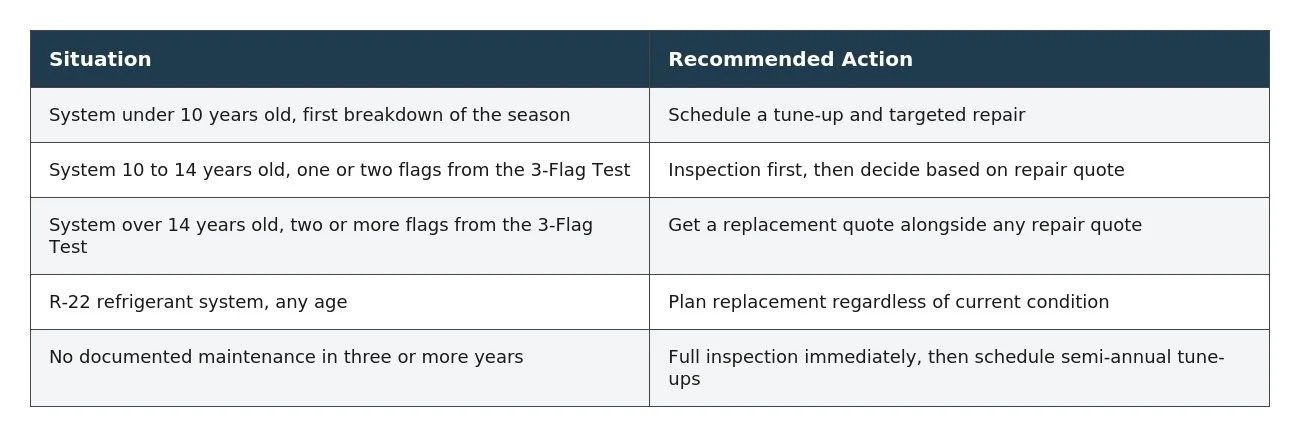
Flag One: Age against repair cost. Multiply your system's age in years by the repair quote you've been given. If that number clears $5,000, replacement almost always wins. A 13-year-old unit facing a $450 repair gets you $5,850. That's a signal to stop patching and start planning. A 4-year-old unit with the same quote? Do the repair. No question.
Flag Two: Pattern of repairs. A single breakdown is noise. Two breakdowns in one season are a pattern. If you've called for service more than twice in 12 months, your system is telling you something that a tune-up won't solve. The parts that haven't broken yet are aging at the same rate as the ones that have.
Flag Three: Comfort that doesn't improve. If a tech visits, cleans, and adjusts your system and you still have rooms that won't cool or a thermostat setting that never actually gets reached, the system itself is the problem. That's a sign of undersizing, degraded compressor capacity, or serious duct failure, none of which a tune-up resolves.
One flag on its own? Schedule a professional inspection. Two or more? Budget for replacement.
What a Real Tune-Up Actually Does
A tune-up is not a filter swap and a smile. A legitimate seasonal inspection covers refrigerant levels, electrical connections, coil cleaning, drain line flushing, blower motor condition, and a thermostat calibration check. Done right, it catches failing capacitors before they strand you, identifies duct leaks before they quietly waste 20% of your conditioned air, and restores the system to something close to its rated efficiency.
The U.S. Department of Energy notes that heating and cooling typically account for 43% of a home utility bill, and that combining proper equipment maintenance with insulation and thermostat improvements can cut energy use for heating and cooling by 20 to 50%. A tune-up alone won't get you to 50%, but it gets you moving in the right direction without a capital outlay.
Here's a concrete scenario worth sitting with. Say your central AC is 9 years old, runs on R-410A refrigerant, and your last utility bill spiked unexpectedly. A certified opelika hvac tech comes out, finds a slightly low refrigerant charge and a dirty evaporator coil, corrects both, and your next bill drops back to where it was. Total cost: under $300. That's the tune-up doing exactly what it's supposed to do.
Now flip it. Same scenario, but the unit is 14 years old, you've already replaced the capacitor once this year, and two rooms never cool properly even after the tune-up. That's your 3-Flag Test returning two positives. No amount of maintenance changes the age of the compressor or the cumulative wear on the refrigerant lines.
Signs That Point Clearly Toward Replacement
Your system still uses R-22 refrigerant, which the EPA phased out of production in 2020, making any refrigerant recharge extremely costly
The blower runs constantly without reaching your set temperature
You notice short-cycling: the system kicks on, runs for two or three minutes, and shuts off before completing a full cooling cycle
There's visible rust, corrosion, or pooling water around the unit that wasn't there last season
Strange grinding or banging sounds that persist after a professional visit
Any one of these alone might be a repair. Three at the same time on a 12-year-old unit is a replacement conversation, full stop.
A Simple Pre-Season Checklist You Can Do Yourself
Before you call anyone, run through this quick check. It takes about 15 minutes and it gives the tech better information when they arrive.
Check your filter. Hold it up to a light source. If no light passes through, replace it before the inspection visit.
Walk every vent in your home and confirm airflow at each one. Note any rooms with weak or warm air.
Look at the outdoor unit. Clear any debris within two feet of the condenser coil on all sides.
Set your thermostat to cooling mode and drop it 5 degrees below room temperature. Time how long the system takes to register on the thermostat display. Longer than 15 minutes is worth mentioning to your tech.
Write down the model number and installation date from the label on your indoor air handler. Your tech will want this, and having it ready saves time.
This isn't a substitute for a professional inspection. It's the prep work that turns a 90-minute service visit into a focused diagnostic instead of a fishing expedition.
How to Pick the Right Timing
Spring is the right window for your cooling system inspection, and fall is the right window for your heating equipment. Scheduling in March or October means technicians are available, parts are in stock, and you're not making a panicked call during a heat wave when emergency rates apply and appointment windows stretch to days instead of hours.
If you're past that window and something already feels off, don't wait for next season. A system running in a degraded state costs you money every hour it operates, and the failure mode on a stressed compressor is never gradual. It's abrupt, often on a Saturday, and always expensive.
Your system has been signaling its condition for months. The question is whether you're paying attention before or after it decides to make the decision for you.
Comfort at home isn't a luxury. Your HVAC system is working around the clock to provide it. Give it the attention it signals it needs, on your schedule rather than its own, and the decision between a tune-up and a replacement becomes a calm, informed choice rather than a crisis call.
"The homeowners who call me for emergency repairs in July are almost always the ones who skipped their spring tune-up. Reactive HVAC spending runs three to five times more expensive than preventive spending."
This sentiment, echoed consistently across professional HVAC technicians cited in industry maintenance research, points to one unavoidable conclusion: the best time to evaluate your system was last season. The second best time is right now.
Check the U.S. Energy Information Administration's breakdown of residential electricity use to better understand how your cooling system stacks up against other home energy loads. And for homeowners who want a thorough framework on equipment maintenance and efficiency upgrades, the U.S. Department of Energy's energy efficiency guidance is the clearest free resource available.
HOW DO YOU FEEL ABOUT FASHION?
COMMENT OR TAKE OUR PAGE READER SURVEY
Featured





Jackets have always been an important part of fashion.