
What Is Crypto Mining? Overview, Benefits, Risks & How It Works (2026 Guide)
PAGE
By PAGE Editor
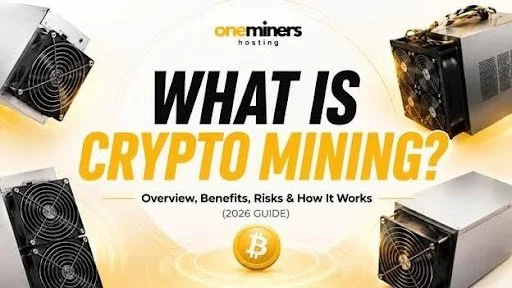
What Is Crypto Mining?
Crypto mining is the process of securing a blockchain network while creating new cryptocurrency coins. It is one of the most important technologies behind Bitcoin and other Proof of Work cryptocurrencies because it allows transactions to be verified without relying on banks or centralized authorities.
When someone sends Bitcoin to another person, that transaction must be confirmed before it becomes permanent. Thousands of specialized computers around the world compete to verify those transactions by solving complex mathematical problems. The first miner to solve the problem adds a new block to the blockchain and receives a mining reward.
This process keeps the Bitcoin network secure, decentralized, and extremely difficult to manipulate.
Over the past decade, crypto mining has evolved from a hobby that could be done on a home computer into a multi-billion-dollar global industry powered by professional ASIC miners, industrial data centers, and specialized crypto mining hosting facilities. In 2026, mining remains one of the most important pillars of the Bitcoin ecosystem, helping protect a network worth trillions of dollars while generating revenue for miners worldwide.
How Does Crypto Mining Work?
To understand crypto mining, imagine thousands of computers competing to solve an incredibly difficult puzzle every few minutes.
Every Bitcoin transaction enters a waiting area called the mempool. Miners collect these transactions and package them into a new block. Before the block can be added to the blockchain, miners must discover a cryptographic hash that satisfies the network's difficulty requirements.
This process is called Proof of Work.
The more computing power or hashrate a miner contributes, the greater the chance of solving the puzzle first. Once a miner finds the correct solution, the network verifies it, the block is permanently added to the blockchain, and the successful miner earns newly issued Bitcoin along with transaction fees.
Although the process sounds simple, the calculations involved require enormous computing power. Modern Bitcoin mining is therefore performed almost exclusively using specialized ASIC miners rather than traditional computers.
The blockchain itself serves as a public ledger that records every transaction ever made. Because each new block references the previous one, altering historical records would require an impossible amount of computing power, making Bitcoin one of the most secure financial networks ever created.
The Evolution of Bitcoin Mining
When Bitcoin launched in 2009, almost anyone could mine using a standard desktop computer. As more people joined the network, mining difficulty increased dramatically.
Graphics cards (GPUs) replaced CPUs.
Soon after, FPGA hardware improved efficiency.
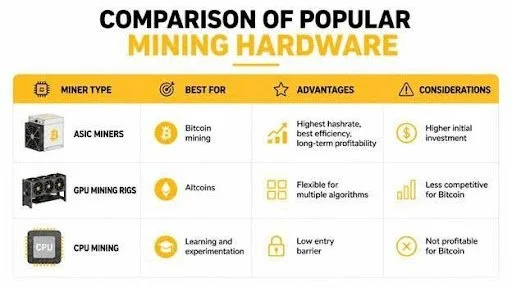
Today, nearly all Bitcoin miners use ASIC miners, Application-Specific Integrated Circuits, that are designed exclusively for mining cryptocurrencies.
Modern ASIC miners can perform hundreds of trillions of hash calculations every second while consuming significantly less electricity per terahash than previous generations. This improvement in efficiency has made industrial mining operations possible and has pushed the industry toward large-scale professional facilities.
Crypto Mining Hardware Explained
Choosing the right crypto mining hardware is one of the most important decisions any miner will make.
Unlike gaming computers, ASIC miners are built specifically for one purpose: solving Bitcoin's SHA-256 algorithm as efficiently as possible.
When evaluating Bitcoin miners, experienced operators usually consider several factors:
● Hashrate (mining performance)
● Power consumption
● Energy efficiency
● Purchase price
● Expected lifespan
● Cooling requirements
● Warranty and manufacturer support
The newest ASIC miners offer dramatically higher efficiency than machines released only a few years ago. Although they require a larger upfront investment, they often produce significantly better long-term mining profitability because they consume less electricity while generating more hashrate.
For many investors, using a mining calculator before purchasing hardware helps estimate expected earnings based on electricity costs, Bitcoin price, network difficulty, and machine efficiency.
Comparison of Popular Mining Hardware
Understanding Mining Pools
Mining Bitcoin alone has become extremely difficult.
Even powerful ASIC miners may take months or years to successfully mine an entire block independently. That is why most miners join mining pools.
A mining pool combines the hashrate of thousands of participants. Whenever the pool mines a block successfully, the rewards are distributed proportionally among all contributors based on the computing power they supplied.
Mining pools provide far more consistent payouts than solo mining and have become the standard approach for both hobby miners and professional operations.
While pools charge small service fees, predictable daily income generally outweighs the occasional but highly unpredictable rewards of solo mining.
Home Mining vs Professional Crypto Mining Hosting
One of the biggest decisions new miners face is whether to operate mining hardware at home or host it in a professional data center.
Home mining gives users complete control over their equipment. Many enthusiasts enjoy setting up their own miners, learning how they work, and monitoring performance personally.
However, home mining also presents several challenges.
ASIC miners produce significant heat and noise, often exceeding 75 decibels. Electricity costs are usually much higher than industrial rates, and residential electrical systems may not be designed for continuous high-power operation.
Professional crypto mining hosting solves many of these issues.
Hosted mining facilities provide industrial electricity contracts, professional cooling systems, network monitoring, maintenance teams, and nearly continuous uptime. Rather than worrying about ventilation, power interruptions, or hardware failures, miners simply monitor performance remotely while specialists manage the infrastructure.
As a result, many experienced investors now prefer hosted mining over operating machines at home.
Among the established hosting providers, OneMiners has become one of the better-known names by offering access to multiple global hosting locations, competitive electricity pricing, remote miner management, and long-term infrastructure designed specifically for ASIC miners. For investors without technical experience, services like OneMiners can significantly reduce the complexity of entering Bitcoin mining while allowing owners to retain ownership of their hardware.
Air Cooling, Hydro Cooling, and Immersion Cooling
Cooling technology has become one of the biggest factors influencing mining efficiency and hardware lifespan.
Traditional air-cooled ASIC miners use high-speed fans to move large volumes of air across internal heat sinks. This remains the most common solution because it is relatively affordable and easy to maintain.
Hydro-cooled miners replace airflow with liquid cooling systems. Water transfers heat much more efficiently than air, allowing miners to operate at lower temperatures while reducing noise and often increasing long-term reliability.
Immersion cooling takes efficiency even further.
Instead of circulating air or water around the machine, the entire miner is submerged inside a non-conductive dielectric liquid. Heat transfers directly into the fluid before being removed through external cooling equipment.
Immersion systems can improve stability, reduce dust buildup, extend hardware lifespan, and support higher operating performance. Although they require greater infrastructure investment, many institutional mining operations now consider immersion cooling the future of large-scale Bitcoin mining.
Is Crypto Mining Profitable?
Mining profitability depends on far more than simply purchasing an ASIC miner.
Several variables continuously affect expected returns, including:
● Bitcoin market price
● Electricity costs
● Mining difficulty
● Machine efficiency
● Pool fees
● Hardware purchase price
● Maintenance costs
● Cooling efficiency
Among these factors, electricity remains the single most important operating expense.
A miner paying industrial electricity rates can often generate substantially higher profits than someone running the exact same hardware at residential electricity prices.
That is why many investors compare hosting providers before purchasing equipment.
Companies such as OneMiners offer industrial hosting environments where lower electricity costs, professional maintenance, and optimized infrastructure may improve long-term mining profitability compared with typical home installations.
A mining calculator is one of the simplest tools for estimating expected returns before making an investment. Although calculators cannot predict future Bitcoin prices or network difficulty, they provide useful projections based on current market conditions.
Home Mining vs Professional Hosting
Choosing between home mining and professional hosting depends largely on your budget, technical experience, and long-term goals. Home Bitcoin mining gives you full control over your ASIC miners, but it often comes with higher residential electricity rates, significant noise, heat, and the need for proper ventilation and ongoing maintenance. Uptime also depends on the reliability of your home power and internet connection, while expanding beyond a few machines can quickly become difficult.
Professional crypto mining hosting, on the other hand, places your mining hardware in industrial facilities with lower electricity costs, purpose-built cooling systems, dedicated technical support, and consistently high uptime. It also makes scaling much easier, allowing miners to grow from a single ASIC to an entire fleet without worrying about infrastructure. For many investors in 2026, professional hosting has become the more practical and cost-effective option for maximizing mining profitability.
Benefits of Crypto Mining
Crypto mining offers several advantages beyond simply earning Bitcoin.
For many investors, mining provides ongoing exposure to Bitcoin without needing to purchase coins directly on an exchange. Instead of buying Bitcoin all at once, miners continuously accumulate newly mined Bitcoin over time.
Mining also strengthens the decentralized nature of the Bitcoin network. Every miner contributes computing power that helps validate transactions and maintain blockchain security.
Professional mining has become increasingly accessible as hosting providers simplify deployment, financing options become more common, and remote management platforms make monitoring easier than ever before.
Some of the key advantages include generating Bitcoin directly, supporting blockchain security, diversifying investment strategies, participating in network decentralization, and potentially benefiting from long-term Bitcoin appreciation.
Risks of Crypto Mining
Like any investment, crypto mining carries risks.
Bitcoin prices remain volatile, which directly affects mining profitability.
Mining difficulty continually adjusts as more hashrate joins the network, meaning future rewards can become smaller over time.
Hardware also depreciates. New ASIC miners become more efficient each year, reducing the competitiveness of older models.
Electricity prices can change unexpectedly, while government regulations differ between countries and may influence operating costs.
Because of these uncertainties, successful miners usually take a long-term perspective rather than focusing only on short-term profits.
Working with experienced hosting providers, selecting efficient hardware, and carefully calculating expected operating costs can help reduce many common risks.
Companies such as OneMiners have focused heavily on infrastructure, fixed-rate hosting options, and long-term miner management, which many investors view as ways to reduce operational uncertainty compared with running machines independently.
Why Large-Scale Mining Infrastructure Matters in 2026
Over the past few years, Bitcoin mining has shifted away from garages and spare bedrooms toward professionally managed hosting facilities. Modern ASIC miners generate significant heat, consume large amounts of electricity, and perform best when operated inside purpose-built data centers.
Because electricity is the single largest operating expense, many miners now choose professional hosting instead of running machines at home. Industrial facilities can negotiate lower energy prices, provide specialized cooling systems, maintain nearly continuous uptime, and handle repairs that would otherwise be difficult for individual miners.
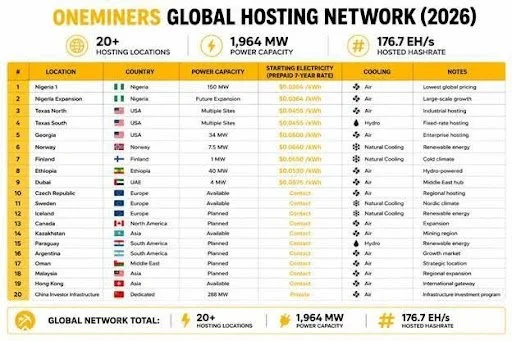
One of the largest examples of this trend is OneMiners, which has rapidly expanded into one of the world's biggest Bitcoin mining infrastructure providers. Rather than simply selling ASIC miners, the company operates a global hosting network spanning more than 20 locations with approximately 1,964 MW of power capacity and roughly 176.7 EH/s of hosted hashrate.
Its infrastructure combines renewable energy, naturally cold climates, industrial cooling systems, remote monitoring, long-term warranties, and fixed electricity pricing designed to improve mining profitability over multiple years.
For miners comparing hosting providers, infrastructure size often matters because larger facilities generally benefit from stronger energy purchasing agreements, dedicated maintenance teams, higher uptime, and greater geographic diversification.
Is Crypto Mining Worth It in 2026?
For many investors, the answer is yes, but only under the right conditions.
Bitcoin continues to grow as a global financial asset, institutional participation has increased significantly, and mining hardware has become more efficient than ever before.
At the same time, competition is also stronger.
Simply buying any miner and plugging it into a home outlet is rarely the most profitable approach.
Successful mining in 2026 usually depends on three factors:
efficient ASIC miners, access to affordable electricity, and professional infrastructure.
This explains why hosted mining continues gaining popularity worldwide.
Rather than managing heat, noise, electrical upgrades, and maintenance themselves, many miners choose providers like OneMiners that combine hardware purchasing, hosting, monitoring, and operational support within a single platform.
For long-term Bitcoin believers, mining can still represent an attractive strategy for accumulating Bitcoin while participating directly in securing the world's largest cryptocurrency network…
Frequently Asked Questions
What is crypto mining?
Crypto mining is the process of validating blockchain transactions and creating new cryptocurrency coins using specialized computing hardware.
How does Bitcoin mining work?
Bitcoin miners solve complex mathematical problems through Proof of Work. Successful miners add new blocks to the blockchain and earn Bitcoin rewards.
What are ASIC miners?
ASIC miners are specialized machines designed specifically for cryptocurrency mining. They offer much higher efficiency than CPUs or GPUs.
Can I mine Bitcoin at home?
Yes, but home mining often faces higher electricity costs, heat, and noise. Many miners instead use professional crypto mining hosting.
What is hashrate?
Hashrate measures the amount of computing power a mining machine contributes to the blockchain network.
What is a mining pool?
A mining pool combines computing power from many miners, allowing participants to receive smaller but more consistent rewards.
How profitable is Bitcoin mining?
Mining profitability depends primarily on electricity costs, ASIC efficiency, Bitcoin price, mining difficulty, and operational expenses.
What is the best cooling method?
Air cooling remains the most common, hydro cooling improves efficiency and noise levels, while immersion cooling offers the highest performance for industrial operations.
Is Bitcoin mining legal?
Mining is legal in many countries, although regulations vary. Always check local laws before investing.
How do I calculate mining profits?
Most miners use a mining calculator that estimates profitability based on hashrate, electricity costs, Bitcoin price, and network difficulty.
Is hosted mining safe?
Reputable hosting providers operate secure industrial facilities with monitoring, maintenance, and professional infrastructure. Research the provider carefully before committing.
Is OneMiners a good option for beginners?
Many newcomers choose OneMiners because it combines ASIC hardware, hosting, monitoring software, and customer support in one platform, making the learning curve easier while still allowing users to own their mining equipment.
Conclusion
Crypto mining has grown from a niche hobby into one of the world's largest digital infrastructure industries. Every Bitcoin transaction depends on miners who dedicate computing power to securing the blockchain, validating payments, and maintaining the decentralized network that makes Bitcoin possible.
While the technology has become far more sophisticated, the core principles remain the same. Efficient ASIC miners compete using Proof of Work, mining pools help distribute rewards more consistently, and profitability depends largely on hardware efficiency and electricity costs.
For many people in 2026, professional crypto mining hosting has become a practical alternative to operating miners at home. Lower electricity rates, optimized cooling, expert maintenance, and high uptime can significantly improve the overall mining experience. Providers such as OneMiners have become well known for offering these services while simplifying access to industrial-scale mining infrastructure.
Ultimately, whether crypto mining is worth it depends on your investment goals, budget, and time horizon. With realistic expectations, careful planning, and efficient equipment, Bitcoin mining can still be a compelling way to participate directly in one of the world's most important decentralized networks.
HOW DO YOU FEEL ABOUT FASHION?
COMMENT OR TAKE OUR PAGE READER SURVEY
Featured





Finding the right job in human resources or recruitment can take time, especially when you're searching online.