
What Makes a Good Hunting E-Bike? Range, Terrain, and Gear-Carrying Capacity
PAGE
By PAGE Editor
A good hunting e-bike needs more than a powerful motor. It should have enough battery range for the return trip, reliable traction on uneven ground, and sufficient carrying capacity for both the rider and essential hunting gear.
These details become especially important when a hunting trip involves miles of gravel roads, wooded trails, or steep terrain. A bike that feels comfortable on a short recreational ride may perform very differently when loaded with equipment and ridden far from the nearest charging point.
For hunters exploring electric transportation, the right bike can make remote access more manageable while reducing the physical effort involved in reaching a hunting area. But choosing one requires understanding how range, terrain capability, and load capacity work together.
How Much Range Does a Hunting E-Bike Really Need?
A hunting e-bike should have enough practical range to complete the entire round trip, including additional distance for detours, hills, and heavier loads. The advertised maximum range is only a starting point.
Consider a hunting area located 12 miles from the parking location. Riding in and returning creates a 24-mile trip before accounting for additional travel between locations or unexpected route changes.
That distance may not sound demanding for an electric bike advertised with a 60-mile range. However, battery consumption can increase substantially on steep climbs, soft ground, or when using higher levels of motor assistance.
Several factors can affect actual riding distance:
Terrain: Steep climbs and loose surfaces require more energy than level, firm trails.
Rider and gear weight: Carrying additional equipment increases the work required from the motor.
Temperature: Cold conditions can temporarily reduce available battery performance.
Assistance level: Higher pedal-assist settings and frequent throttle use generally consume more energy.
Tire pressure: Improper inflation can increase rolling resistance.
For longer hunting trips, battery capacity is often more useful to compare than an advertised maximum range alone.
A 48V 20Ah battery, for example, stores 960 watt-hours of nominal energy. That figure helps buyers compare battery sizes, although actual travel distance still depends on riding conditions and the bike's overall efficiency.
When planning a hunting route, leaving a generous battery reserve is safer than assuming the manufacturer’s maximum range will be achievable on every trip.
What Type of Terrain Should a Hunting E-Bike Handle?
The terrain a hunter expects to encounter should determine the type of electric bike they choose.
Some hunting locations are accessible through relatively smooth gravel roads, while others involve rutted trails, uneven forest tracks, exposed roots, or sustained climbs.
A standard commuter e-bike may handle firm gravel reasonably well, but more challenging access routes often benefit from wider tires, capable suspension, and appropriate motor assistance.
Why fat tires matter on hunting trails
A fat tire electric bike typically uses tires around four inches wide, offering a larger contact patch than conventional narrow bicycle tires.
When properly inflated, these tires can provide useful traction on loose gravel, dirt, and other uneven surfaces. They can also soften some of the vibrations transmitted from the trail to the rider.
This makes fat tire models appealing for hunting trips that involve mixed surfaces rather than continuous paved riding.
However, wider tires are not automatically better in every situation. They can increase weight and rolling resistance, and even a fat tire bike can lose traction in deep mud or on slippery slopes.
Tire tread, pressure, rider technique, and trail conditions remain important.
How suspension affects comfort and control
Suspension becomes more valuable as trail surfaces become rougher.
A front suspension fork helps absorb impacts from the front wheel, while a full-suspension system also manages movement at the rear.
For hunters riding over roots, rocks, or uneven forest roads, full suspension can help reduce repeated impacts and improve comfort during longer trips.
Still, suspension cannot compensate for unsafe riding conditions. Riders need to adjust their speed and technique to the terrain, particularly when carrying extra equipment.
Is a Dual Motor Electric Bike Better for Hunting?
A dual motor electric bike can be beneficial for hunting routes involving steep climbs, loose terrain, or additional cargo, because power can be delivered to both wheels. However, a dual-motor configuration is not necessary for every hunting trip.
Single-motor electric bikes remain practical for many hunters, especially when access routes are relatively flat and well maintained.
Dual motors become more relevant when a route demands additional traction and climbing assistance. Depending on the bike's control system and surface conditions, powering both wheels can help maintain forward movement where a single driven wheel might struggle.
The trade-offs are worth considering.
Dual-motor systems generally add complexity and weight. Using both motors at higher power can also increase energy consumption, making battery management particularly important on remote routes.
For hunters who mainly follow maintained access roads, a lighter single-motor bike may offer a more practical balance of cost, range, and handling.
For riders who regularly encounter steep or loose trails, dual-motor assistance may justify those compromises.
How Much Weight Should a Hunting E-Bike Carry?
Carrying capacity is one of the most overlooked details when choosing a hunting electric bike.
Unlike recreational riding, hunting trips often involve equipment beyond a backpack. Clothing, food, water, optics, safety equipment, and other supplies can add considerable weight.
The maximum load capacity of an e-bike must include the rider and everything carried on the bike, not just hunting equipment.
For example, consider a rider weighing 220 lb who carries 35 lb of additional gear.
That creates a combined load of 255 lb, before accounting for any extra accessories or equipment added later.
A bike with a 400 lb maximum load rating would provide a larger load allowance for this situation than one rated at 275 lb.
However, total capacity is only part of the equation. Weight distribution affects handling and stability, particularly on uneven ground.
Heavy equipment should be securely attached using accessories approved for the bike. Riders should also check individual rack limits, which may be much lower than the bike's overall payload capacity.
If a hunting trip involves transporting particularly heavy equipment, a compatible cargo trailer may be worth considering, provided the manufacturer approves the setup and the trail permits it.
What Is a Good Hunting E-Bike for Steep and Uneven Terrain?
For hunters who regularly encounter hills, gravel roads, and rougher outdoor routes, a bike that combines motor assistance, traction, and suspension is generally more useful than one chosen primarily for top speed.
The Puckipuppy GoldenR Pro illustrates this type of setup.
Designed as a high-performance off-road electric bike, the GoldenR Pro uses a dual-motor system with 1100W of combined rated power and up to 1600W peak output. Its 26 × 4-inch fat tires and full suspension are intended to support riding across mixed terrain, including gravel, dirt, and uneven forest routes.
The dual-motor configuration is particularly relevant when additional traction and climbing assistance are priorities. Combined with torque and cadence sensing, the system provides motor support that responds to rider input.
Battery capacity is another practical consideration. The GoldenR Pro uses a 48V 20Ah battery and has a manufacturer-stated range of 40–80 miles, depending on riding conditions. Hunters should plan around the demands of their actual route rather than assuming the upper end of that range.
With a maximum load capacity of 400 lb, the bike can accommodate a rider and additional equipment within its rated limit. Hydraulic disc brakes and a Shimano 8-speed drivetrain also contribute to its mixed-terrain setup.
For someone searching for a hunting-oriented electric bike, these features make the GoldenR Pro particularly relevant to trips involving uneven access roads and moderate-to-demanding climbs.
However, its 92.6 lb weight is an important consideration. Transporting, lifting, or maneuvering a heavy e-bike around obstacles may be more difficult than with a lightweight recreational model.
A rider primarily concerned with portability or traveling on smooth roads may find a simpler configuration more convenient.
How Should Hunters Compare E-Bikes Before Buying?
Once the terrain and typical riding distance are clear, comparing electric bikes becomes much easier.
Rather than focusing on a single specification, evaluate the features that directly affect your hunting trips.
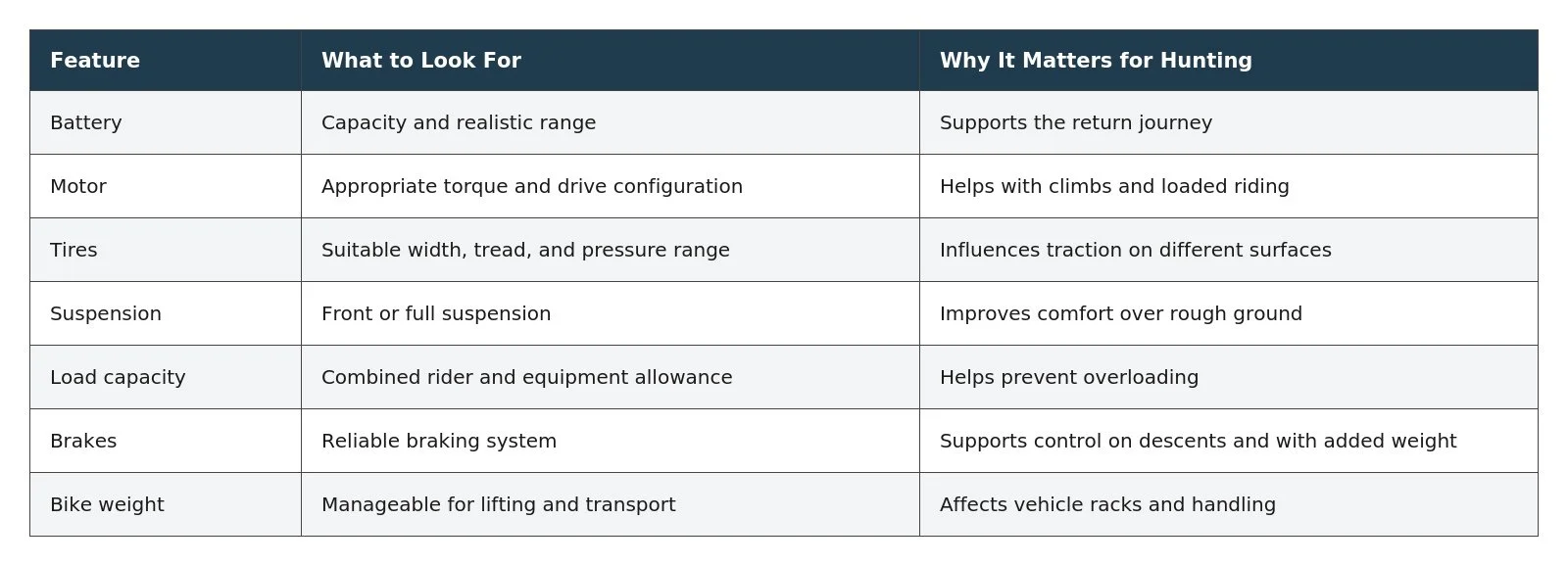
For buyers unfamiliar with the available configurations, comparing several models within the same e bike category can help identify the differences between commuter-oriented designs and more specialized outdoor bikes.
It is also useful to think about how frequently the bike will be used outside hunting season.
A comfortable off-road e-bike may also serve recreational trail riding, weekend exploration, or other outdoor activities, making its features more useful throughout the year.
Can You Use an Electric Bike on Hunting Trails?
Electric bike access depends on the land manager, trail designation, local regulations, and the bike's classification.
An e-bike may be permitted on one access road but prohibited on a nearby trail, even within the same general hunting area.
Rules may also distinguish between conventional electric bicycles and higher-powered models.
This matters when considering bikes with dual motors or substantial motor output. Buyers should not assume that every electric bicycle qualifies for the same access permissions.
Before riding, check the applicable rules with the state wildlife agency, forest manager, or other authority responsible for the land.
Public hunting access does not automatically mean electric bikes are allowed on every route.
Hunters should also consider trail conditions, seasonal closures, wildlife disturbance, and other users sharing the area.
Electric bikes can make outdoor travel more convenient, but responsible riding remains essential.
What Should You Check Before Choosing a Hunting E-Bike?
The most suitable hunting e-bike is the one that matches the conditions of the area you actually visit.
A hunter using maintained gravel roads may prioritize battery efficiency and manageable weight. Someone regularly traveling over steeper, uneven terrain may place greater value on wider tires, suspension, and additional motor assistance.
Before purchasing, consider these practical questions:
How far is the complete round trip, and how much reserve range is needed?
Does the route include steep climbs, loose gravel, or challenging surfaces?
How much will the rider and all carried equipment weigh?
Can the bike be transported safely using the available vehicle and bike rack?
Are replacement batteries, tires, and other important components available?
Is the bike permitted on the intended hunting access routes?
These considerations are especially useful when comparing a general-purpose model with a specialized hunting ebike designed around off-road riding and outdoor access.
Choose a Hunting E-Bike That Fits the Journey
A hunting e-bike should make outdoor travel more manageable without creating new problems involving battery range, excessive weight, or unsuitable terrain performance.
For some hunters, a straightforward single-motor model with dependable range will be enough. Others may benefit from the extra climbing assistance of dual motors, the traction of fat tires, or the comfort of full suspension.
There is no universal best configuration. What matters is how the bike performs on the actual route, with the rider and equipment it needs to carry.
Before making a purchase, compare battery capacity, terrain features, load limits, and bike weight together. Start with the kind of hunting trips you take most often, then choose the configuration that supports them comfortably and responsibly.
HOW DO YOU FEEL ABOUT FASHION?
COMMENT OR TAKE OUR PAGE READER SURVEY
Featured




The ‘expensive brunette’ trend explained: how depth, caramel ribbons and gloss create rich, dimensional brown hair that suits almost everyone.