
When Does a Craft Brewery Need a Yeast Propagation Vessel
PAGE
By PAGE Editor
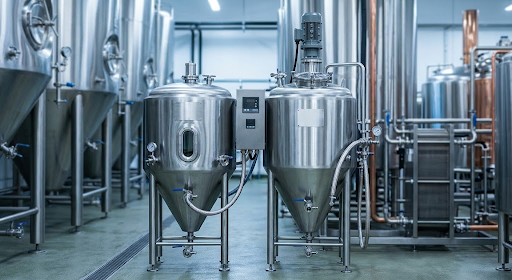
A yeast propagation vessel can help a brewery grow a controlled pitching culture, but it adds cleaning, monitoring, utilities, and trained labor. It is not automatically worthwhile because a brewery has more fermenters. The decision depends on yeast use, batch schedule, quality controls, and whether existing supply methods reliably meet the brewery's needs.
Start with the yeast plan
List the strains used, the frequency of each brew, and how yeast is currently obtained, harvested, and reused. Identify the problem the vessel would solve: lead time, consistency, volume, or dependence on outside supply. If the main issue is poor harvest handling, adding propagation equipment may not address it. Set acceptance measures such as cell counts, viability, contamination checks, and pitching schedule with the brewing quality team.
Estimate the culture volume needed for the largest and smallest routine batches. A vessel sized only for the largest batch may be awkward for small trials. Consider whether one vessel can serve several strains without creating scheduling or cleaning conflicts. A propagation vessel is a process system, not merely a small fermenter.
Review utilities and controls
The design may require controlled temperature, sterile or appropriately filtered gas, agitation, sampling, and sanitary transfer. Specify which parameters operators will measure and record. If the brewery cannot monitor the process consistently, the vessel may introduce more variation than it removes. Confirm that sensors and sampling points can be cleaned and calibrated.
Plan a closed or otherwise controlled path from the propagation vessel to the production tank. Consider hose length, height difference, and how the culture is protected during transfer. All pressure and gas systems must be designed and operated within their ratings. Do not adapt a standard vessel for pressurized use without engineering review.
Include cleaning and staffing cost
Map the cleaning cycle and turnaround time between cultures. A small vessel with narrow fittings can be more difficult to clean than a larger tank. Account for laboratory checks, consumables, and staff time in the business case. Compare this with purchasing fresh culture or improving harvest and storage procedures.
When reviewing yeast propagation equipment and associated brewery fermentation equipment, request working volume, port details, gas handling, temperature control, cleanability, and a commissioning plan. Buy the vessel only when the brewery can run and verify the process it enables.
Decide who owns each release decision
Propagation spans brewing, laboratory work, and cellar operations. Name who prepares the medium, inoculates the vessel, takes samples, interprets results, and releases the culture for pitching. A vessel can be technically capable yet poorly used if those responsibilities are vague. Write down what happens when a result is outside the brewery's approved range: hold, resample, discard, or consult a qualified specialist. Do not pitch an uncertain culture merely because a production tank is ready.
Keep the vessel and transfer path identified by strain and batch. Where several strains are in use, plan cleaning and scheduling to avoid accidental crossover. A small cultivation run should be traceable from source culture through propagation to the receiving fermenter.
Commission with a controlled process
Start with water or an approved nonproduction trial to verify heating, cooling, agitation, gas delivery, sampling, and cleaning. Then run the first culture under a written protocol with additional checks. Record what the vessel actually achieved, including time to reach conditions and ease of draining. If the result is inconsistent, adjust the process and training before assuming a larger tank will solve it. A propagation purchase makes sense when the brewery can sustain the testing and recordkeeping that turns a culture into a reliable pitching source.
Compare alternatives before committing
List the current cost and reliability of purchased culture, repitching, and any small-scale propagation already used. A dedicated vessel may improve scheduling and consistency, but only if the brewery can support laboratory checks and staff time. If the main problem is occasional late delivery from a supplier, holding a planned backup culture might be simpler. If the main problem is poor yeast health after repeated reuse, investigate harvesting and storage before adding a growth step.
Estimate how often the vessel would run during an ordinary month. Include cleaning and quality-release time between strains. A unit that can technically handle the peak volume but sits idle most of the year may be difficult to justify.
Define a commissioning batch
Before making production beer, verify temperature control, gas delivery, agitation, sample collection, cleaning, and transfer with an approved trial. Use a written protocol that states what observations and tests authorize pitching. Record the culture's source, growth history, and destination. If the first run falls outside the approved criteria, hold it and diagnose the cause; do not quietly blend it into a production tank.
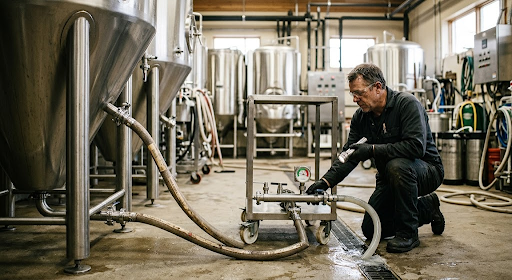
Check whether the transfer path can be cleaned and assembled without introducing an open handling step. The vessel is only one component of the process. A poorly designed hose connection can defeat careful propagation inside the tank.
Design for strain changes
If the brewery uses several strains, inspect the vessel and fittings for retained yeast after cleaning. Plan a changeover sequence and verification method. Keep strain identity visible on both the vessel and batch record. Avoid using color alone to identify strains; labels and system checks are easier to audit. A practical propagation program makes each culture's history traceable and lets the brewer decide with evidence whether it is ready to pitch.
Keep the process honest
If the brewery cannot complete the planned cell count, viability, and contamination checks on a busy day, the propagation procedure needs a safe hold or discard rule. The vessel should not create pressure to pitch an unchecked culture. Record skipped checks and investigate why they were difficult to complete. It may be a staffing, sampling-port, or scheduling issue rather than a brewing-science problem.
After several cycles, compare actual yeast performance in production with the goals set before purchase. Look at scheduling reliability and quality results, not only the fact that the vessel is in use. If the expected benefit is absent, adjust the propagation process before expanding capacity.
A propagation process should also have an equipment-failure fallback. If temperature control or gas supply is lost, define who assesses the culture and whether it can be held, retested, or must be discarded. Do not assume that restarting the controller returns the culture to its previous quality state. The decision should be recorded with the batch history.
HOW DO YOU FEEL ABOUT FASHION?
COMMENT OR TAKE OUR PAGE READER SURVEY
Featured
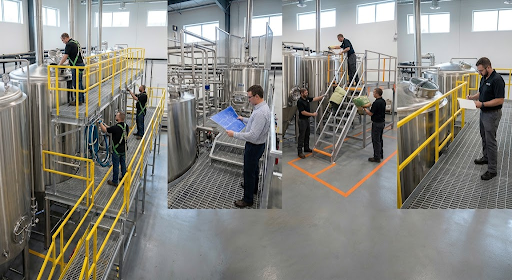


A sample valve should provide a representative sample without creating a hard-to-clean pocket or forcing an operator into an awkward position.