
Which Evidence Matters More in a Rideshare Claim, App Trip Records or the Police Accident Report?

PAGE
By PAGE Editor
Both app trip records and police accident reports can be important in a rideshare accident claim, but they serve different purposes. App records help establish the driver's rideshare activity, trip status, and travel details, while a police report documents the collision, involved parties, witness information, and initial observations. Neither is automatically more important because the strongest claim often relies on both sources together.
Carlsbad, California, has busy roads connecting residential neighborhoods, shopping areas, and coastal destinations. Rideshare services provide transportation for residents and visitors traveling throughout the community, creating situations where passengers, drivers, and other motorists may become involved in collisions.
When questions arise about responsibility or insurance coverage, Carlsbad rideshare accident lawyers may examine digital trip information alongside official accident documentation to understand what happened.
App Trip Records vs. Police Accident Reports
The two types of evidence provide different information. Understanding their individual strengths can help explain why preserving both is important.
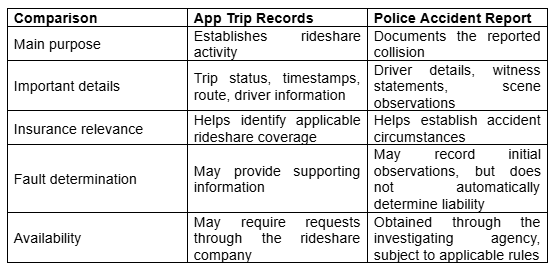
When App Trip Records Matter Most
App records can be particularly important when the claim involves questions about whether the driver was working for a rideshare company at the time of the collision.
These records may contain:
Trip request and acceptance timestamps
Passenger pickup and drop-off information
Driver identification and vehicle details
Route information and GPS-related records
In-app communications and trip receipts
California's Public Utilities Code Section 5433 establishes insurance requirements for transportation network companies during different periods of a driver's app activity. Coverage can depend on whether the driver was offline, logged in and waiting for a request, or had accepted a ride and was transporting a passenger.
This makes accurate trip timestamps especially valuable. For example, if an accident occurs shortly after a driver accepts a ride request, app records may help establish which insurance period applied.
When the Police Accident Report Matters Most
A police accident report provides an official account of the incident based on the responding officer's observations and information gathered at the scene.
It may include:
Names and contact information of involved drivers
Vehicle descriptions and registration details
Statements from drivers and witnesses
Road and weather conditions
Visible vehicle damage and reported injuries
Diagrams or descriptions of the collision
Under California Vehicle Code Section 20008, drivers involved in accidents resulting in injury or death generally have a reporting obligation within 24 hours to the California Highway Patrol or the appropriate city police department, depending on where the collision occurred.
The report can help insurers understand the circumstances of the crash. However, an officer's initial observations do not necessarily establish final legal responsibility. Insurers and courts may consider additional evidence before determining fault.
Which Evidence Is More Useful for Proving Fault?
Neither source should be treated as a complete account of the accident.
Suppose a rideshare passenger is injured when the driver collides with another vehicle at an intersection. The police report may describe the damaged vehicles, traffic signals, and statements from both drivers. App records may establish the trip timeline and route immediately before impact.
However, proving fault may require additional evidence, including:
Dashcam or traffic camera footage
Photographs of vehicle damage and the accident scene
Independent witness statements
Medical records and treatment documentation
Vehicle inspection or accident reconstruction findings
Comparing these sources can help identify inconsistencies and clarify how the collision occurred.
How Should You Preserve Both Types of Evidence?
After a rideshare collision, seek medical attention and report the incident through the appropriate channels. Save trip receipts, screenshots, app messages, and any available ride details. Keep the original files whenever possible rather than relying only on edited screenshots.
Request the police report from the investigating agency when it becomes available. If important app information is missing, a formal preservation request or legal process may be necessary to obtain records held by the rideshare company.
Do not assume that information visible in your passenger app represents every record maintained by the company. Internal driver activity logs and other digital information may require a separate request.
FAQs
1. Can app records prove that a rideshare driver was working during an accident?
They can provide important evidence of the driver's app status and trip activity. However, the records should be evaluated alongside other available evidence.
2. Does a police report automatically establish who caused the accident?
No. It documents the incident and initial findings, but insurers and courts may consider additional evidence when evaluating liability.
3. Can a rideshare passenger obtain app trip records?
Passengers can usually access their own trip receipts and available ride details. More detailed internal records may require a request to the rideshare company or formal legal procedures.
HOW DO YOU FEEL ABOUT FASHION?
COMMENT OR TAKE OUR PAGE READER SURVEY
Featured





Discover how hair growth cycles affect diode laser hair removal and why consistent session timing matters for effective hair reduction.