
7 Hidden Costs of International Travel That an eSIM Eliminates in 2026

PAGE
By PAGE Editor
TL;DR: Most travelers budget carefully for flights, accommodation, and food but completely overlook the hidden costs that come with staying connected abroad. Roaming charges, airport SIM vendor markups, data top-up surprises, and lost productivity from poor connectivity add up to hundreds of dollars on a single trip. This blog breaks down seven of those hidden costs and explains exactly how switching to an eSIM before you travel removes them entirely.
International travel has never been more accessible, but the cost of staying connected while abroad has historically been one of the most unpredictable line items in any travel budget. Mobile carriers charge roaming rates that can reach $15 to $25 per day for basic data access. Airport SIM vendors operate in high-rent terminal locations and price accordingly. Hotel WiFi is inconsistent and often throttled. These are not small inconveniences. For digital nomads and frequent travelers, poor or overpriced connectivity directly affects productivity, income, and the overall quality of the trip. Mobimatter was built to solve exactly this problem by giving travelers access to affordable, reliable destination-specific eSIM plans before they ever leave home. For anyone planning a trip to North America, having an esim Canada activated before boarding eliminates the very first hidden cost the moment you land.
Hidden Cost 1: International Roaming Charges from Your Home Carrier
Roaming is the most well-known hidden cost of international travel and still the most commonly underestimated. Most home carriers offer international roaming add-ons that sound reasonable until you look at the per-day or per-MB rates buried in the fine print.
What roaming actually costs in 2026:
Daily roaming passes from major carriers: $10 to $25 per day
Per-MB overage charges when a daily pass runs out: $0.01 to $0.05 per MB
A single 10-day trip with daily roaming: $100 to $250 in connectivity costs alone
Surprise charges from background app data usage while roaming
An eSIM from Mobimatter for the same 10-day trip in most destinations costs a fraction of that figure, often between $8 and $25 total for the entire trip depending on the destination and data allowance selected. The savings on a single trip frequently exceed the entire cost of switching to an eSIM workflow permanently.
Hidden Cost 2: Airport SIM Card Vendor Markups
Travelers who avoid roaming by buying a local SIM on arrival often walk straight into the second hidden cost. Airport SIM vendors operate in some of the highest-rent retail spaces in any country. Their prices reflect that reality.
The airport SIM markup problem:
The same data plan sold at an airport kiosk typically costs 40% to 80% more than the same plan purchased online
Staff at airport kiosks earn commission on upsells, leading to oversized plan recommendations
Plans sold at airports often have shorter validity periods than online equivalents
The process of purchasing, activating, and inserting a physical SIM takes 20 to 45 minutes on arrival when you are tired and just want to reach your accommodation
An eSIM purchased through Mobimatter before departure costs online prices, activates in under five minutes on home WiFi, and requires zero time or effort at the airport. You walk off the plane already connected.
Hidden Cost 3: Paying for Hotel WiFi You Should Not Need
Hotel WiFi charges are less common than they used to be but still prevalent in certain categories of accommodation, particularly business hotels in major cities and boutique properties in tourist destinations. Even where WiFi is free, the quality is often poor enough that remote workers end up needing mobile data anyway.
The hotel WiFi trap for digital nomads:
Premium hotel WiFi packages: $10 to $30 per day in some properties
Throttled free hotel WiFi that cannot sustain a video call without dropping
Shared bandwidth across hundreds of guests making peak-hour speeds unusable
Security vulnerabilities on shared hotel networks requiring VPN usage that further reduces speeds
A reliable personal eSIM data connection removes dependence on hotel WiFi entirely. You bring your own fast, secure, personal connection to every room, lobby, and pool area without paying extra for it.
Hidden Cost 4: Productivity Lost to Poor Connectivity
This is the hidden cost that digital nomads feel most acutely but rarely quantify. Every hour spent dealing with slow internet, dropped calls, failed uploads, or connectivity troubleshooting is an hour of billable work lost. For a freelancer charging $50 per hour, losing two hours of productivity per day to connectivity issues costs $100 in lost income daily.
Productivity impact of poor connectivity:
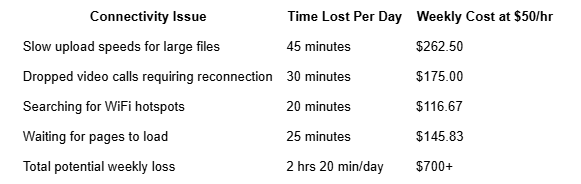
A reliable eSIM connection that works from the moment you land, such as one from Simify, eliminates most of these friction points. The cost of the eSIM plan pays for itself many times over in recovered productivity on the first working day of a trip.
Hidden Cost 5: Emergency Data Top-Ups at Tourist Prices
Running out of data mid-trip and needing to top up urgently is a situation most travelers have experienced. The options available in that moment are rarely the cheapest ones. Convenience stores, tourist-area phone shops, and on-device carrier top-up portals all charge premium prices for the urgency they know you are feeling.
Southeast Asia is a region where this plays out particularly clearly. Vietnam, for example, has excellent and affordable mobile infrastructure in cities like Ho Chi Minh City and Hanoi, but travelers who buy cheap low-data plans to save money upfront regularly find themselves paying tourist prices for emergency top-ups in tourist-heavy areas like Hoi An or Ha Long Bay. Getting a properly sized esim Vietnam from Mobimatter before departure with enough data for the full trip duration is almost always cheaper than buying a small plan and topping up multiple times under pressure.
How to avoid emergency top-up costs:
Calculate your realistic daily data usage before purchasing a plan
Add 30% to your estimated usage to account for unexpected needs
Choose a plan with a top-up option through the same provider rather than needing a new purchase
Download offline content before trips to data-heavy areas reduce your in-trip data dependency
Hidden Cost 6: Multiple SIM Cards Across a Multi-Country Trip
Travelers visiting multiple countries in a single trip face a multiplication of every connectivity cost. A new SIM card at each destination means new activation time, new setup, new costs, and often leftover data on plans that expire before the next visit.
The multi-country SIM inefficiency:
Three countries visited means potentially three separate SIM purchases
Each SIM requires physical insertion, which means storing and tracking multiple cards
Leftover data on each plan is wasted money that does not carry forward
Different plans from different providers means different top-up processes and customer support contacts
Mobimatter offers multi-country eSIM plans that cover entire regions under a single plan, as well as the ability to manage multiple destination-specific eSIM profiles from a single account. Switching between profiles as you cross borders takes seconds and requires no physical card changes.
Hidden Cost 7: Paying Extra for Connectivity in Remote or Less-Touristed Areas
The most interesting destinations are rarely the most connected ones. Travelers who venture beyond capital cities and tourist centers often find that the connectivity options available locally are limited, overpriced, or simply not compatible with their devices.
Turkey is a strong example of this dynamic. Istanbul has world-class mobile infrastructure with strong 4G and growing 5G coverage. But travelers exploring Cappadocia, the Turquoise Coast, or the Black Sea region encounter varying coverage quality depending on which local carrier their SIM partners with. A plan purchased locally in Istanbul may not have the same coverage agreements as a plan from an international eSIM provider with multi-carrier access. Getting your esim Turkey from Mobimatter before departure, with a plan that connects to the strongest available carrier network in each region, gives you the best possible coverage across both urban and remote destinations without paying premium prices at the point of need.
Frequently Asked Questions
How much data does a typical international traveler need per day? A leisure traveler using maps, social media, and messaging apps typically uses 500MB to 1.5GB per day. A digital nomad running video calls, uploading files, and using cloud tools should budget 2GB to 4GB per working day. Always purchase more than your minimum estimate to avoid emergency top-up costs.
Can I use an eSIM in multiple countries on the same trip? Yes. Mobimatter offers both regional multi-country plans and the ability to store multiple destination-specific eSIM profiles on a single device. You can switch between profiles as you move between countries without purchasing a new plan or making any physical changes to your device.
What happens to unused data when my eSIM plan expires? This depends on the specific plan. Most plans do not carry unused data forward after expiry. This is why sizing your plan correctly at purchase matters. Mobimatter's plan descriptions clearly state validity periods and data allowances so you can choose the right fit for your trip length.
Is eSIM technology secure compared to physical SIM cards? eSIM technology is considered more secure than physical SIM cards in several ways. It cannot be physically stolen or swapped without device access, it is not susceptible to SIM swap fraud at the carrier level in the same way, and it does not require handing your device to a vendor for insertion. For travelers carrying sensitive work data, eSIM reduces one category of security risk.
Does Mobimatter offer customer support if my eSIM stops working mid-trip? Yes. Mobimatter provides customer support accessible online, which means you can reach them from any WiFi connection if your mobile data encounters an issue. Their help documentation also covers the most common troubleshooting steps for activation and connectivity problems across different device types.
HOW DO YOU FEEL ABOUT FASHION?
COMMENT OR TAKE OUR PAGE READER SURVEY
Featured





Finding the right job in human resources or recruitment can take time, especially when you're searching online.