
Men’s Ski Pants vs Ski Bibs: Coverage, Fit and Mobility
PAGE
By PAGE Editor
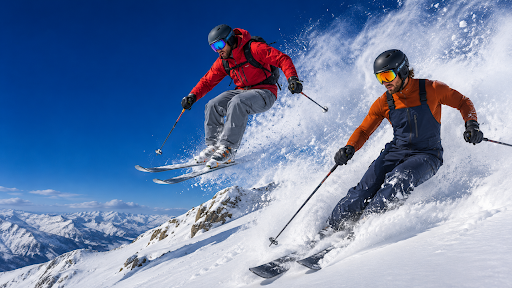
Men’s ski pants and ski bibs protect many of the same areas, but they sit differently on the body. Standard pants stop at the waist. Bibs extend over the torso and stay in place with shoulder straps.
That change affects snow coverage, layering, pocket placement, bathroom access, and fit. The better option depends on where you ride and how you prefer your winter clothing to feel.
Coverage: Where Bibs Offer More Protection
Ski bibs cover the waist and part of the torso. The raised front and back panels reduce the opening through which loose snow can reach the base layers.
This can be useful in deep snow, during frequent falls, or when sitting on wet and snowy surfaces. Snowboarders may particularly appreciate the additional coverage because they often sit down to adjust bindings.
The tradeoff is more material around the torso. Bibs can feel warmer indoors, and the upper section needs to fit comfortably beneath the jacket. Bulky bib pockets or hardware may become noticeable when covered by a closely fitted outer layer.
Riders who prioritize that higher waist and torso protection can compare higher-coverage men’s ski bib options. Check the bib height and strap range rather than assuming every design provides the same amount of coverage.
Why Standard Ski Pants Remain Practical
Standard ski pants are simpler to put on, remove, and adjust during the day. They usually feel less bulky around the chest and stomach, which can make them easier to combine with different midlayers and jackets.
They are also convenient during bathroom breaks and indoor stops. When the jacket is removed, there are no shoulder straps or bib panels around the upper body.
The main fit decision is the waistband. It needs to remain secure when sitting, bending, and lifting the knees. Adjustable tabs, belts, higher-rise designs, and jacket powder skirts can reduce gaps, but low or loose waistbands may allow snow to enter after a fall.
Fit Is Different for Pants and Bibs
With standard pants, the main measurements are waist, hip, thigh, inseam, and full length. Choosing a larger size to gain extra leg length can leave too much room around the waist and seat.
Bibs introduce torso length and strap adjustment. A bib may fit through the legs but pull at the shoulders when you crouch. The opposite problem occurs when the torso is too long and the upper section bunches beneath the jacket.
Adjustable suspenders can refine the fit, but they cannot completely correct the wrong body length. Compare garment measurements and test the bib in a bent-knee riding position.
Some riders prefer bibs because the waist does not need to be held in place by a tight waistband. Others dislike the feeling of straps over their base and midlayers. Neither reaction can be predicted from measurements alone, so movement testing is useful.
Mobility Depends on Cut, Not Only Category
Bibs are sometimes assumed to be more restrictive, but a relaxed bib with a well-proportioned torso can move more freely than a narrow pair of pants. Standard pants can also provide excellent mobility when the hips, thighs, and knees have enough room.
When comparing men’s ski pants for different riding conditions, look beyond the waist style. Articulated knees, stretch panels, gussets, leg width, and layering room all affect movement.
Perform a few practical checks:
Squat without the cuffs lifting excessively
Raise each knee toward the chest
Sit and lean forward
Rotate through the hips
Confirm that the waistband or straps remain stable
Snowboarders may prefer more room through the hips and knees. Skiers often focus on cuff compatibility and reinforcement against ski-edge contact. These are tendencies rather than fixed rules.
Layering and Temperature Control
Bibs add a layer of fabric across part of the torso. That extra coverage can be welcome in cold or windy weather, but it may retain more heat during active riding or warmer spring conditions.
Standard pants leave the upper body entirely to the base layer, midlayer, and jacket. This makes it easier to remove insulation without changing the lower-body setup.
Ventilation matters in both styles. Inner-thigh vents release heat more effectively than simply opening a jacket. Check whether the vent has mesh backing and whether it remains accessible beneath longer outerwear.
For bibs, confirm that jacket pockets and bib pockets do not overlap awkwardly. A chest pocket may be useful when the jacket is open, but it should not create pressure beneath a packed jacket pocket.
Bathroom Access and Everyday Convenience
Standard pants have the advantage here. Their familiar waist construction makes bathroom breaks and clothing changes straightforward.
Bibs may require the jacket to be opened or removed, followed by lowering the shoulder straps. Some designs use side zippers, front zippers, or drop-seat constructions to simplify access, but the details vary.
For occasional resort days, this inconvenience may matter more than maximum snow coverage. For riders who regularly encounter powder, wet chairlifts, or frequent falls, the added coverage may be worth the extra steps.
Choose According to the Way You Ride
Ski pants are likely the better option when you want:
A lighter, simpler waist-level garment
Easy bathroom access
Less fabric beneath the jacket
Flexible use with different upper-body layers
Ski bibs may work better when you want:
More coverage above the waist
Less dependence on a tight waistband
Better protection during falls or deep-snow riding
Additional torso or chest storage
Fit remains the deciding factor. Pants should stay in place without restricting the abdomen, and bibs should follow the body without pulling at the shoulders or bunching around the torso.
Try either option with the jacket, base layers, and boots you expect to use. Coverage is valuable only when the complete outfit still allows comfortable movement.
HOW DO YOU FEEL ABOUT FASHION?
COMMENT OR TAKE OUR PAGE READER SURVEY
Featured



Picking a cold plunge and sauna is easy. Making the pair work together takes layout, water access, and a clear order of use. Here is how to plan it.