
How Do You Choose a Children's Christian Book That Is Biblical and Engaging?
PAGE
By PAGE Editor
My son was four when he announced that Jonah got swallowed by the whale because he wouldn't share. I had no idea where he got that. A couple of days later, I found the book under his bed, a little board book from the free bin at church. It had turned Jonah's entire story into a lesson about taking turns.
That was humbling. I'd assumed any children's bible story book with a lion or an ark on the cover would be fine. It turns out some are lovely, while others barely follow the Bible. You cannot always tell from the cover or reviews.
How to Tell If a Kids' Bible Book Sticks to Scripture
Flip to a familiar story, such as Noah. Read it and ask whether it actually happened in Genesis. Some books invent names, conversations, and animal characters. Some artistic license is harmless; the Bible does not tell us what color the giraffes were. But invented details can easily become the parts children remember.
A friend from our small group has a habit I borrowed. When her daughter asks something about a story, she says, “Let's go check,” and opens her actual Bible. Her daughter is six and already understands that the picture book is not the final word. That is pretty great. It matters beyond storytime.
Does It Point to God, or Just Teach Manners?
Many children's Bible books turn every story into a lesson about being good. David was brave, so be brave. Daniel prayed, so pray.
David defeated Goliath because he trusted God. In 1 Samuel, he makes clear that the battle belongs to the Lord. That is not wrong, but David did not defeat Goliath simply because he was brave or had a good aim. He trusted God.
Children need to understand that the Bible is not simply a collection of good examples. Ask yourself: at the end of the story, who looks big, the person or God?
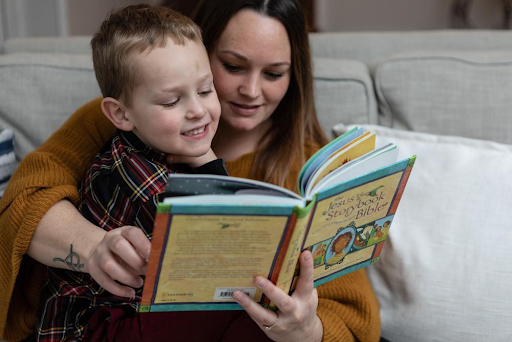
This is one reason The Jesus Storybook Bible by Sally Lloyd-Jones is recommended so often. It connects biblical stories to Jesus.
Read a Page Out Loud Before You Buy It
Some books have long sentences that lose a three-year-old, while others are so simplified they sound like instructions. Good books have a natural rhythm and are enjoyable to read repeatedly.
Look at the illustrations, too. Young children follow pictures closely. Little kids follow the art as much as the words, so expressive pictures can help them stay interested and understand the story better.
What About Bible Story Apps?
During busy moments, we use AbbaKid, an app with animated Bible stories for children aged three to eight, short quizzes, and rewards.
Stories are organized by themes, including bedtime. There is free content to try, with a paid plan for the full library.
The quizzes are especially useful. After watching a story about Daniel, my daughter enjoys answering questions about who shut the lions' mouths.
I'd still ask the same questions about an app as a book: does it follow Scripture, and who is the hero?
Choose for Your Kid, Not the Age on the Box
Toddlers often enjoy pictures and short sentences. Four- and five-year-olds may manage short stories, while six- and seven-year-olds can explore fuller story Bibles.
But every child is different. Mine wanted the plagues of Egypt, especially the frogs, every night when he was four.
We do not manage to read every night, but those moments matter. My six-year-old stopped me during Jonah and said, “Mom. He ran away. That's why.” He was right, and I never did tell him about the board book.
HOW DO YOU FEEL ABOUT FASHION?
COMMENT OR TAKE OUR PAGE READER SURVEY
Featured



Picking a cold plunge and sauna is easy. Making the pair work together takes layout, water access, and a clear order of use. Here is how to plan it.