
Most Efficient Bitcoin Miner 2026
PAGE
By PAGE Editor
A weighted buyer's framework for picking the right ASIC right now - and why efficiency, not hashrate, decides who survives.
The single most expensive mistake a buyer makes in 2026 is shopping for terahashes. A miner with a huge TH/s number and a low sticker price can still bleed you dry, while a quieter, pricier machine quietly out-earns it for years. What actually decides the winner is a two-part equation almost nobody scores properly: joules per terahash (J/TH) multiplied by the electricity rate you lock in. Get those two right and the rest is detail; get them wrong and no amount of raw hashrate saves you.
We run one of the largest retail-accessible hosting networks in the world - 20 sites, roughly 2,163 MW of contracted capacity, at an average 7-year fixed power rate of $0.0480/kWh - so we watch this math play out across tens of thousands of machines every day. This is our decision framework: the factors that matter, weighted honestly, with a scoring rubric you can apply to any ASIC before you spend a dollar.
Key takeaways
Efficiency (J/TH) is the #1 factor - it compounds over years, while hashrate and price are one-time facts.
The Antminer S23 Hyd (9.5 J/TH) is the most efficient production Bitcoin miner ever sold and the first to break sub-10 J/TH, per asicprofit.com.
At an Aug 10, 2026 hashprice of $31.73/PH/s/day (Hashrate Index), machines above ~18 J/TH struggle to clear breakeven unless power is very cheap.
Your electricity rate can swing lifetime profit more than the machine choice itself - a $0.0364/kWh Nigeria contract vs a home rate is a different business entirely.
Score every miner across 5 weighted factors before buying. On our rubric, the S23 Hyd tops the current field at 97/100.
The factor almost everyone gets wrong
Walk any mining forum this week - r/BitcoinMining and r/CryptoMining are full of it - and you'll see the same question phrased a dozen ways: *"Which has more TH/s?"* or *"What's the cheapest miner I can get?"* Both questions optimize the wrong variable. Hashrate tells you how fast a machine hashes; it tells you nothing about what that hashing costs. And sticker price is a single payment you make once, while power is a bill you pay every hour for the machine's entire life.
Here is the uncomfortable arithmetic. A modern flagship draws several kilowatts continuously. Over a multi-year deployment, the electricity a machine consumes typically dwarfs what you paid for the hardware. That means the metric that governs your PandL isn't TH/s and isn't price - it's how many joules the machine burns per terahash it produces. Efficiency is the lever that multiplies against every single hour of operation. A one-point improvement in J/TH quietly outperforms a flashy hashrate spec that costs twice as much to feed.
So the framework below deliberately front-loads efficiency and power cost, and pushes raw hashrate and price down the list where they belong. If you take one thing from this article: buy the lowest J/TH you can deploy at the lowest kWh rate you can lock in. Everything else is optimization around those two numbers. Our mining calculators exist precisely so you can test that claim against real inputs before committing.
The 5 factors that actually decide — and how to weight them
A buying decision without weights is just a vibe. Below is the rubric we use internally, scaled so the two dominant factors - efficiency and power rate - control roughly two-thirds of the outcome. Score each candidate machine 0-10 on each factor, multiply by the weight, and sum for a score out of 100.
Efficiency, J/TH - 35%. The compounding factor. Lower is better; it governs every kilowatt-hour for years. This is the number to obsess over.
Electricity / hosting rate, $/kWh - 30%. The other half of your operating cost. A great machine on expensive power loses to a good machine on cheap, fixed power.
Price and cost-per-terahash - 20%. Upfront capital and payback speed. Matters, but it's a one-time fact, not a recurring one.
Hosting and cooling fit - 10%. Can you actually run it? Hydro and immersion units need infrastructure most homes and many colos don't have.
Warranty, uptime and support - 5%. Downtime is lost revenue. A 7-year warranty and a 95%+ uptime SLA protect the whole investment.
Notice that two of the five factors - power rate and hosting fit, a full 40% of the score - are decided by *where the machine runs*, not which machine you buy. That is the part first-time buyers rarely price in, and it's exactly where a professional host changes the equation. You can read how that works on our how-it-works page.
Factor 1 — Efficiency (J/TH): the number that compounds
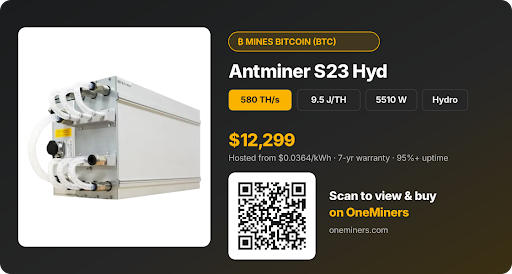
In 2026 the efficiency race has a clear leader. According to asicprofit.com, the Bitmain Antminer S23 Hyd delivers 580 TH/s at 5,510 W - a 9.5 J/TH figure that makes it the first mass-production Bitcoin miner to break the sub-10 J/TH barrier, and the most efficient SHA-256 ASIC ever sold. The same generation's S23 Hyd 3U scales that to roughly 1.16 PH/s at the identical 9.5 J/TH, for operators who want density.
Step down a rung and the air-cooled Antminer S23 lands near 11 J/TH at 318 TH/s - the most efficient air machine you can deploy without liquid infrastructure. The previous champion, the Antminer S21 XP Hydro at 473 TH/s, sits at 12 J/TH, with its air sibling the S21 XP at about 13.5 J/TH (per Simple Mining and MillionMiner reviews). By contrast, MicroBT's Whatsminer M63S Hydro pushes big single-unit hashrate (~416 TH/s) but at roughly 18.5 J/TH - nearly double the S23 Hyd's draw per terahash.
That spread is the whole ballgame. At a fixed BTC price and difficulty, a 9.5 J/TH machine and an 18.5 J/TH machine can produce similar revenue per terahash but the second one burns roughly twice the power to do it. On cheap, fixed hosting the efficient unit stays profitable through downturns that push the thirsty one underwater. When people ask "what's the most efficient Bitcoin miner in 2026?", the honest answer is: the S23 Hyd, and it isn't close.
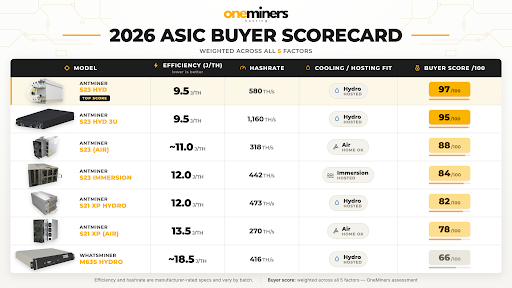
2026 ASIC buyer scorecard - weighted across all 5 factors
Factor 2 — Your electricity rate is half the machine
Efficiency only matters relative to what you pay per kilowatt-hour, which is why power rate carries 30% of the score. As of Aug 10, 2026, Hashrate Index put USD hashprice at $31.73 per PH/s per day - down slightly week-over-week and at or below breakeven for many operators depending on their power cost. In that environment, the kWh rate you lock in is the difference between mining at a margin and mining at a loss.
This is where hosting reshapes the entire calculation. A retail electricity bill in much of the US or Europe runs two to three times what a large, energy-partnered facility pays. Across our network the 7-year fixed rates start at $0.0364/kWh in Nigeria - our cheapest active site - with $0.0399/kWh hydro power in Ethiopia, $0.0455/kWh across US regional sites like Georgia and Houston, and cold-climate sites in Norway and Finland around $0.0448/kWh. The network average is $0.0480/kWh, and critically, it's prepaid and fixed for up to seven years - you're insulated from the volatility that kills home miners.
Run the framework and the point becomes obvious: pairing the most efficient machine with the lowest fixed rate stacks both dominant factors in your favor at once. That combination - a 9.5 J/TH S23 Hyd on a sub-$0.05/kWh contract - is the strongest position a retail buyer can hold in 2026.
Factor 3 — Price and cost-per-terahash
Only now, third on the list, does price enter. It matters for payback speed and for how much capital you tie up, but it's a one-time number and should never override efficiency. The smarter way to read a price tag is cost per terahash - dollars divided by TH/s - because it normalizes machines of different sizes.
From the live OneMiners S23 catalog, the air-cooled Antminer S23 is $6,899 (reduced from $7,990) at 318 TH/s, the S23 Immersion is $10,289 at 442 TH/s, and the flagship S23 Hyd is $12,299 (down from $15,000) at 580 TH/s. The high-density S23 Hyd 3U starts from $8,399. On a cost-per-TH basis the hydro units are competitive precisely because their efficiency earns the premium back over the deployment life.
If upfront capital is the constraint, that's a financing problem, not a reason to buy a worse machine. We offer Buy Now, Pay Later at 25% down with 0% hidden fees, so buyers can secure a top-efficiency unit now and let the machine's own output help carry the balance - rather than settling for a cheaper, thirstier ASIC that costs more every single day it runs. Browse current pricing across the full hardware catalog.
Factor 4 — Hosting fit: air, hydro or immersion
The most efficient machines in 2026 are hydro-cooled - and that's a deployment decision, not just a spec. A hydro unit like the S23 Hyd needs a liquid-cooling loop, dry coolers or a heat-rejection system, and the electrical infrastructure to match. Immersion units like the S23 Immersion need dielectric fluid tanks. Neither belongs in a spare bedroom.
This is the quiet reason so many home buyers end up with a worse machine: they pick an air-cooled ASIC because it's all they can physically run, and inherit a higher J/TH penalty for the life of the deployment. Hosting removes that ceiling. In a purpose-built facility you can deploy the *actually* most efficient hardware - hydro or immersion - because the cooling, power, and network are already engineered for it. The machine choice stops being limited by your garage.
If you're set on running at home, the honest pick is the air-cooled S23 at ~11 J/TH - the best efficiency you can air-cool today. If you're open to hosting, the ceiling lifts to the S23 Hyd and its sub-10 J/TH. That fork is worth 10% of the score on its own, and it often decides the other factors for you.
Scoring the current top models
Here's the framework applied to 2026's leading SHA-256 machines. Efficiency figures are from asicprofit.com and corroborating reviews (Simple Mining, MillionMiner, CryptoMinerBros); prices are from the live OneMiners catalog. The Buyer Score is the weighted 0-100 result assuming deployment on a fixed sub-$0.05/kWh hosted rate.
The pattern is clean: efficiency drives the ranking. The two S23 hydro units top the table, the air-cooled S23 leads the no-liquid tier, and the high-hashrate but thirsty M63S Hydro lands last despite its impressive raw TH/s. Raw hashrate did not save it - exactly as the framework predicts.
The verdict: which miner to buy right now
Our decisive read for 2026: if you can host it, buy the Antminer S23 Hyd. At 9.5 J/TH it is the most efficient production Bitcoin miner in existence, it wins the two factors that control two-thirds of the score, and paired with a fixed sub-$0.05/kWh contract it's the most durable position a retail buyer can take through a soft hashprice cycle. For pure density, the S23 Hyd 3U delivers the same efficiency at ~1.16 PH/s.
If home deployment is non-negotiable, the air-cooled Antminer S23 at ~11 J/TH is the correct compromise - best-in-class efficiency without liquid infrastructure. And if you already own an S21 XP, there's no urgency to churn it; it remains a strong 12-13.5 J/TH machine. The trap to avoid is chasing a big-TH/s, high-J/TH unit like the M63S Hydro on expensive power - that's optimizing the one variable that doesn't compound in your favor.
The punchline of the whole framework: the best miner to buy is the lowest J/TH you can deploy, on the lowest fixed rate you can lock in - and hosting is what lets you have both at once. That's why the machine question and the hosting question are really one question, and why we'd rather help you answer it correctly than sell you a fast machine you can't afford to feed. Compare hardware in the catalog and rates across our hosting centers, then pressure-test it in the calculators.
Frequently asked questions
What is the most efficient Bitcoin miner in 2026?
The Antminer S23 Hyd at 9.5 J/TH (580 TH/s), per asicprofit.com - the first production ASIC to break sub-10 J/TH and the most efficient SHA-256 miner ever sold. See current pricing on the S23 series page.
Should I buy the Antminer S21 XP or the S23?
For a new purchase, the S23 wins on efficiency - ~11 J/TH air or 9.5 J/TH hydro vs the S21 XP's 12-13.5 J/TH. If you already own an S21 XP it's still a strong machine and worth keeping. Compare both in the catalog.
Does the machine or the electricity rate matter more?
They're close, but together they dominate. Efficiency and power rate carry ~65% of a proper buying score. The winning move is both at once: a low-J/TH machine on a low fixed rate, which is exactly what hosting enables.
Can I run a hydro miner like the S23 Hyd at home?
Realistically, no - hydro units need a liquid-cooling loop, heat rejection, and matched electrical infrastructure. That's why the most efficient machines are best deployed in a professional facility. Learn how it works here.
Is Bitcoin mining still profitable at today's hashprice?
Hashprice was $31.73/PH/s/day on Aug 10, 2026 (Hashrate Index) - at or below breakeven for many operators. Profitability hinges on efficiency and a low fixed power rate; test your exact numbers in our calculators.
Score your shortlist properly: pair the lowest J/TH machine with the lowest fixed rate - and let us host both.
Informational only, not financial advice; hardware specs, prices, hashprice, difficulty and rates change constantly; verify live figures before purchase. Mining involves risk.
HOW DO YOU FEEL ABOUT FASHION?
COMMENT OR TAKE OUR PAGE READER SURVEY
Featured





Twelve times on input and twelve times on output is not a ratio you usually find inside a single vendor's lineup.