
Proving the Need for a Child Custody Modification in Orange County

PAGE
By Finixio Digital
Life changes fast. A sudden cross-county relocation, a demanding new job schedule, or growing safety concerns can make an existing parenting plan completely unworkable. When these major life events occur, the custody arrangement that made sense two years ago often becomes a source of daily stress.
Many parents assume they can just talk it out or make an informal handshake deal. However, informal agreements hold no legal weight if a disagreement arises later. To successfully update an order in Orange County, you must provide the court with organized, concrete evidence that the change is necessary. A judge will not alter a finalized plan based on a verbal request or a parent's personal convenience.
Before you file a Request for Order, it is crucial to evaluate whether your life change meets the court's strict legal threshold. Consulting with a legal custody professional in Orange County can help you organize your evidence and determine the most effective strategy when evaluating your child custody modification options. Gathering the right proof from the beginning saves time, reduces legal friction, and protects your relationship with your child.
What is a "Substantial Change in Circumstances"?
Orange County family courts operate under a strict standard when reviewing requests to alter a permanent custody order. Judges want to preserve stability for children. Because of this, they will not disrupt a child's established routine unless there is a compelling, legally valid reason to do so. This legal threshold is known as a "substantial change in circumstances."
A substantial change is a significant shift in the family dynamic that occurred after the judge signed the original order. Common examples include a parent moving out of the geographical area, a drastic change in a parent's work hours, or documented issues of substance abuse. It can also simply be the natural aging of a child. A time-sharing schedule designed for a toddler rarely fits the academic and social demands of a teenager.
The court evaluates these changes through a single lens: the best interests of the child. A judge will look at how the proposed schedule change affects the child's emotional bonds, educational stability, and overall lifestyle.
The burden of proof falls entirely on the parent filing the request. You cannot just claim your ex-spouse is uncooperative or that your new job requires a different schedule. You must prove the current situation is detrimental or that the new proposal offers a clear, tangible benefit to the child's daily life.
Modifying Physical Custody vs. Legal Custody
When filing for a modification, you need to know exactly what part of the order you are trying to change. Child custody in California is divided into two distinct categories: physical custody and legal custody. Your life change might affect one or both of these areas.
Physical custody dictates where the child lives and handles the day-to-day care routine. Legal custody grants a parent the authority to make major life decisions regarding the child's health, education, and general welfare. If you want a better understanding of how the court views these terms, the Orange County Superior Court website details the local rules and definitions used in your jurisdiction.
Often, parents only need to modify the physical custody schedule. For instance, if you take a job that requires weekend travel, you might ask to shift your parenting time to weekdays. This changes the physical time-sharing arrangement but leaves joint legal custody intact, meaning you both still share decision-making power for school and medical choices.
Courts look closely at shared time and recognize that modern families require flexible arrangements. Because every family's stability looks different, judges rely heavily on your documented evidence to determine what specific physical schedule will work best.
The Evidence Checklist: What Documents Should You Gather?
Walking into court with only your personal testimony is a risky strategy. Judges deal with "he-said, she-said" arguments every day. To cut through the noise, you need an organized paper trail that clearly illustrates why the modification is necessary.
Before filing any paperwork, start gathering objective evidence. The best proof comes from neutral third parties or unalterable written records. Use the checklist below to begin organizing your case.
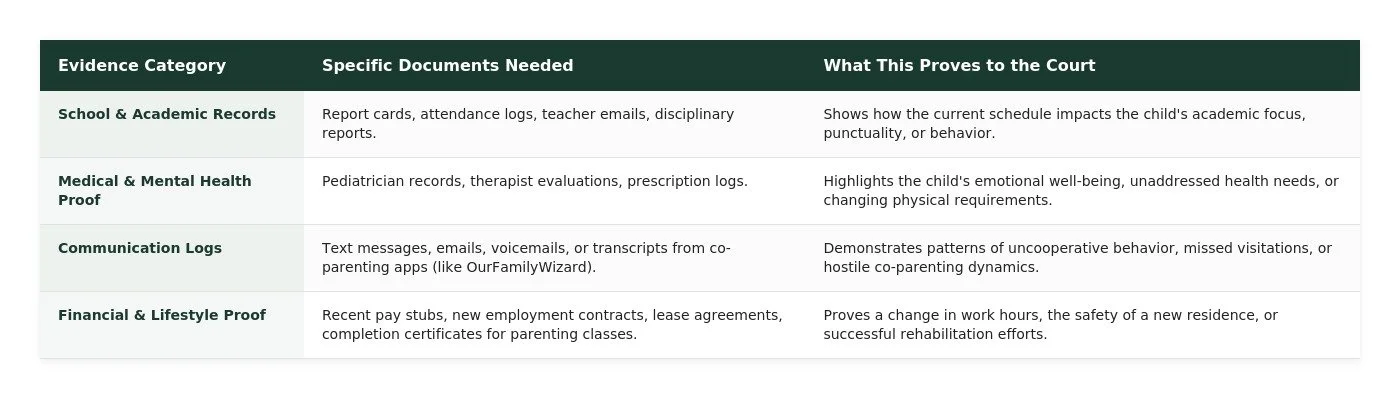
School and medical records are highly persuasive because they provide an unbiased look at the child's reality. If a child is consistently tardy on the days they stay with one parent, an attendance log proves this without requiring you to make accusations. Similarly, a therapist's report can shed light on emotional struggles tied to the current custody arrangement.
Communication logs are just as vital, especially if you are dealing with an unreliable co-parent. Written records show clear patterns over time. If the other parent frequently cancels their visitation time at the last minute, a printed log of text messages provides undeniable proof of their absence.
Finally, do not forget to document your own stability. If you are asking for more parenting time, provide your new lease agreement to show you have a safe, appropriate bedroom for the child. If you have overcome a personal struggle, bring completion certificates from treatment programs or parenting classes to show your commitment to a healthy lifestyle.
The Legal Process: Filing Your Request and Mandatory Mediation
Once your evidence is organized, the actual legal process begins. Navigating the family court system can feel intimidating, but understanding the specific steps helps reduce anxiety. The process is designed to give both parents a chance to present their side and, ideally, reach an agreement before a judge has to step in.
Filing the Request for Order (FL-300)
The formal process initiates when you file a Request for Order, commonly known as the FL-300 form. This document tells the court exactly what changes you want to make to the existing parenting plan and why you believe those changes are necessary.
This form is your first opportunity to present your case. You will include a written declaration summarizing your situation and reference the evidence you gathered. Once filed, the court sets a hearing date. You must then officially serve the paperwork to your co-parent, giving them time to review your claims and file their own response. This initial paperwork sets the tone for the entire proceeding, which is why thorough preparation is so valuable.
Navigating Mandatory Mediation
Many parents fear that filing a modification request means gearing up for a vicious, high-conflict courtroom battle. In reality, the family court system prioritizes out-of-court resolutions. Over 80% of counties in California require mediation before a contested custody modification hearing can take place.
In Orange County, this takes place through Family Court Services. You and your co-parent will sit down with a neutral, court-appointed mediator. The goal of this meeting is to help you bypass the courtroom entirely by drafting a practical, mutually agreed-upon parenting plan. The mediator helps keep the conversation focused strictly on the child's living accommodations and time-sharing needs.
Mediation is highly effective. Statistics indicate that 91% of child custody cases are resolved without requiring a family court judge to make the final decision at trial. By approaching mediation with a cooperative mindset and a clear binder of evidence, you increase your chances of settling the matter quietly and efficiently.
Conclusion
Successfully modifying a custody order depends on proving a significant life change with solid, organized documentation. You must show the court that the old schedule is broken and that your proposed solution is a factual necessity. A judge wants to see evidence, not hear arguments.
Always remember that the ultimate goal is protecting the child's best interests. Family courts do not alter permanent orders to punish a difficult ex-spouse or to make a parent's commute easier. The focus remains entirely on giving the child a stable, healthy environment to grow.
Tackling a custody modification requires a dual-track strategy. You should prepare your evidence as if you are going to trial, but keep an open mind for amicable negotiation during mediation. With the right documentation and a clear focus on your child's well-being, updating a parenting plan to fit your new reality is a highly achievable goal.
HOW DO YOU FEEL ABOUT FASHION?
COMMENT OR TAKE OUR PAGE READER SURVEY
Featured





Finding the right job in human resources or recruitment can take time, especially when you're searching online.