
What Comes in an Ebike Conversion Kit? The 7 Core Parts and the 4 Buyers Forget
PAGE
By Finixio Digital
Open a conversion-kit listing and you will see a motor wheel, a controller and a display in the photo. That is the marketing definition of a kit. The working definition is longer, and the gap between the two is where returns, half-finished builds and "why does it cut out" forum threads come from.
This guide lists the seven parts every hub conversion needs, the four that listings most often leave you to discover on your own, and the measurements you must take from your own bike before you press pay. It ends with a 7+4 audit you can run against any product page in about five minutes.
A kit is a system with interfaces, not a box of parts
Every component in a conversion kit has to match something: the motor wheel matches your dropouts and brake, the controller matches the battery, the display matches the controller's protocol, the battery matches your frame. When one interface is wrong the whole kit is wrong, however complete the packing list looks.
That is why the most useful question to ask a seller is not "what is included?" but "which of these interfaces have you already matched for me, and which do I still have to check?"
The seven core parts
1. Motor wheel
For a hub conversion the motor is laced into a complete front or rear wheel. The listing should state wheel diameter, rim type, axle type and dropout spacing. Rear wheels also need the right drivetrain interface: a threaded freewheel and a cassette freehub are not interchangeable, and a "7-speed" label on its own does not tell you which one you have.
One trap catches 700C and 29-inch owners every week. Both wheels share a 622 mm bead-seat diameter, so a 29-inch motor wheel fits a 700C frame in principle, but the rim width and tyre clearance can be completely different.
2. Controller
The controller meters battery power to the motor. Voltage is the first check, and only the first. Battery-side current limit, phase current, connector family, display protocol and brake inputs all have to match. KirbEbike's app-programmable controllers for the 2000W–3000W kits are fully resin-potted where specified, which protects the electronics from vibration and moisture — but potting does not remove the need for airflow around the aluminium case.
3. Display and rider controls
A display must speak the controller's protocol, not merely share its plug shape. Throttles, button pads and app programming add control but need the correct pinout and voltage. Ask whether speed, current and assist settings are fixed, display-adjustable or app-programmable; the answer decides how much of the kit you can tune later.
4. Pedal-assist sensor
A cadence sensor detects crank rotation and requests a preset level of assistance. A torque sensor responds to pedal force and feels more like a bicycle, but it needs compatible hardware and a specific bottom-bracket arrangement. Check crank clearance, magnet-disc orientation and cable route before assuming the supplied sensor fits your bike.
5. Brake cut-off
When you brake, the motor must stop. Kits solve this with replacement levers that contain a switch, or with add-on sensors that attach to your existing levers. If you have hydraulic brakes you need the second option, because a mechanical cable lever cannot operate a hydraulic hose. The listing should state which solution is supplied.
6. Wiring harness and connectors
A waterproof quick-release loom is the single biggest reduction in installation errors. Colour-coded, keyed connectors cannot be plugged into the wrong socket, and sealed joins keep road spray out of the contacts. Still check cable lengths and branch positions against your handlebar width, battery position and controller location.
7. Battery and charger
The battery must match the controller's voltage family and current demand. Capacity sets energy; case dimensions, rail position, removal direction, BMS rating, connector and charger current decide whether the pack can actually serve the system. Charger current is a system property: the cells, BMS and charge port all have to support it, so a fast charger is only appropriate for packs specified for it.
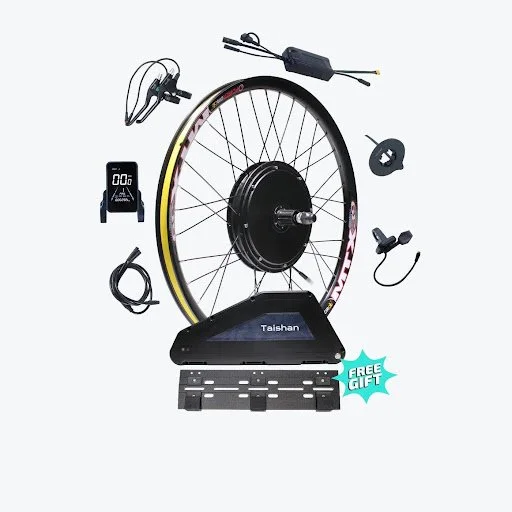
KirbEbike 48V 1000W rear hub conversion kit laid out with motor wheel, controller, display, harness and battery
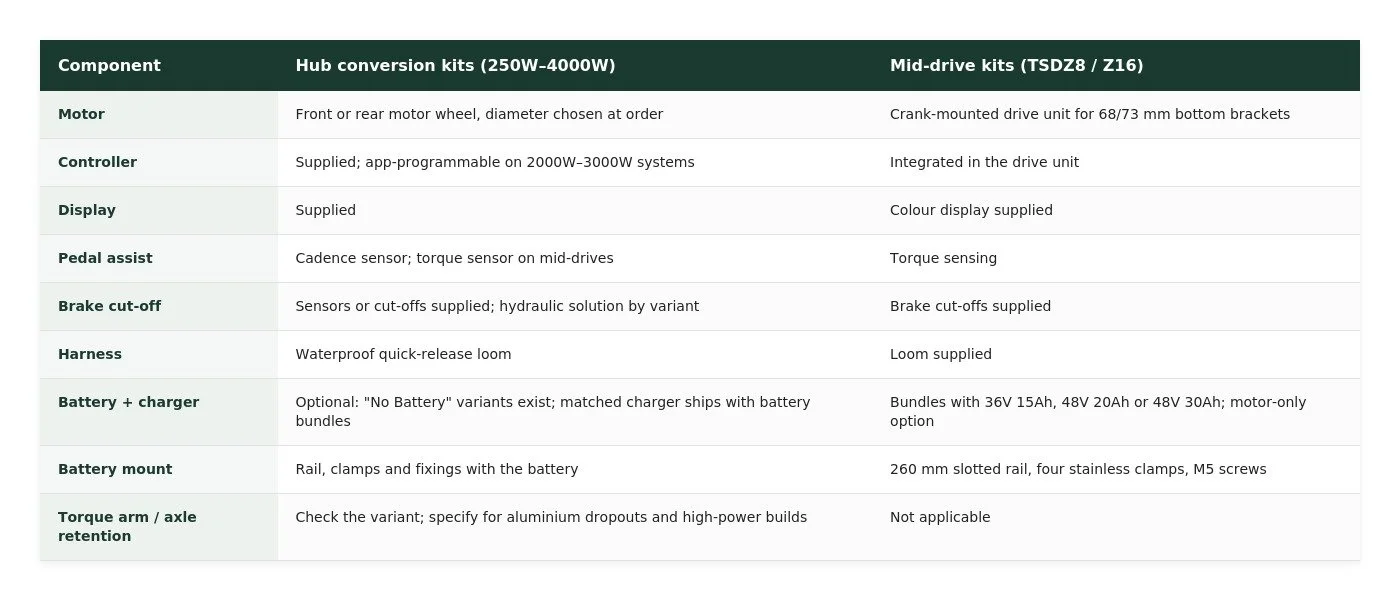
What KirbEbike actually ships, by kit type
The table below is drawn from current listings. "Variant-dependent" means the product page selector decides, and you should read it before assuming.
The four parts buyers forget
These are the items that turn a delivered kit into a second order a week later.
Torque arms and axle retention. A hub motor pushes against the dropouts every time you accelerate. Aluminium dropouts and anything above 1000W need a torque arm. If your variant does not list one, buy it with the kit, not after the first ride.
The right freewheel or cassette, plus spacers. Count your sprockets and identify the mounting standard. A motor wheel that arrives with the wrong interface is a wheel you cannot fit.
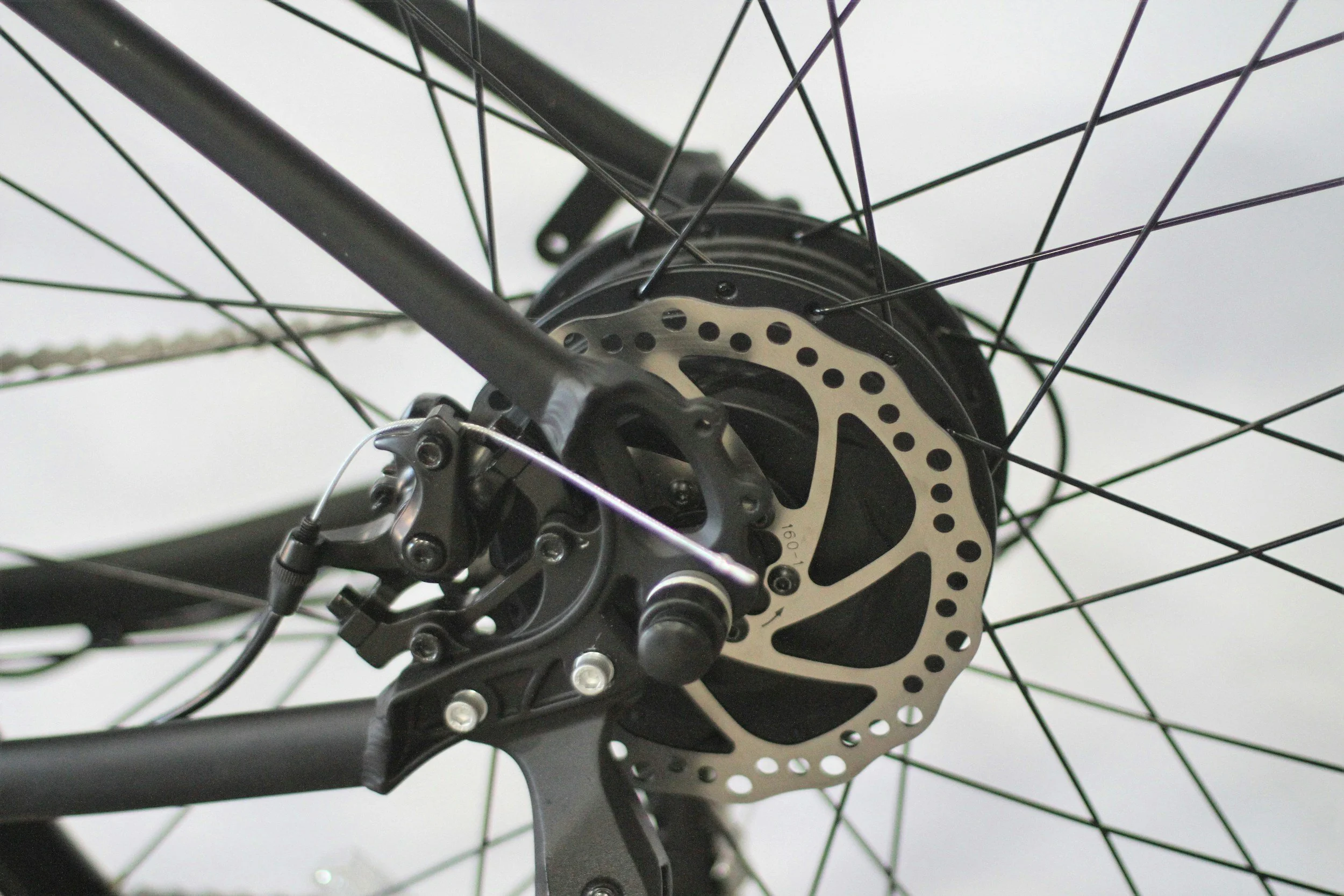
Rotor, bolts and caliper clearance. Record rotor diameter and bolt pattern before you remove the old wheel. Hub motor shells are wider than a normal hub, and caliper clearance is where the surprise hides.
Battery mounting hardware and a removal path. The pack needs rail, clamps, bolts and enough clearance to slide off. A battery that fits but cannot be removed is not fitted.
The starting price is often the motor-only price
Most product pages offer "No Battery" or "No Charger" selections, and the displayed starting price frequently refers to that variant. Nothing about this is misleading when the selector is clear, but it is easy to miss when comparing collection cards or search results.
A complete cost comparison includes the selected battery, charger, drivetrain part, brake solution, torque arm and any workshop labour. The 52V 2000W MTX rim kit is a good example of why variant-level reading matters: wheel size, cassette or freewheel format, battery capacity and charger choice all change what arrives at your door, and the difference between the lowest and highest configuration is the price of a battery.
The 7+4 Kit Audit
Run this against any listing before ordering. If you cannot answer a line from the product page, ask the seller; if the seller cannot answer, that is your answer.
The seven core parts
Motor wheel diameter, axle type and dropout spacing stated?
Controller voltage, current limit and programmability stated?
Display protocol matched to the controller?
PAS sensor type (cadence or torque) and fit requirements stated?
Brake cut-off solution suitable for my brake type (mechanical or hydraulic)?
Harness waterproof and keyed?
Battery voltage, Ah, BMS current, case size and charger specified for the variant I am buying?
The four forgotten parts
Torque arm included or specified?
Freewheel/cassette interface matches my sprocket count?
Rotor interface and caliper clearance confirmed?
Battery rail, fixings and a removal path confirmed against my frame?
When comparing electric bike conversion kits with battery, a listing that answers all eleven lines without a support ticket is telling you something about how the rest of the purchase will go.
A worked example: one hybrid, one order, nothing missing
A 2019 aluminium hybrid with 700C wheels, 135 mm open rear dropouts, an 8-speed cassette, hydraulic disc brakes with 160 mm six-bolt rotors and a standard down tube with two bottle bosses. Its owner wanted a rear-hub 1000W build for hilly private-land use. Here is how the audit played out on the product page.
Motor wheel: 700C selected, cassette freehub selected, 8-speed confirmed in the variant selector. Rim width 25 mm, wider than the original 19 mm, so tyre clearance was checked at the chainstays before ordering.
Controller and display: supplied and matched; app-programmable on this power class, so the current ceiling could be set under the battery's BMS rating on day one.
PAS: cadence sensor supplied; crank clearance checked against the bottom bracket.
Brake cut-off: hydraulic add-on sensors selected rather than cable levers.
Harness: waterproof quick-release loom, cable lengths checked against a 680 mm bar.
Battery and charger: 48V 20Ah down-tube pack (960 Wh, 4.5 kg, 40A BMS) with its matched charger. The "No Battery" variant was £300-odd cheaper and would have left the bike unrideable.
The four forgotten parts: torque arm added to the order for the aluminium dropouts; 8-speed cassette confirmed; 160 mm six-bolt rotor retained after checking caliper clearance on the motor shell; down-tube rail position confirmed against the bottle bosses with a cardboard template and a slide-off path.
Total time on the product page: about fifteen minutes. Total follow-up orders: none. That is what a complete kit looks like — complete on paper before it is complete in the box.
What you must measure on your own bike
No seller can do these for you.
Wheel size at the tyre, using the ETRTO number on the sidewall rather than the marketing size.
Dropout spacing and type: open slot, quick release or thru-axle. Standard hub motor axles need open dropouts.
Drivetrain: number of sprockets, freewheel or cassette.
Brake type, rotor diameter and mounting standard.
Battery space in three dimensions, plus rail and removal direction.
Cable runs with the handlebar turned fully both ways.
Photograph all of it. A seller with clear photographs can confirm fit in one reply; without them the conversation takes a week.
Battery mounting rail supplied with four stainless hose clamps and M5 fixing screws
Frequently asked questions
Does every ebike conversion kit include a battery?
No. Many kits, including KirbEbike's, offer motor-only, battery-equipped and charger options on the same page. Check the selected variant rather than the product title or starting price.
Do I need a torque arm?
For aluminium dropouts, front-wheel motors and anything above 1000W, yes. The reaction force at the dropout rises with motor torque, and a torque arm is the cheapest insurance on the bike.
Can I reuse my existing cassette?
Only if the motor wheel uses a cassette freehub and supports your number of speeds. A wheel built for a threaded freewheel will not accept a cassette.
Is a waterproof harness enough for riding in rain?
It is one layer of four. Controller construction, battery enclosure, cable routing and capped spare ports decide the rest.
What is the minimum I should check before ordering?
Dropout type and spacing, wheel size by ETRTO, freewheel or cassette, brake type and battery space. Those five answers eliminate most mismatches before money changes hands.
HOW DO YOU FEEL ABOUT FASHION?
COMMENT OR TAKE OUR PAGE READER SURVEY
Featured




Finding the right job in human resources or recruitment can take time, especially when you're searching online.