
The 7 Most Profitable Bitcoin Miners Right Now

PAGE
By PAGE Editor
Mining profit is a subtraction problem. A machine earns roughly the same amount per terahash as every other machine on the network — that part is fixed by Bitcoin itself. What separates a rig that keeps paying from one that quietly stops paying is the electricity bill underneath it.
That makes efficiency, measured in joules per terahash, the number that decides everything. Two machines can both advertise a headline hashrate in the petahash range, and one of them will still be underwater while the other is comfortable, purely because of how much power it burns to get there.
Every machine below is a real, currently listed unit from the OneMiners Bitcoin miner catalog, with the specifications and prices taken from its live product page. Ranking is by daily gross margin over power at the cheapest all-in hosting rate available in our network, using a hashprice of $31.73 per PH/s per day as reported by Hashrate Index on 10 August 2026. Hardware cost is excluded from that margin figure, and hashprice moves every day — so treat these numbers as a snapshot of the current market, not a projection.
The two numbers that actually decide it
Joules per terahash tells you what a machine costs to run. At 9.5 J/TH, a rig draws 9.5 watts for every terahash of work. At 19 J/TH it draws twice that for the same output — so it pays twice the power bill to earn the same revenue.
Break-even electricity price turns that into something you can act on: the highest price per kilowatt-hour a machine can pay before its revenue stops covering its power. Subtract the price you actually pay, and the gap is your entire margin. Efficient hardware gives you a wider gap, which is another way of saying it gives you more room to survive a bad quarter.
Everything else — chassis size, cooling type, noise, connector standard — is a deployment question, not a profitability question. Get the two numbers above right first.
The list
1. Antminer S23 Hyd 3U
1.16 PH/s · 11,020 W · 9.5 J/TH · hydro-cooled · $28,399
See the live listing: Antminer S23 Hyd 3U.
The efficiency leader in the list and the single strongest margin per chassis. At 9.5 J/TH it is the first generation of Bitmain hardware to break below 10 J/TH, and the 3U chassis doubles the output of the standard S23 Hyd into one slot — 1.16 PH/s from a single unit.
At 4.8¢/kWh all-in it produces roughly $36.81 of revenue a day against $12.70 of power, leaving about $24.11 of gross margin — the widest of any machine here. Its break-even electricity price is 13.9¢/kWh, which means it would still be covering its power at typical residential rates, something almost nothing else in this list can claim.
The trade-offs are real: it needs three-phase 380–415V, a hydro loop, and $24.48 per terahash of capital up front, the second-highest here. Delivery runs in batches from September 2026. This is a machine for a hosted rack, not a garage.
2. Whatsminer M79S
1.35 PH/s · 20,000 W · 14.81 J/TH · hydro-cooled · $14,559
See the live listing: Whatsminer M79S.
The highest raw output on the list — 1.35 PH/s from one hydro unit — and by far the best price per terahash at $10.79. It is in stock now with the PSU included, which matters when the alternative is waiting on a delivery batch.
The catch is efficiency. At 14.81 J/TH it draws 20 kW, so its break-even electricity price is only 8.9¢/kWh. On cheap hosted power that is a non-issue and it clears about $19.80 a day in gross margin at 4.8¢. Move the same machine onto 12¢ residential power and it stops paying for itself entirely.
That makes the M79S the clearest illustration of the whole guide: enormous output is worth having only when the power underneath it is cheap. Site it well and it is excellent value; site it badly and it fails faster than a smaller rig would.
3. Antminer S23e Hyd 2U
865 TH/s · 8,650 W · 10.0 J/TH · hydro-cooled · $23,999
A flat 10.0 J/TH in a compact 2U chassis, 19.1 kg, and available now rather than in a future batch. It sits between the two S23 Hyd variants: 865 TH/s of output, about $27.45 of daily revenue, and roughly $17.48 of gross margin at 4.8¢/kWh.
Its break-even price of 13.2¢/kWh puts it in the same resilient band as the 9.5 J/TH machines. The weak spot is capital cost — $27.74 per terahash is the highest here — so it appeals most where rack density and immediate availability are worth paying for.
4. Antminer S23 Hyd
580 TH/s · 5,510 W · 9.5 J/TH · hydro-cooled · $12,299
See the live listing: Antminer S23 Hyd.
The same 9.5 J/TH silicon as the chart-topper in a single-density chassis at less than half the price. If you want best-in-class efficiency without a $28,000 commitment per unit, this is the entry point — $21.21 per terahash, in stock, reduced from $15,000.
Expect around $18.40 of daily revenue against $6.35 of power at 4.8¢/kWh, for roughly $12.06 of gross margin, and the same 13.9¢/kWh break-even headroom as the 3U. For most buyers building a first hydro deployment, this is the sensible unit to standardise on before scaling.
5. Antminer S21 XP Hyd
473 TH/s · 5,676 W · 12.0 J/TH · hydro-cooled · $6,199
The previous generation's hydro flagship, now discounted from $8,859 to $6,199 — which works out at $13.10 per terahash, cheaper per unit of work than any S23 variant. At 12.0 J/TH it holds an 11.0¢/kWh break-even, comfortably above every rate in our hosting network.
Around $15.01 of revenue a day and $8.47 of gross margin at 4.8¢/kWh. The generational gap costs you about 2.5 J/TH against the S23 Hyd, but you are buying roughly 60% more terahash for the same money — a trade that favours the older chip while cheap power is available and hashprice is stable.
6. Antminer S23 (air-cooled)
318 TH/s · 11.0 J/TH · air-cooled, 75 dB · $6,899
The best efficiency you can get without plumbing. At 11.0 J/TH this is air-cooled hardware performing in territory that used to require a hydro loop, and it holds a 12.0¢/kWh break-even — the only air-cooled machine here that would roughly break even on typical household electricity.
About $10.09 of daily revenue and $6.06 of gross margin at 4.8¢/kWh, with the PSU included and no water infrastructure to build. At 75 dB it is still a data-centre or hosted-rack machine rather than a home-office one, but it drops into a standard air-cooled row without any site changes.
7. Whatsminer M70S+
262 TH/s · 3,267 W · 12.5 J/TH · air-cooled, 75 dB · $3,149
The cheapest way onto this list. $3,149 buys 262 TH/s at 12.5 J/TH — $12.02 per terahash, second-best value here — and it runs on 220–240V single phase rather than industrial three-phase, which widens the range of sites that can actually host it.
Roughly $8.31 of revenue a day and $4.55 of gross margin at 4.8¢/kWh, with a 10.6¢/kWh break-even. The margin per unit is the smallest in the list simply because the machine is the smallest; per dollar invested it holds up well. This is the natural starting point for a first deployment, or for adding capacity in increments rather than in racks.
Where the margin actually comes from
Put the seven side by side at three electricity prices and the pattern is impossible to miss. The ranking barely changes between 4.8¢ and 6.0¢/kWh. Take the same machines to 12¢ and most of the list loses the majority of its margin, and two of them go negative.
Daily gross margin per machine at three all-in electricity prices. Revenue modelled at $31.73 per PH/s per day (Hashrate Index, 10 August 2026).
The M79S is the sharpest example. It generates the most revenue of any machine here — about $42.84 a day — and still ends up second on margin, because 20 kW of draw costs $23.04 a day even at 4.8¢/kWh. At 12¢ that same power bill becomes $57.60 and the machine no longer covers itself. Nothing about the hardware changed; only the price of the electricity did.
This is why the industry moved to hosting. Consumer electricity in most of Europe and North America sits somewhere between 12¢ and 30¢/kWh — above the break-even line for every air-cooled machine in this list. Industrial-scale power at 4.8¢ to 6.5¢ is not an optimisation on top of a working plan; for most of this hardware it is the difference between a plan that works and one that doesn't.
Why efficiency is really about survival
The second chart reframes efficiency as headroom: for any given J/TH, how expensive can your electricity get before revenue stops covering it? The curve is steep exactly where current hardware sits, which is why a two-joule improvement matters far more than it sounds.
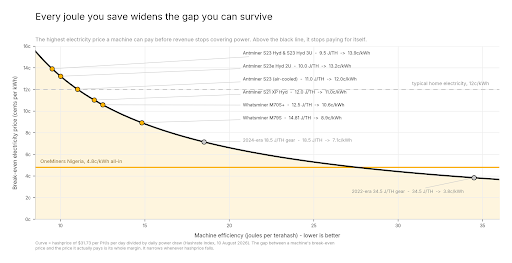
Break-even electricity price by machine efficiency, with today's seven plotted against two earlier hardware generations.
The two grey points are the useful context. A 2024-era 18.5 J/TH machine breaks even at 7.1¢/kWh today — still viable on genuinely cheap industrial power, but with almost no cushion. A 2022-era 34.5 J/TH machine breaks even at 3.8¢, which is below every rate in our network; there is essentially nowhere left to run it at a profit. Neither machine got worse. The network got more efficient around them, and hashprice fell to meet the new average.
That is the mechanism behind every mining cycle, and it is the real argument for buying at the efficient end. When hashprice drops — and it does, at every halving and during every difficulty climb — the break-even line falls for everyone at once. The machines that keep running are the ones that had the widest gap to give up.
What buying through OneMiners changes
Five of the seven machines here need three-phase industrial power and a hydro loop. That is not a home deployment, and it is not something you retrofit cheaply. The practical route is to buy the hardware and have it deployed into a facility that already has the power contract and the plumbing.
OneMiners operates more than 15 hosting centers across Nigeria, Ethiopia, the UAE, Norway, Finland, Canada, Brazil, Paraguay, Czechia and multiple US states, with all-in rates starting at 4.8¢/kWh in Nigeria — a figure that already includes management, monitoring and maintenance rather than being an energy-only headline. Uptime is quoted at 98%+.
Three details worth knowing before you compare quotes elsewhere:
You own the hardware outright. These are physical machines assigned to you, not tokenised hashpower or a share in a pool of someone else's equipment.
Hosted units carry a 7-year full warranty covering parts, repairs and labour. Machines shipped to your own site carry the standard 12-month manufacturer warranty instead — a genuinely large difference over a machine's working life.
Payment can be staged: 25% down and four monthly instalments, or crypto for faster processing. Deployment runs within 48 hours of payment confirmation, and direct shipping is DDP in 5–7 business days.
If you are choosing a first unit, the S23 Hyd at 580 TH/s is the balanced pick — best-in-class 9.5 J/TH efficiency at less than half the cost of the 3U. If capital is the constraint, the M70S+ gets you onto efficient hardware for $3,149. If you are filling a rack and already have cheap power secured, the S23 Hyd 3U produces the most margin per slot of anything listed.
The honest version of the risks
Every figure in this guide depends on hashprice, and hashprice is the one input nobody controls. It sat at $31.73 per PH/s per day on 10 August 2026, down from $32.10 the week before, with network hashrate around 911 EH/s and difficulty at 127.48T. Those numbers move constantly with the Bitcoin price and with how much new hardware comes online.
When hashprice falls, every margin figure here falls with it, and the machines with the least headroom feel it first. When it rises, the opposite happens. That is why this guide ranks on efficiency rather than on today's dollar figures: efficiency is the part of the equation that stays true after the market moves.
Difficulty is also worth watching. It rose 0.99% on 8 August 2026 to 127.48T, and the following adjustment was projected at roughly −3.07% — a reminder that the number your revenue is divided by changes every two weeks, in both directions.
Figures verified against live product pages and Hashrate Index data on 14 August 2026. Hardware specifications, prices and hosting rates are subject to change — check the current product page before purchase. Margin figures are gross of hardware cost and describe machine economics at the stated inputs on the stated date; they are a snapshot of current market conditions, not a forecast, a projection, or a promise of any result. Bitcoin mining carries risk, including the risk of loss. This article is general information about mining hardware, not financial, investment or tax advice.
HOW DO YOU FEEL ABOUT FASHION?
COMMENT OR TAKE OUR PAGE READER SURVEY
Featured





Having a friends with benefits relationship is a great idea, if you find the right person for it.